
On Thursday, October 8, two fuel surcharges were live in the same building, and they were reading two different weeks. The LTL carrier had already moved to the October 5 diesel price. The parcel carrier was still billing off September 28. If your 3PL fuel surcharge billing runs on one stored percentage, at least one of those rebills was wrong before the truck left.
That is not a mistake anyone on your team made. It is a seam. The carriers publish a number that changes every week. Most billing setups hold a number that changes when somebody remembers.
In a normal year the gap is small enough to ignore. This is not a normal year.
Why fuel became the line that moves
Diesel set a record in the federal weekly series on September 7. It kept climbing for two more weeks and peaked on September 21. The EIA weekly on-highway diesel price for October 5 came in about 5% below that peak. It is still roughly 67% above the same week last year.
Carrier surcharges followed the index up, week by week. Trade analysts at TransImpact tracked the September parcel fuel surcharge increases across both national carriers. Domestic ground moved from 27.50% to 29.50% in three weeks. One international air import surcharge reached 47.75%.
LTL sits higher still. The FedEx Freight weekly fuel surcharge for October 7 through 13 is 57.70%. At that level, fuel is more than a third of the combined linehaul and fuel charge.
So the fuel line is now large, and it moves every week. A 3PL that rebills freight is passing that line through to clients. Whether it passes through cleanly depends on one thing. Does your system know this week's number?
Three carriers, three clocks
The index is one number. The carriers do not apply it on the same day.
Here is what the published rules say:
- The index. EIA prices diesel each Monday and releases the figure early that week.
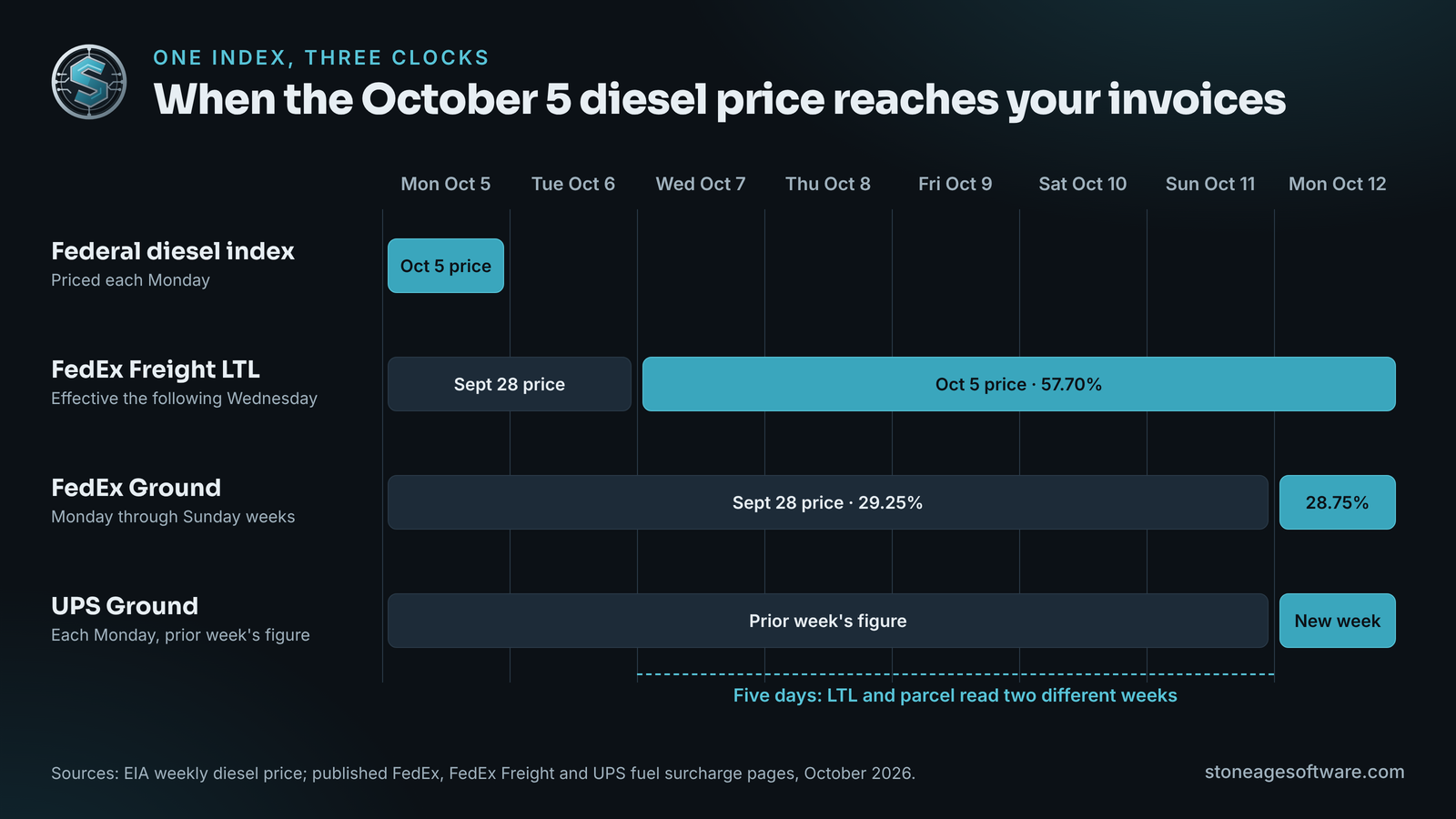
- FedEx Freight. The new percentage takes effect the following Wednesday. If the index arrives late, the change is delayed.
- FedEx parcel. The FedEx fuel surcharge tables run Monday through Sunday. Each week uses an index figure about a week old.
- UPS. The UPS fuel surcharge page says changes take effect each Monday. They use the figure released the prior week.
Walk the October 5 price through that list. FedEx Freight applied it on Wednesday, October 7. FedEx Ground applies it on Monday, October 12, when the ground surcharge drops from 29.25% to 28.75%. For five days, two services in one carrier family read two different weeks.
Regional LTL carriers add their own formulas. Many use the same federal index with different steps and different start points. Your contract can change the rules again. Both FedEx pages state that the customer agreement is the final authority.
None of this is hidden. It is simply more clocks than a single rate field can hold.
Where 3PL fuel surcharge billing goes stale
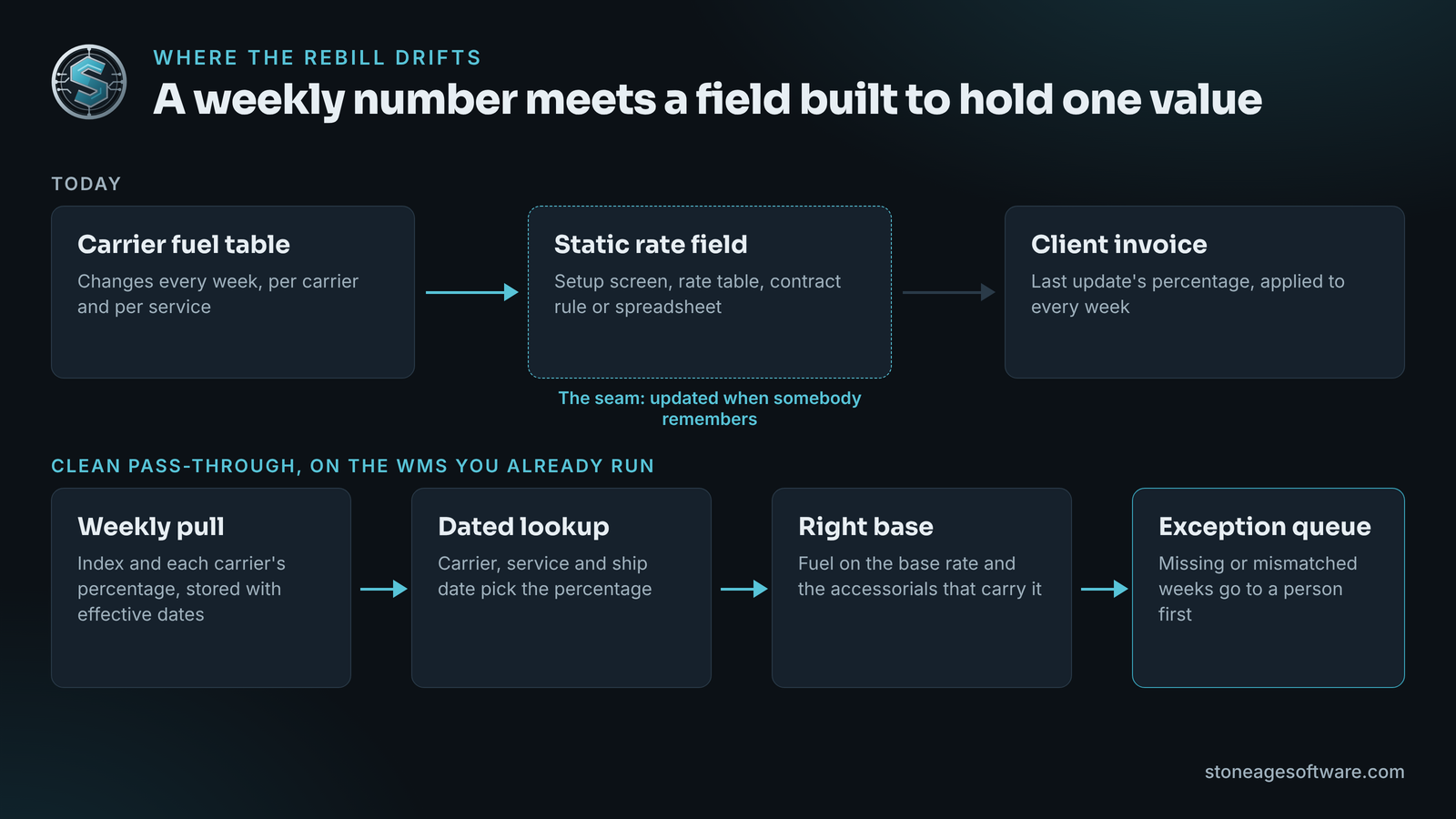
Most warehouse systems were built to store a rate, not to track one. So the fuel percentage ends up living somewhere static. Common places include:
- A surcharge field on the carrier setup screen.
- A column in a rate table that was loaded once.
- A markup rule in the client contract record.
- A spreadsheet the billing lead updates by hand.
Each of those works on the day it is updated. Each one starts to drift the next Monday.
Drift costs you in both directions. When diesel climbs, a stale percentage under-recovers. A table loaded on September 7 was two full points short on ground by September 21. That shortfall landed on every package, on every client, with no alert.
When diesel falls, the same stale number over-bills. Clients do audit freight. A surcharge that is higher than the published table is an easy dispute to win. It also costs trust that takes longer to rebuild than the credit memo takes to issue.
There is a second seam inside the first. The surcharge does not only apply to the base rate. FedEx lists accessorials that carry fuel on ground, including additional handling, residential delivery, delivery area, and oversize charges. UPS applies fuel to transportation charges and to certain accessorial charges, and it publishes a separate list.
A rebill that adds fuel to the base rate only will miss the fuel on those lines. On heavy or oversize freight, that gap can be larger than the rate drift.
Then there is timing. Three dates are in play on every shipment:
- The date the label was printed or the load was tendered.
- The date the carrier picked it up.
- The date your billing cycle closed.
The carrier bills fuel by its own effective week. A weekly or monthly billing run that applies one percentage to the whole period will mix weeks together. In a flat market nobody notices. In this one, two weeks can sit a full point apart.
What a clean pass-through looks like
The fix is not a new WMS. Your WMS already knows the shipment, the client, the service, and the ship date. What it lacks is a dated history of the percentage and a rule for matching the two.
A clean pass-through has four parts:
- A weekly pull. A small job reads the federal index and each carrier's published percentage. It stores every value with its effective start and end dates.
- A dated lookup. Billing asks one question per shipment. Which percentage was effective for this carrier, this service, on this ship date?
- The right base. The calculation applies fuel to the base rate and to the accessorials that carrier says carry it.
- An exception queue. If a new week has no value, or a carrier invoice disagrees with the stored one, a person sees it before the client invoice goes out.
That last part matters most. The UPS page says percentages and thresholds can change without prior notice. FedEx revised its ground table on June 1. No job should guess its way through a table change. It should stop, flag the week, and hand the decision to someone who knows the account.
That is the division of labor we aim for. The software carries the weekly routine. Your billing lead keeps the judgment calls, such as a contract with a fuel cap or a client on a fixed quote. As Cap Logistics noted in its September fuel surcharge analysis, carriers are shortening quote validity. Those conversations need a person with the numbers already in hand.
We built the same pattern for inbound freight. Our inbound freight tracking integration polls four carrier lanes on a ten-minute cycle. It writes results onto the open shipment record and routes anything unusual to an owned exception queue. Fuel is the same shape with a slower clock. Carrier data comes in on a schedule, lands on the record you already keep, and exceptions go to a named person.
It also sets you up for January. Both national carriers publish new rate tables around the turn of the year. We covered those dates in our FedEx 2027 rate increase checklist. A system that already stores dated carrier values takes a new table as one more row.
A one-hour check you can run this week
You do not need a project to find out where you stand. You need one hour and last month's data.
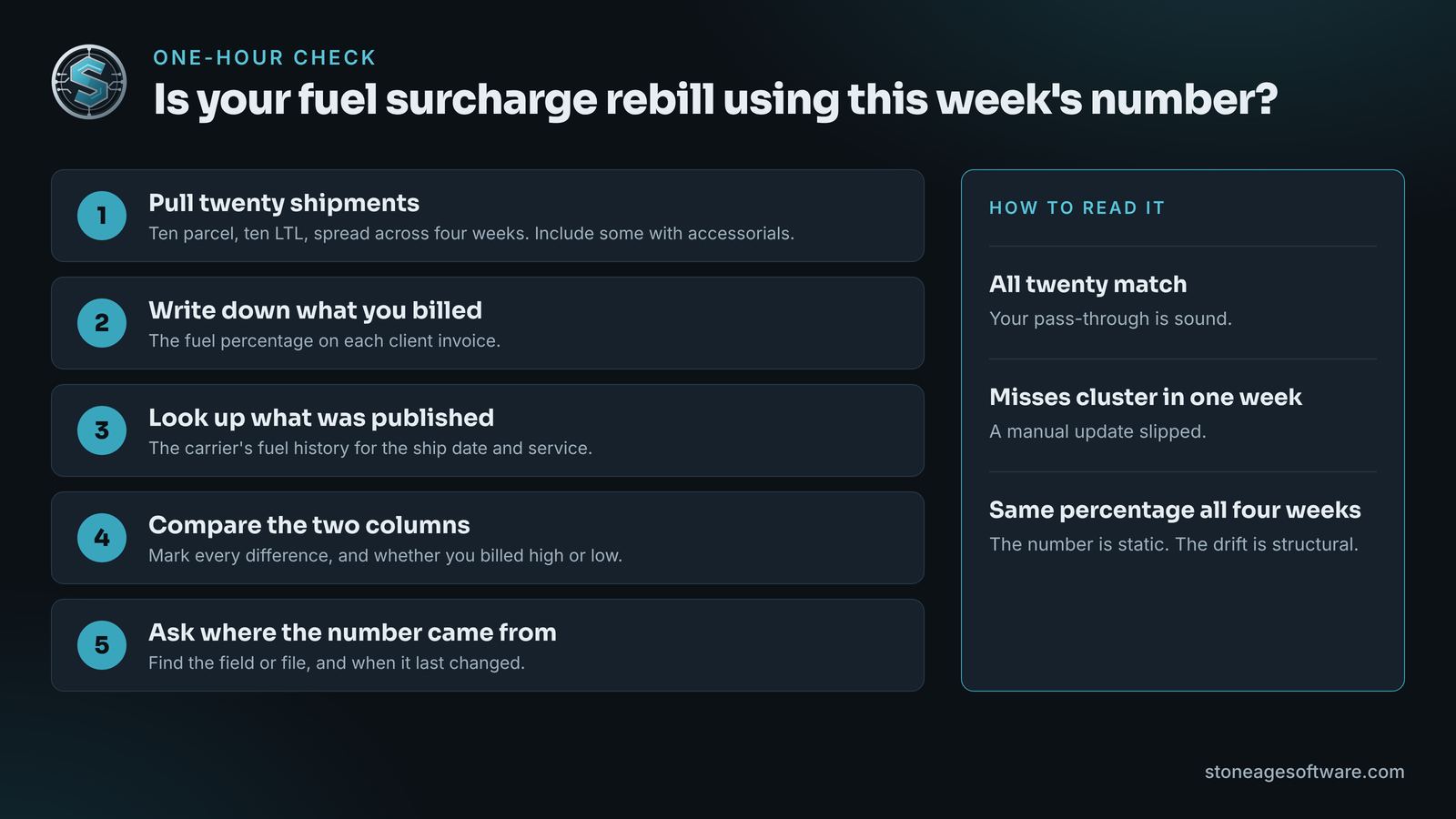
- Pull twenty shipments. Take ten parcel and ten LTL from September, spread across all four weeks. Include a few with accessorials.
- Write down what you billed. For each one, note the fuel percentage on the client invoice.
- Look up what was published. Use the carrier's fuel history for the ship date. Match the service, since ground and air use different indexes.
- Compare the two columns. Mark every shipment where the numbers differ. Note whether you billed high or low.
- Ask where the number came from. For each miss, find the field or file that supplied it. Check when it was last changed.
Read the result plainly. If all twenty match, your pass-through is sound and you can stop. If the misses cluster in one week, a manual update slipped. If the same percentage shows up across all four weeks, the number is static, and the drift is structural.
Also check the accessorial shipments on their own. If fuel was applied to the base rate but not to the handling or residential line, that is a separate gap. It will not show up in a percentage comparison alone.
Whatever you find, keep the sheet. It is the fastest way to explain the problem to anyone, including us.
If the check turns up a static number, that is exactly the kind of seam our carrier integration practice closes. We build the weekly pull and the dated lookup on top of the WMS you already run. You own the code outright, and nothing gets ripped out.