
On January 4, 2027, a number changes inside your building. Nobody in the building will type it.
The FedEx 2027 rate increase takes effect that Monday. FedEx puts the average at 5.9% for package list rates. That is the fourth year running at the same headline figure. Most 3PL operators will read the headline, nod, and move on.
The headline is not the part that reaches your invoices. The part that reaches them is quieter. It sits in ZIP code lists, minimum charges, and surcharge tables. Those live in more places in your operation than anyone has written down.
This is a guide to those places. It covers what changed, where the old numbers hide, and how to test your own setup before the first January bill arrives.
What the FedEx 2027 rate increase actually changes
Start with the carrier's own words. The FedEx rate changes page says standard list rates for U.S., export, and import package services rise an average of 5.9%. The effective date is January 4, 2027. The same page says surcharges and fees will change too, and links to the full list.
An average hides a lot. Two independent reviews of the published tables show where the spread is.
Loop's breakdown of the 2027 tables found these patterns:
- Ground rates rise about 6.1% in nearly every zone.
- Ground packages of 1 to 5 pounds rise about 6.5%.
- Express Saver rises closer to 3.1%.
- The Ground minimum charge rises about 5.9%.
- Additional handling rises between 7.1% and 7.6%.
- Extended delivery area surcharges rise 8% to 9%.
Intelligent Audit's review adds the structural piece:
- 2,533 ZIP codes move from the Extended tier to the Remote tier.
- 240 ZIP codes move into the Extended tier for the first time.
- 45 ZIP codes join the delivery area surcharge list.
- The Remote list grows by more than 70%.
- Zone assignments change on February 1, 2027. The affected ZIP pairs were not yet published at the time of that review.
So the same carton, to the same address, can cost more for three separate reasons. The base rate moved. The surcharge moved. And the address itself changed category.
UPS has not published its 2027 numbers yet. Transportation Insight's weekly brief expects that announcement in October. The same brief lists three LTL carriers with increases between 4.9% and 7.1% this year. Plan for more than one table to change.
Four dates, not one
Most calendars carry January 4 and nothing else. The season has more turns than that.
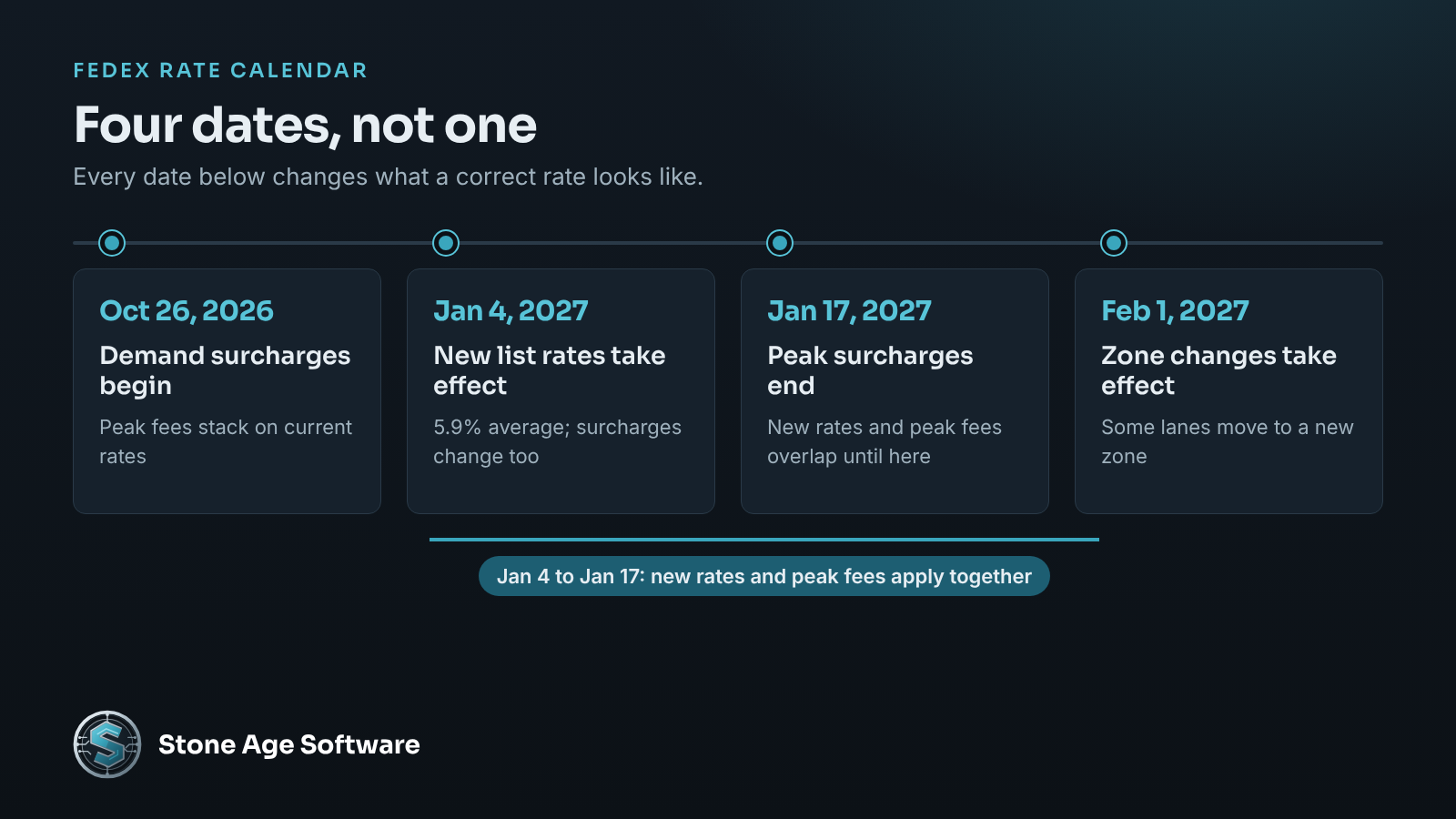
Here is the sequence:
- October 26, 2026. FedEx demand surcharges begin, as Supply Chain Dive reported.
- January 4, 2027. New list rates and most surcharge changes take effect.
- January 17, 2027. Peak surcharges end.
- February 1, 2027. Zone changes take effect.
Look at the two weeks between January 4 and January 17. New base rates and old peak surcharges apply together. That is a rate combination that exists for fourteen days and never again. Any table that stores one number per service cannot describe it.
Then February 1 arrives and some lanes shift zones. A rate that was right on January 31 is wrong the next morning. The carton did not change. The lookup did.
Where the old rate hides
Ask where your FedEx rates live. The honest answer is usually "in the shipping system." That is true, and it is one of five answers.
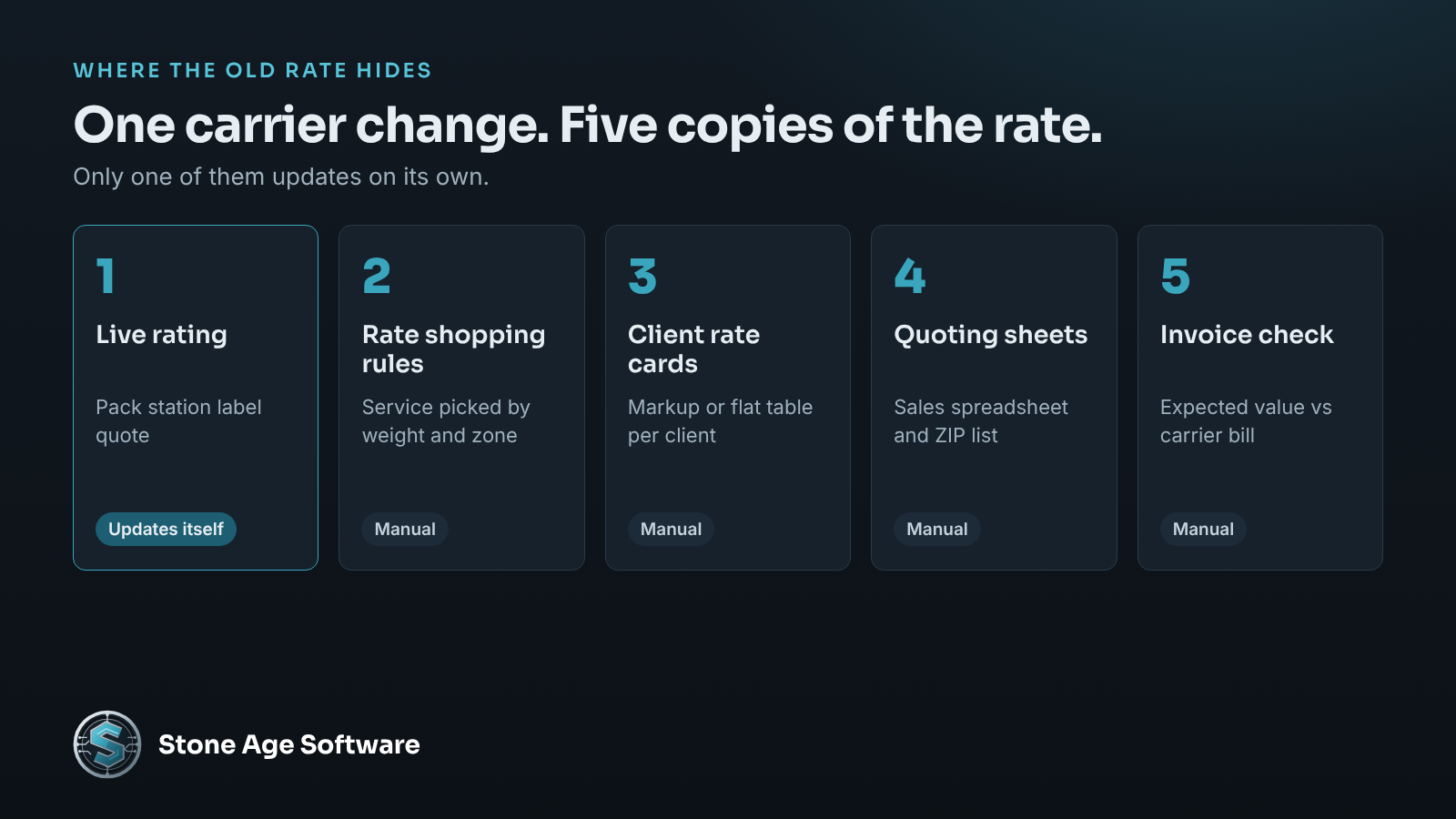
1. Live rating at the pack station. If labels come from a live carrier connection, this copy updates itself. This is the one place the change is automatic.
2. Rate shopping rules. Many operations pick a service with rules, not live quotes. "Under two pounds, use this service. Zone 5 and up, use that one." Those rules were tuned against last year's spread. Light packages now rise faster than heavy ones. A rule that was right in 2026 can quietly pick the costlier service in 2027.
3. Client rate cards. Each client has a markup, a discount, or a flat table. Those tables were built from a carrier table. When the carrier table moves, each client card needs a decision. Does it move with the carrier? On what date? The agreement answers that, and the agreement is a document, not a field.
4. Quoting sheets. Sales quotes a prospect from a spreadsheet. That spreadsheet has a copy of the rates, and often a copy of the surcharge ZIP list. A quote written in December gets honored in March.
5. The invoice check. Someone compares the carrier bill to what was expected. If the expected value comes from an old table, every line looks like an overcharge. Real errors get buried under hundreds of false ones.
None of these copies is anyone's mistake. Each was built to do one job, and each does it. No connection ever ran between them. The carrier publishes one change, and nothing carries it to all five places. That is a seam in the software, and it is fixable.
The ZIP code list is the sleeper
Percentages get the attention. The ZIP list deserves it.
A delivery area surcharge applies by destination ZIP. Systems that estimate freight keep a list of those ZIPs. With 2,533 codes changing tier and 285 more joining the lists, last year's file is out of date in thousands of rows.
The effect is uneven, and that makes it hard to see. A client shipping to metro addresses feels nothing. A client shipping farm supplies or outdoor gear to rural addresses feels it on a large share of orders. Their freight estimate at order time comes in low. The carrier bill comes in high. The gap lands with whoever quoted the lower number.
Nobody notices in the first week. It shows up in February, as a margin report that looks slightly off for two or three accounts.
Updating the list is a file load, not a project. The hard part is knowing every place the list was copied.
What a carrier integration does about this
The fix is not a new shipping platform. Your WMS ships orders and should keep doing it. What helps is a small layer on top that holds rates the way carriers publish them.
That layer does a few plain things:
- Stores every rate and surcharge with a start date and an end date.
- Holds surcharge ZIP lists as dated versions, so January and February can both be right.
- Feeds one source to the pack station, the client rate cards, and the quoting sheet.
- Re-rates each shipment when the carrier bill arrives and compares the two.
- Sends only the true mismatches to a person.
The last point matters most. Software does the matching, thousands of lines at a time. Your people do the judging. They decide which dispute is worth filing, which client gets a call before a rate moves, and which exception is fair. That is work a table cannot do. It is also work nobody has time for when they are retyping tables.
We built a version of this pattern for inbound freight. The inbound freight tracking integration replaced manual carrier website lookups with live connections and an exception list. The shape is the same here. The connection does the routine checking, and people handle what falls outside it.
You own the result. The code, the data, and the carrier credentials stay with you. The work is fixed price, quoted up front. When the next rate table is published, the update is a data load.
The re-rate test you can run this week
You can measure your own exposure before January. It takes about an hour and a spreadsheet.
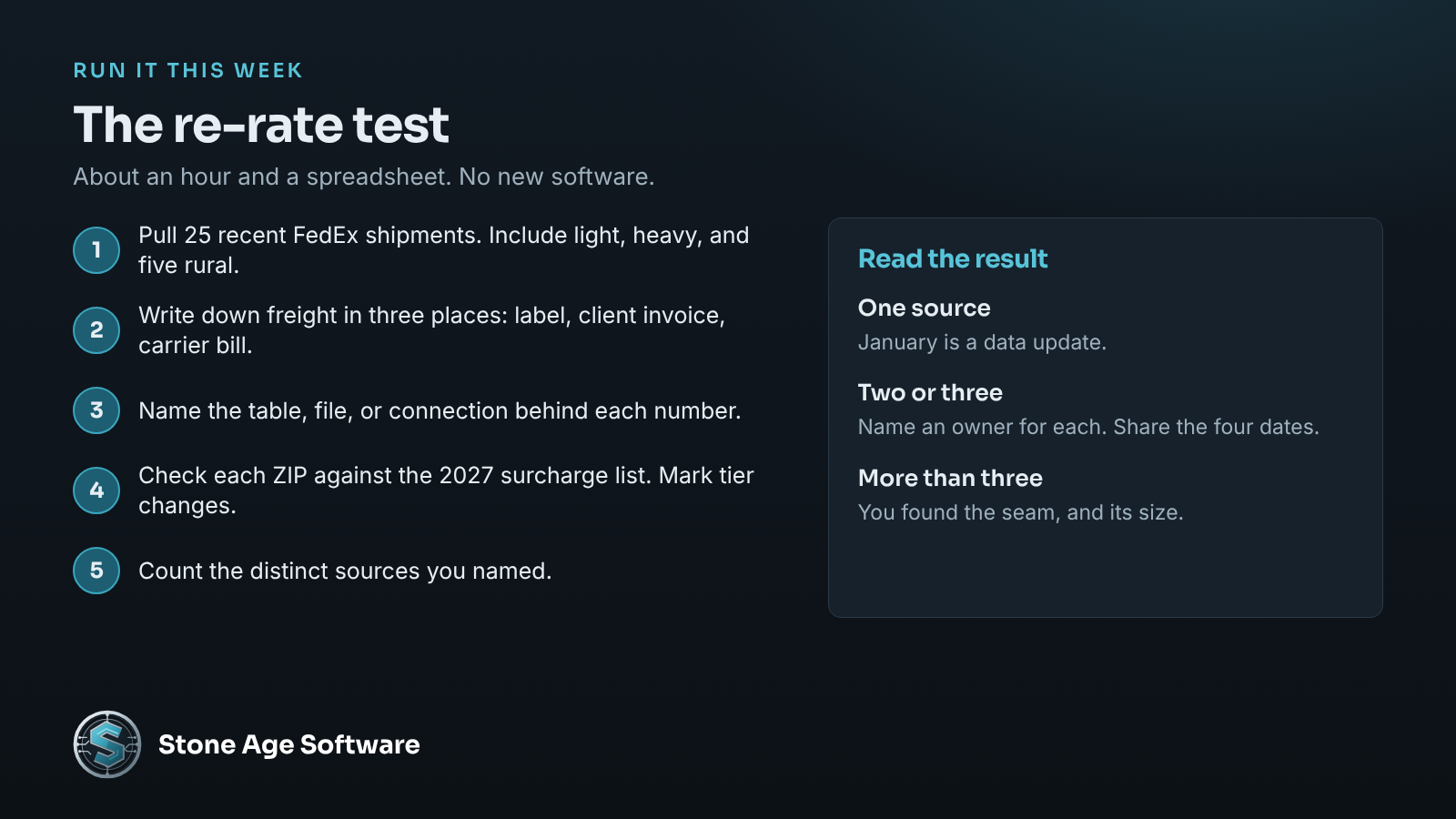
- Pull 25 recent FedEx shipments. Include light parcels, heavy parcels, and at least five rural addresses.
- For each one, write down the freight amount in three places: the label, the client invoice, and the carrier bill.
- Ask where each of those three numbers came from. Name the table, file, or connection.
- Check each destination ZIP against the 2027 surcharge list on the FedEx rate changes page. Mark the ones that change tier.
- Count the distinct sources you named in step 3.
Read the result this way:
- One source. Your rates flow from a single place. January is a data update.
- Two or three sources. List them, name an owner for each, and put the four dates on a shared calendar.
- More than three, or any answer of "not sure." You have found the seam. Now you know its size.
One caution. Before a client rate moves, read that client's agreement. Whether a carrier increase passes through, and when, is a business decision. It belongs to you.
If the test turns up more sources than you expected, that is normal, and it is the kind of gap we close. See how we approach carrier integration for 3PL warehouses on top of the WMS you already run.