
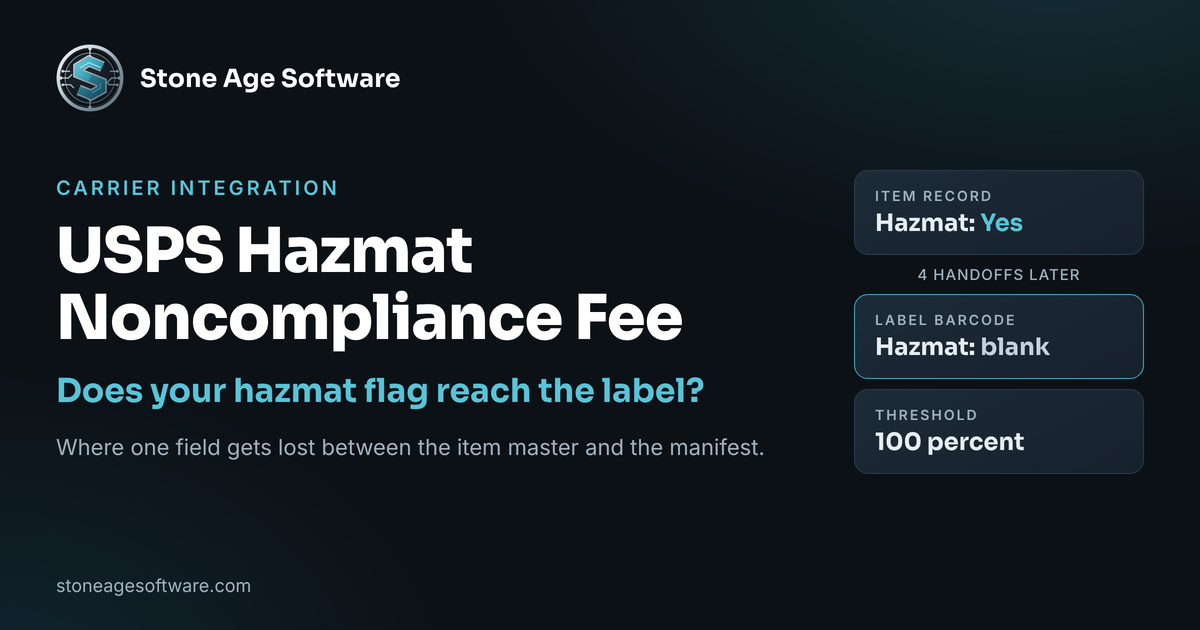
A client ships a cordless trimmer. Their item record says it holds a lithium battery. Your packer builds the parcel correctly. The label prints as an ordinary ground package anyway. Since July 12, that mismatch carries the USPS hazmat noncompliance fee, charged per piece. On October 4, a temporary peak price increase landed on top. The carton was fine. The data about the carton was not.
This is rarely a training problem. Your team knows a battery when they see one. The gap sits between systems. A hazmat flag that lives in one screen has to survive four handoffs to reach the barcode. Most stacks drop it at least once.
What the USPS hazmat noncompliance fee actually checks
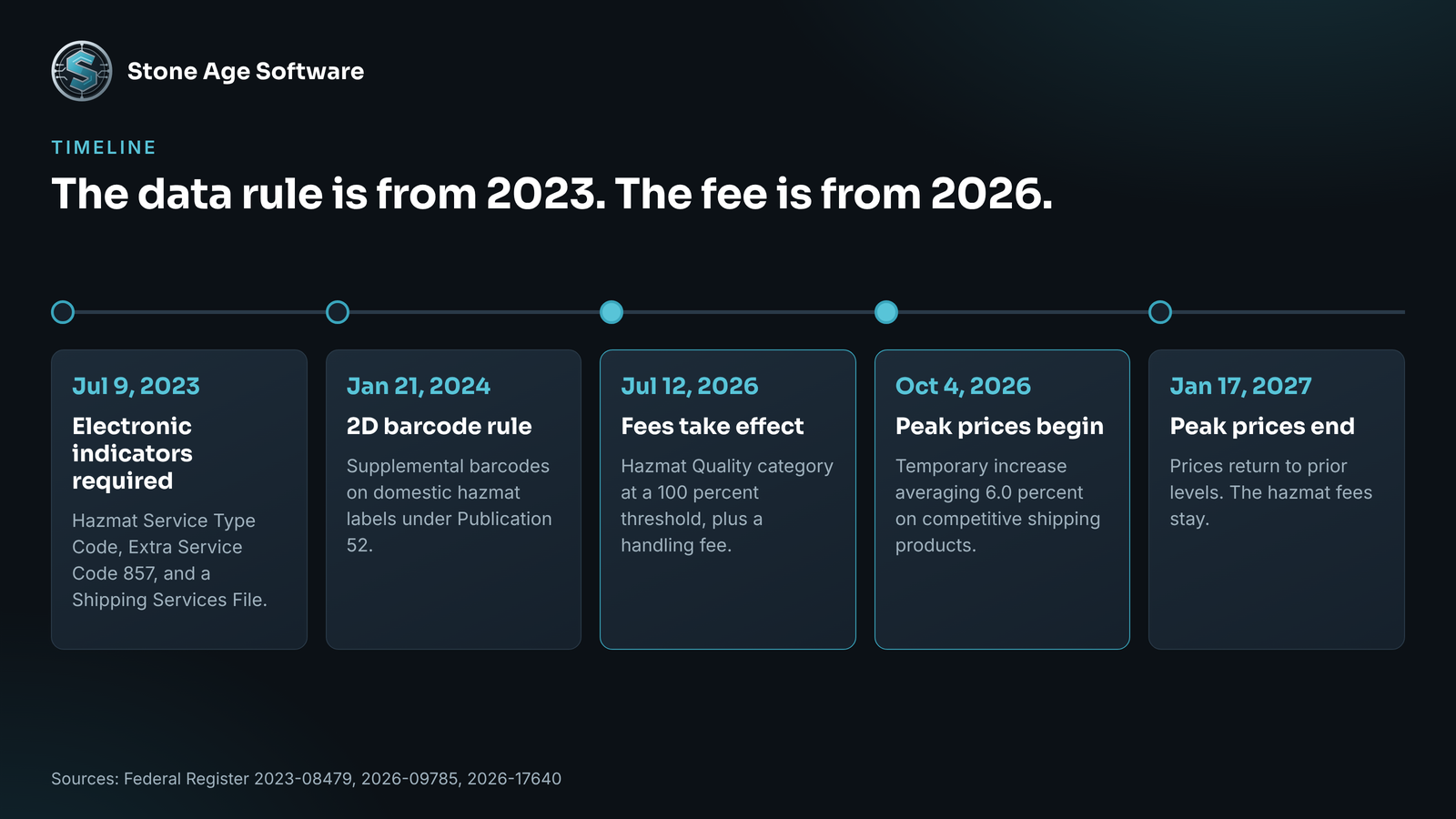
The Postal Service published the change as a final rule on competitive product mailing standards. It took effect July 12, 2026. The rule creates a new compliance category called Hazmat Quality. It applies to commercial products.
Two details matter more than the rest.
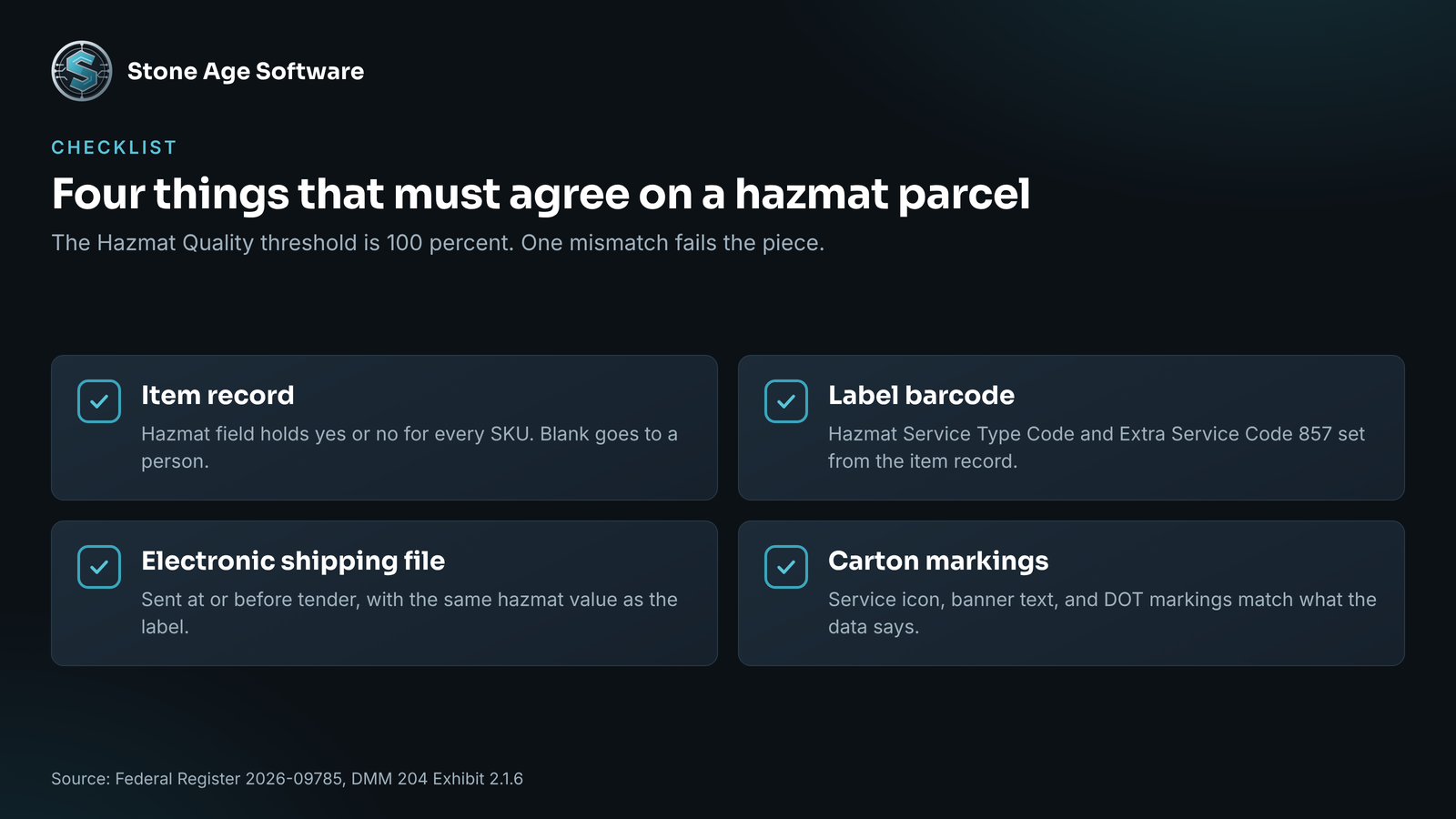
First, the threshold is 100 percent. Other quality categories allow a margin of error. This one does not. A piece that fails any hazmat validation is subject to the fee.
Second, the checks compare things against each other. The rule lists eight validations. Several of them read like this:
- A hazmat symbol on the package, with a non-hazmat Service Type Code in the barcode.
- A hazmat indicator in the data, with a non-hazmat Service Type Code in the barcode.
- A hazmat Service Type Code on a piece bound for a military address.
- Checks on the service icon, the barcode banner text, and the DOT markings.
Read that list again as an operator. Nobody is being tested on chemistry. The Postal Service is testing whether your label, your electronic file, and your physical carton tell the same story.
There is a second charge in the same rule. A hazmat handling fee applies to pieces that contain hazardous matter and are declared correctly. It is nonrefundable once the piece enters the network. The rule says it may be assessed in addition to the noncompliance fee. So a miss can cost twice, and a correct declaration still has a price. Both belong in your billing rules.
Why the timing matters this quarter
The fee has been live for three months. Three things make this the quarter it shows up on statements.
Volume is the first. Peak multiplies every per-piece charge. A mismatch rate that looked like noise in August becomes a line item in December.
Price is the second. The Postal Service raised competitive shipping prices from October 4, 2026 through January 17, 2027. The Federal Register notice for the temporary change puts the average at 6.0 percent across Priority Mail Express, Priority Mail, USPS Ground Advantage, and Parcel Select. Retail Dive covered the peak season increase when it was proposed.
Product mix is the third. Gift season is battery season. Trimmers, toys, speakers, power banks, and scented products all move in higher numbers. EcommerceBytes warned in July that the new fee could take sellers by surprise. Its list of everyday hazmat items included nail polish, perfume, hand sanitizer, and electronics with lithium batteries.
Your clients sell those items. You ship them. The fee lands on the postage account, and in many 3PL setups that account is yours.
The requirement is older than the fee
The fee is new. The data requirement behind it is not.
In 2023 the Postal Service finalized a rule on electronic indicators for the mailing of hazardous materials. It amended Publication 52, the Postal Service manual for hazardous and restricted mail. It has applied since July 9, 2023. In plain terms it asks for four things:
- A hazmat Service Type Code in the tracking barcode.
- Extra Service Code 857 on every package containing hazardous materials.
- A Shipping Services File sent before or at the moment of tender, version 1.7 or higher.
- For labels made through Postal Service tools, a hazmat answer at the time of label generation.
So the rule has been on the books for three years. What changed in July is that a miss now has a fixed price, checked piece by piece.
That history explains a common pattern. A warehouse shipped small battery items by ground for years with no trouble. Nothing about the packing changed. The label logic was simply never built to carry a hazmat answer, because nothing downstream ever asked for one.
One nuance is worth knowing. The 2023 rule exempts certain new electronic devices with lithium batteries that need no hazmat markings in domestic mail. That exemption depends on the battery and how it is packed. It is a decision for a person who knows the product, not a default.
Where the hazmat flag gets lost between systems
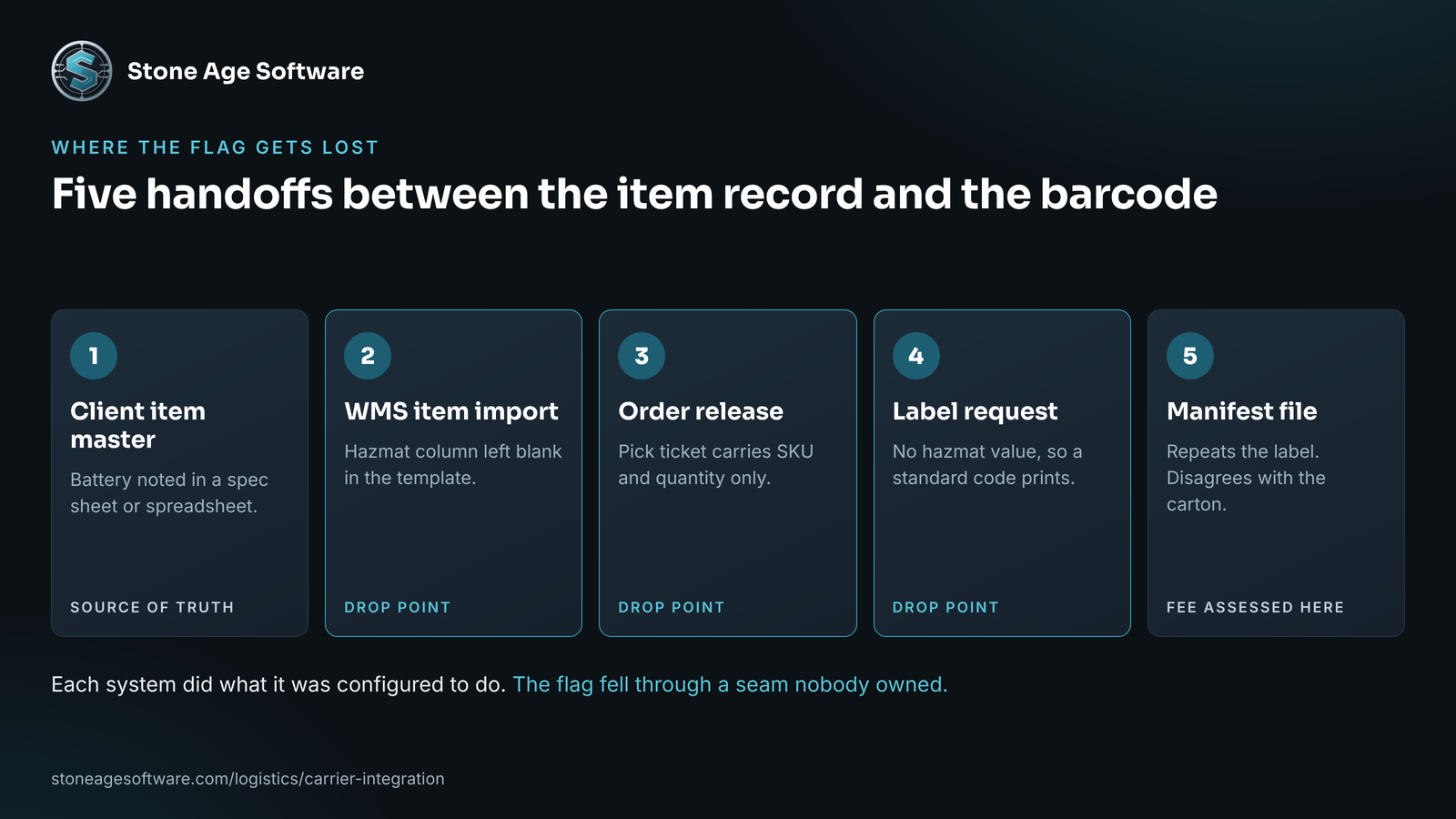
Follow one unit from onboarding to the dock. The flag has to cross five points.
1. Client item master. The brand knows the product has a battery. The fact may sit in a spec sheet, a safety data sheet, or a spreadsheet column. Sometimes it sits in an email.
2. Item import into the WMS. Most WMS platforms have a hazmat field. Many client imports leave it blank. The import template had forty columns and the client filled twelve.
3. Order release to the shipping step. The pick ticket carries SKU, quantity, and location. The hazmat field often stays behind in the item table. The shipping screen never sees it.
4. Label request to the carrier or label service. This is the call that sets the Service Type Code. If the request has no hazmat value, the default is a standard code. The label prints clean and wrong.
5. Manifest or shipping file at close. The end of day file repeats what the label said. Now the barcode and the electronic record agree with each other and disagree with the carton.
Notice what is missing from that list. No step involves a person making a bad call. Each system did what it was configured to do. The flag fell through a seam nobody owned.
Kits make it harder. A gift set with one battery item inherits the answer of its worst component. A kit SKU built in the WMS rarely inherits the hazmat field from its parts. Returns add a second path, with their own service codes.
Carrying the flag end to end without replacing the WMS
None of this calls for a new warehouse system. It calls for a thin layer that reads what you already have and refuses to guess.
Here is what that layer does in practice:
- Reads the hazmat field at label time. It pulls the value from the item table for every line in the carton, not just the first.
- Rolls up kits and multi-line cartons. One flagged unit flags the parcel.
- Maps the flag to the right codes. Service Type Code, extra service code, and the shipping file all get set from one source.
- Stops on blanks. A SKU with no hazmat answer goes to a person. Blank is not treated as no.
- Keeps the evidence. Each label stores the item value it used, so a disputed fee can be checked in minutes.
- Feeds billing. Handling fees and any noncompliance fees post to the right client automatically, through your invoicing/accounting integration.
The stop on blanks matters most. It turns a silent default into a visible question. Your compliance lead answers it once per SKU, with the safety data sheet in hand. That is judgment work, and it is the right place for a person.
We built a version of this pattern for a returns operation. Every outbound document was checked against the customer's item master before upload, and each failure kept its reason. The same idea applies here. Validate against the source record before the carrier does it for you.
For carriers beyond the Postal Service, the mapping differs but the shape holds. One flag, one rule set, many label formats.
A check you can run this week
You can size the exposure in an afternoon. You need three exports and one person who knows the product lines.
- Export the item master. Count SKUs where the hazmat field is yes, no, and blank. The blank count is your first number.
- Search descriptions. Filter for battery, lithium, aerosol, spray, polish, perfume, fragrance, sanitizer, and paint. List every hit marked no or blank.
- Pull 90 days of Postal Service shipments. Join them to that list by SKU. Count parcels shipped with a standard service code.
- Check ten labels by hand. Pick ten parcels with known battery items. Compare the service code, the label text, and the carton markings.
- Read your postage statements since July 12. Look for hazmat and package quality noncompliance lines. Tie each one back to an order.
- Ask who pays. Check each client contract for who absorbs carrier compliance fees. If the answer is unclear, that is your third number.
If step three returns zero, your flag travels. If it returns a few hundred, you know the seam and the size.
Carrying one field from the item record to the barcode is ordinary integration work. It sits on top of the WMS you already run, and you own the code. See how we approach it on our carrier integration practice page, fixed price, quoted up front.