
One client runs a flash sale in the first week of November. Volume on your parcel account jumps. Three weeks later the carrier invoice arrives, and every residential package you shipped that week carries a higher fee. That includes the packages for clients who had a quiet week.
That is how the 2026 UPS demand surcharge works for a larger shipper. It starts on October 25. For a 3PL that ships many clients on one account, the fee is set by the whole building. The bill is then yours to split.
Most 3PL warehouse management systems will not warn you. That is not a defect. A WMS is built to run the floor, client by client. The carrier measures one account against its own yardstick. Nothing sits between the two and keeps the weekly count.
How the 2026 UPS demand surcharge works
UPS published its demand surcharge notice on August 26, 2026. It has two parts.
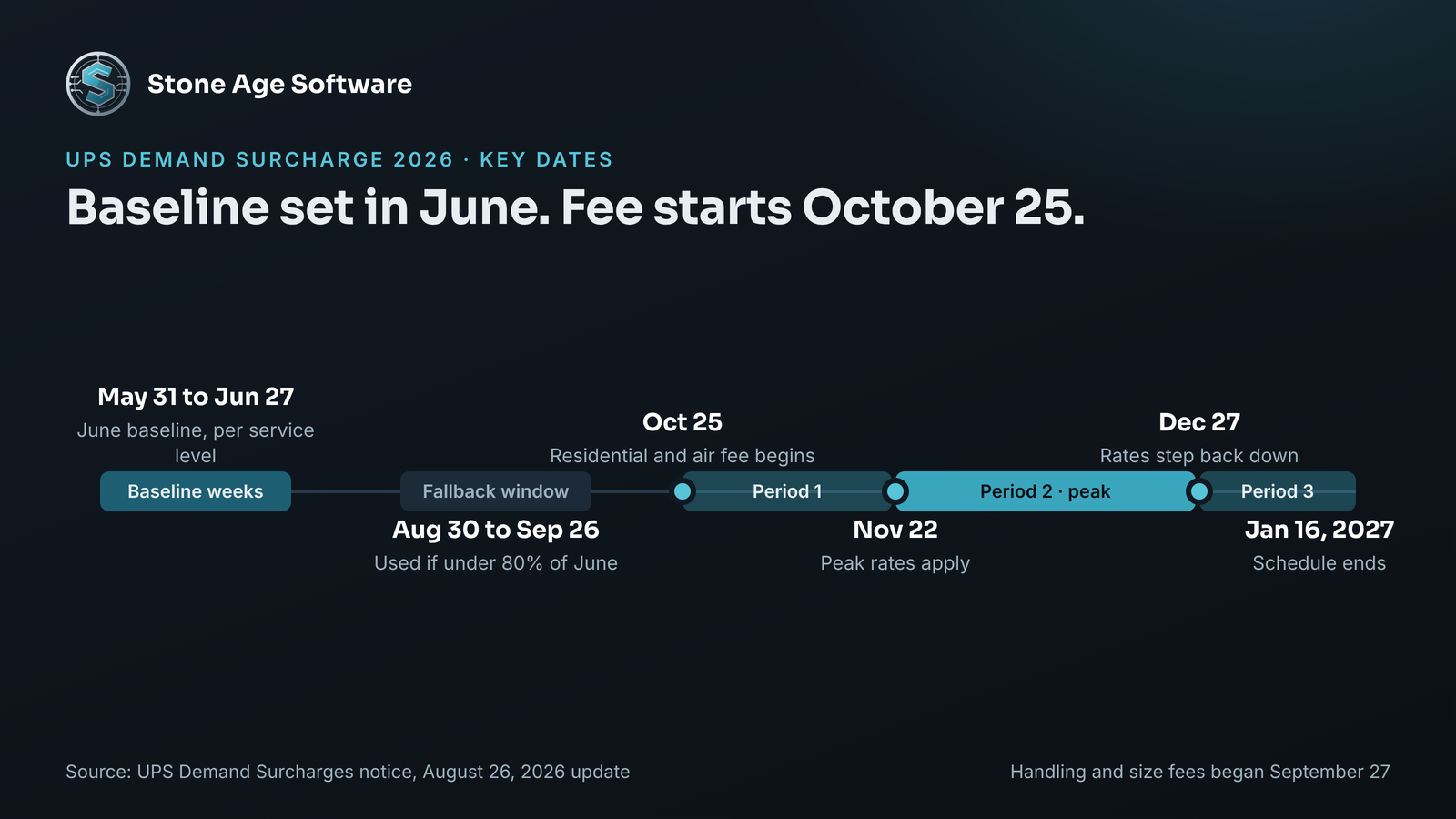
The first part covers awkward freight. Additional handling, large package, and over maximum fees began on September 27. They step up on November 22 and step back down on December 27.
The second part covers residential and air packages. That per-package fee runs in three periods:
- October 25 through November 21, 2026
- November 22 through December 26, 2026
- December 27, 2026 through January 16, 2027
Most shippers pay a flat fee per package in each period. Supply Chain Dive reported that those flat service-level charges rose 22% to 25% over last year. Handling and size charges rose 6% to 10%.
Larger shippers get a different table. The notice applies it to any customer billed for more than 20,000 packages in any week after October 2025. Four residential services count toward that number together. Once you cross it, the higher volume table applies until further notice.
FedEx publishes a similar structure on its own demand surcharges page. It uses the same 20,000 package threshold and a June baseline of its own.
The baseline was set in June, by the whole building
The higher volume table does not look at how many packages you ship. It looks at how many you ship compared with your own June.
The notice defines the baseline as your average weekly volume from May 31 through June 27, 2026. It is measured separately for each service level. Ground residential has one baseline. Next day air residential has another.
There is one fallback. Say your average weekly volume from August 30 through September 26 was under 80% of the June figure. Then the later, lower window becomes the baseline instead.
Three details matter for a 3PL:
- The baseline is already fixed. Those weeks are over. No one can change the number now.
- It is an account number. The carrier does not know which client a package belongs to.
- Related accounts can be combined. The notice says customer volume includes affiliated and related accounts, as UPS determines.
So a client you onboarded in August is not in your June baseline at all. Every package they ship counts as growth. That is true even if their own volume is flat.
One tier applies to every package that week
This is the part that surprises people. The tiers are not marginal.
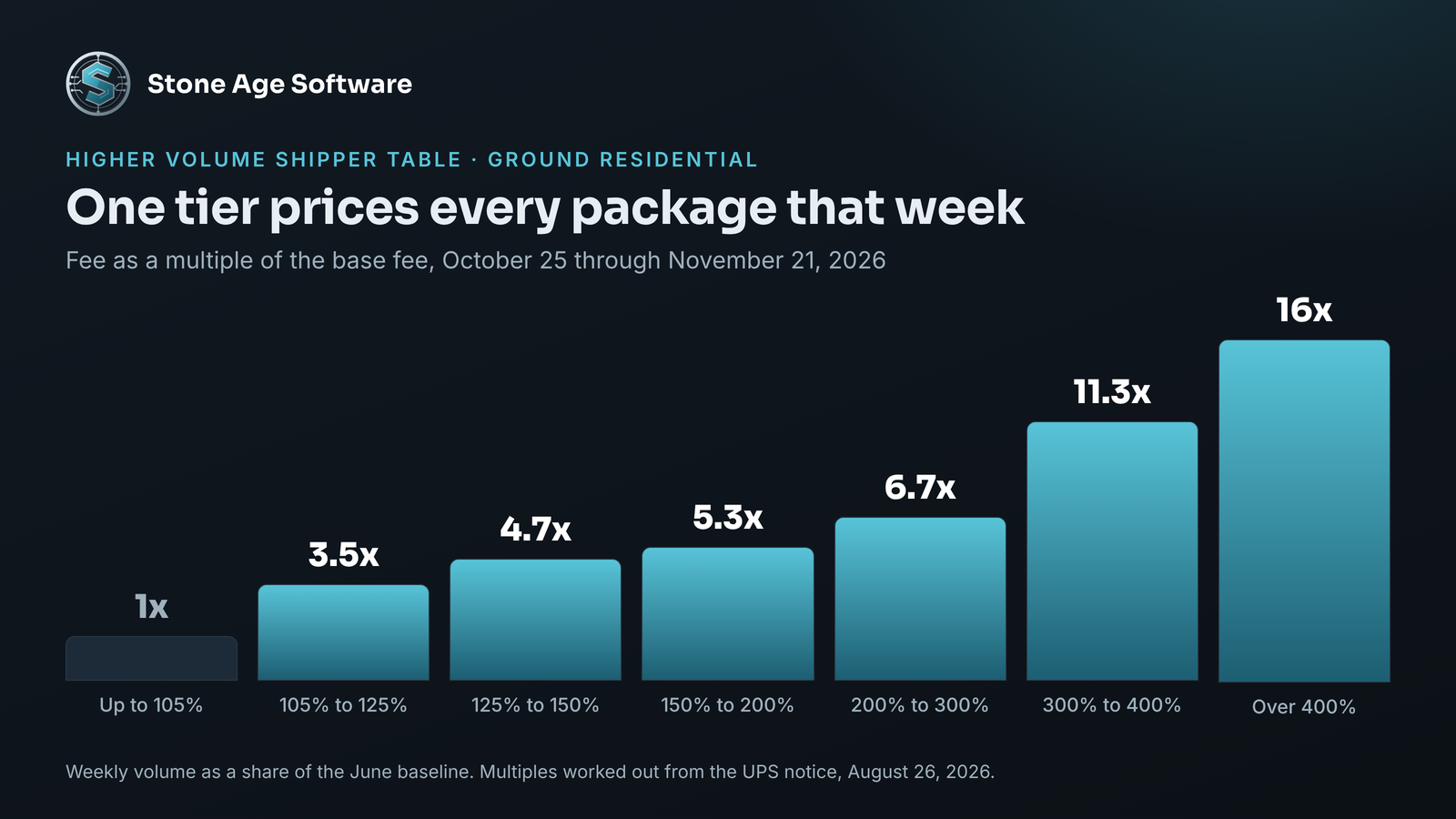
Each week, UPS compares your volume for a service level against its baseline. The result lands in one of seven bands. The fee for that band then applies to every package in that service level for the week. The notice gives its own example. A shipper at 175% of baseline pays the higher fee on each package, "not just those over 150%."
Here is what the ground residential table looks like from October 25 through November 21. The figures are multiples of the base fee, worked out from the published table.
| Weekly volume against baseline | Fee on every package that week | | --- | --- | | Up to 105% | 1 times the base fee | | Over 105% to 125% | 3.5 times | | Over 125% to 150% | 4.7 times | | Over 150% to 200% | 5.3 times | | Over 200% to 300% | 6.7 times | | Over 300% to 400% | 11.3 times | | Over 400% | 16 times |
The first step is the steepest. Going from 105% to 106% of your June average more than triples the fee on the whole week.
Take a 3PL with a June baseline of 22,000 ground residential packages a week. In one November week it ships 27,500. That is 125% of baseline, so the fee is 3.5 times the base. Now add 500 more packages from one client promotion. The week closes at 28,000, which is 127%. Every one of the 28,000 packages moves to 4.7 times the base.
Those last 500 packages changed the price of the other 27,500.
What 3PL warehouse management systems track, and what the carrier counts
Your WMS does its job here. It knows every order, every client, and every tracking number. That is what 3PL warehouse management systems are built for. The carrier does its job too. It bills one account for one week.
The gap is between them. Three things live in neither system:
- The June baseline by service level. It sits in old carrier invoices, not in the order data.
- A running weekly count against that baseline. The carrier works it out after the week closes. You learn the band when the invoice lands.
- Each client's share of the growth. The invoice shows a fee per package. It does not show who pushed the account over a line.
That last one is the hard question. When the invoice arrives, every client's packages carry the same higher fee. A flat pass-through charges the quiet client for the busy client's promotion. Absorbing the difference means the building pays for it.
Neither answer is wrong. It is a commercial decision, and often a contract one. But it should be a decision. Today it is usually a default, because the numbers to decide with arrive three weeks late.
The same seam shows up outside peak. Our earlier piece on the FedEx 2027 rate increase covered dated rate tables. This one is different. The fee here depends on a ratio, and no one in the building is watching it.
What the weekly report needs to show
You do not need a new WMS to close this. If you are comparing 3PL warehouse management systems this fall, do not make this the deciding line. No floor system owns a carrier's ratio. You need one report, built on data you already have. That is the job of a 3PL reporting layer.
It reads shipments from the WMS, read-only. It reads the carrier invoice file when it lands. Then it answers four questions:
- What was our June baseline for each residential service level?
- Where does this week stand against it, as of this morning?
- How many more packages until the next band?
- Which clients are above their own June share, and by how much?
Question three is the one that changes behavior. A number on Wednesday gives a person room to act. They can call the client about a promotion. They can check whether some volume can ship on the client's own account. They can decide the week is worth the higher band and price it that way.
The report does the counting. Your people make the call. That is the right split, because the call depends on the relationship, the contract, and what the client is worth over a year.
Variances also need a memory. We built that for a trading-partner problem in our B2B variance reconciliation project. Each disagreement gets a record, an age, and an owner. It closes only when the difference is gone. A surcharge that was billed to you and not yet assigned to a client deserves the same treatment.
A check you can run before October 25
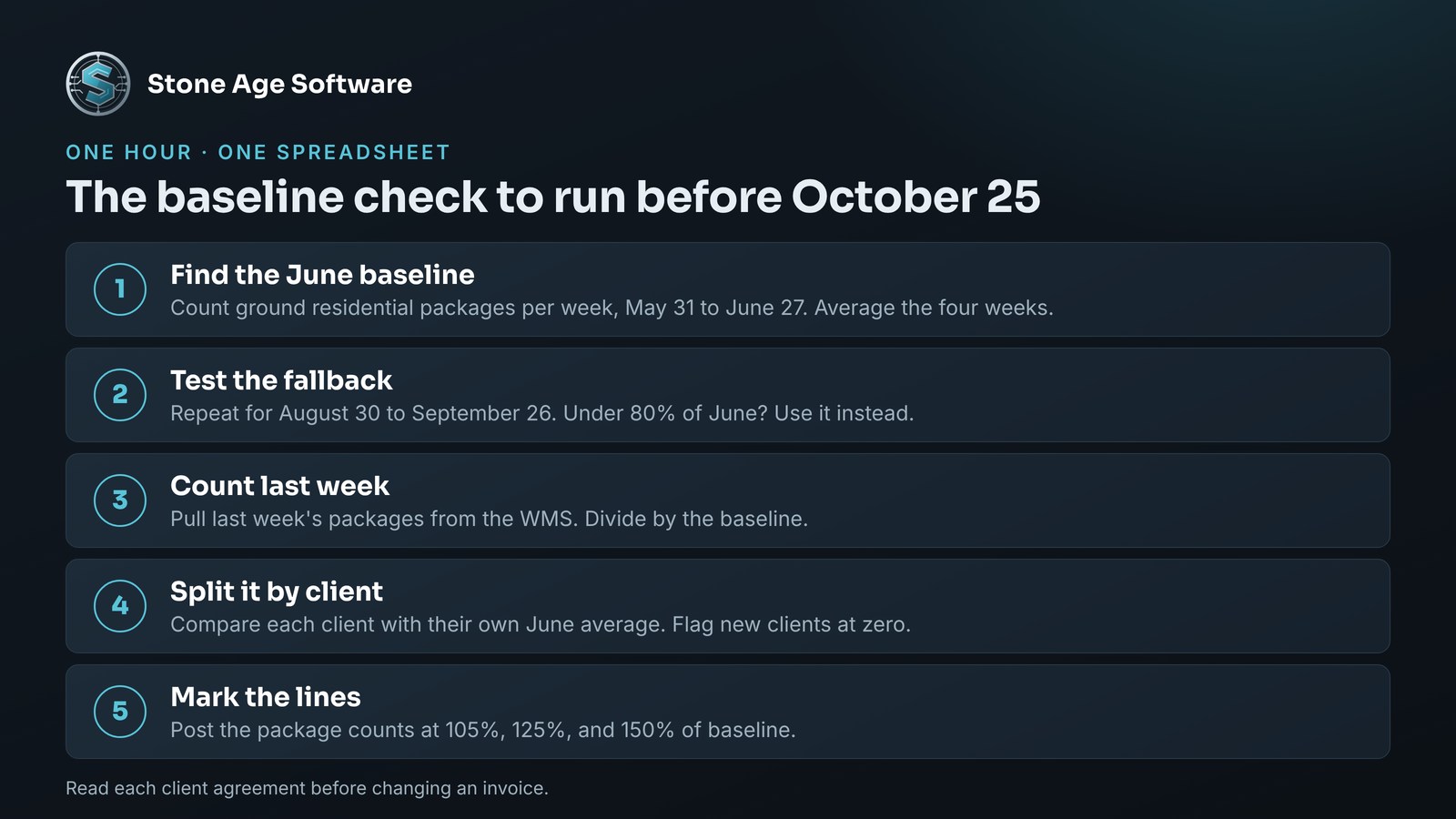
This takes about an hour and a spreadsheet. Run it for ground residential first.
- Find the June baseline. Pull your UPS invoices for May 31 through June 27. Count ground residential packages per week. Average the four weeks.
- Test the fallback. Do the same for August 30 through September 26. If that average is under 80% of June, use it instead.
- Count last week. Pull last week's ground residential packages from your WMS. Divide by the baseline.
- Split it by client. For each client, compare last week with their own June weekly average. List new clients with a June figure of zero.
- Mark the lines. Write down the package count at 105%, 125%, and 150% of baseline. Post those three numbers where the shipping lead can see them.
If last week is already above 105%, you know your starting band. If two or three clients explain most of the growth, you know who to call first. If you never crossed 20,000 packages in a week, the flat schedule applies. The date changes still matter for your rate cards.
Read each client agreement before you change an invoice. Some allow carrier surcharges to pass through and some do not. That part belongs to you.
If you want that count to refresh every morning, that is the kind of third-party logistics software development we do. See how we build on the 3PL and logistics systems you already run. The report reads from your WMS and writes to a database you own. Nothing gets replaced. The work is fixed price, quoted up front.