
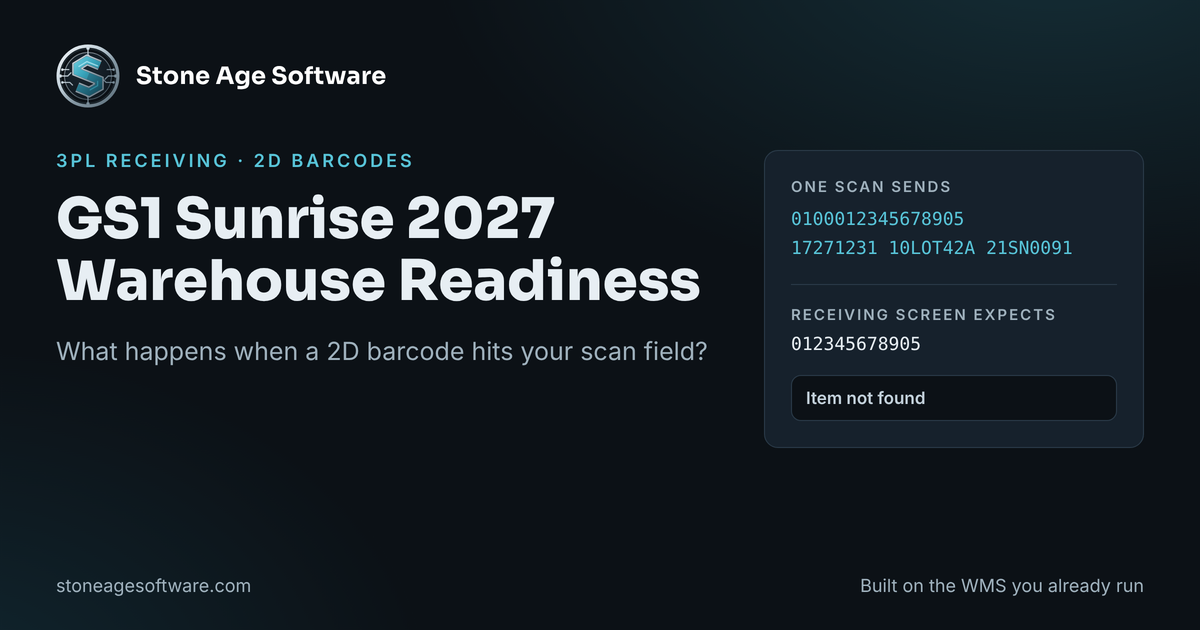
A pallet lands at your dock next spring. The carton label has a small square code where the familiar striped one used to sit alone. Your receiver scans it. The item field fills with forty characters instead of twelve, and the screen says "item not found." Nothing is broken. The scanner did its job, and so did the WMS. That gap between them is the whole GS1 Sunrise 2027 warehouse problem, and it arrives on your client's packaging, not on your schedule.
Retail has a target date. Brands are printing ahead of it. A 3PL sits in the middle, scanning whatever shows up. This article covers what the 2D code actually sends, where it trips a receiving screen, and a test you can run on your own dock this week.
What Sunrise 2027 asks for, and what it does not
The striped UPC was first scanned at a checkout in June 1974. It carries one fact: the product number. GS1 US describes Sunrise 2027 as a transition from 1D UPC barcodes to 2D barcodes. The goal is that retail point of sale can read 2D codes by the end of 2027.
Three points matter to a warehouse operator:
- The UPC is not being switched off. Expect packages that carry both codes for years. The industry calls this dual marking.
- The date is a retail checkout date. GS1 US says it is not necessary to implement every 2D capability by then. No agency is going to audit your dock.
- Your clients move first. Brands redesign packaging on their own cycle. A September 2026 Forbes Business Council piece on brand readiness for 2027 shows where that conversation is. New artwork is being approved now.
So the 3PL has no deadline of its own. It has a surprise instead. One client changes a label, and the first person to find out is a receiver holding a scanner.
What a 2D barcode actually sends your scanner
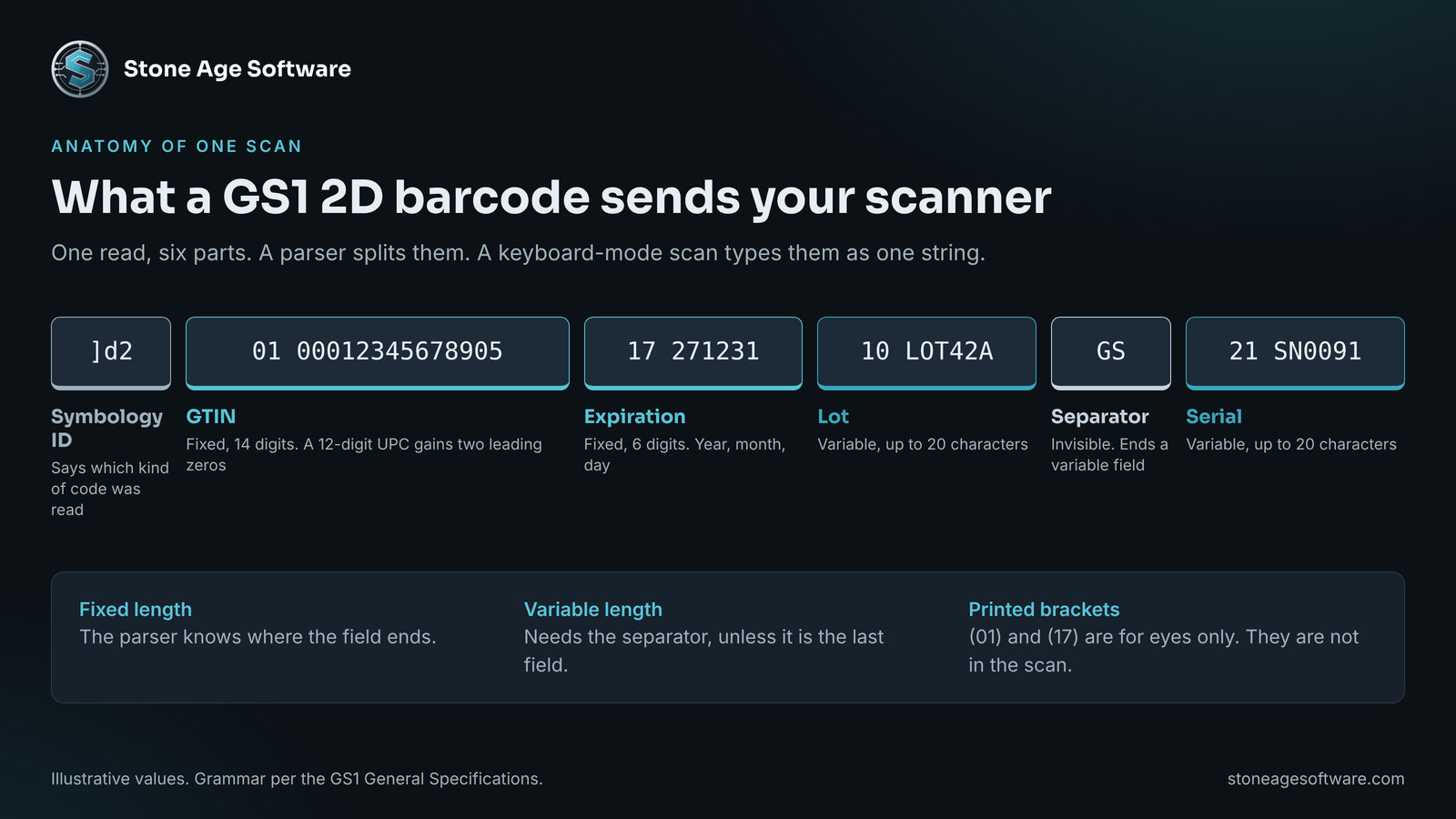
A UPC sends twelve digits. A GS1 2D code sends a sentence. The grammar is set out in the GS1 General Specifications, the standard every compliant label follows.
Each fact in the code starts with a short numeric prefix called an application identifier. Four of them cover most warehouse work:
- 01 is the GTIN. It is always 14 digits. A 12-digit UPC is padded with two leading zeros.
- 17 is the expiration date. It is always six digits, written year, month, day.
- 10 is the lot or batch. It can be up to 20 characters, letters included.
- 21 is the serial number. It can also be up to 20 characters.
The first two are fixed length. The parser knows where they end. The last two are variable length. The code marks their end with an invisible separator character, unless the field is last in the string.
One more piece comes first. A scanner can prefix the data with a three-character symbology identifier. It tells the software which kind of code was read. A GS1 DataMatrix reports itself one way. A plain UPC reports itself another way.
There is a second format too. Some brands print a QR code that holds a web address. This is GS1 Digital Link. The GTIN, lot and date sit inside the address as path segments. A shopper's phone opens a page. Your scanner receives a URL.
Where GS1 Sunrise 2027 warehouse scans go wrong
None of the failures below is a defect in anyone's product. Each lives in a seam between two things that work fine alone.
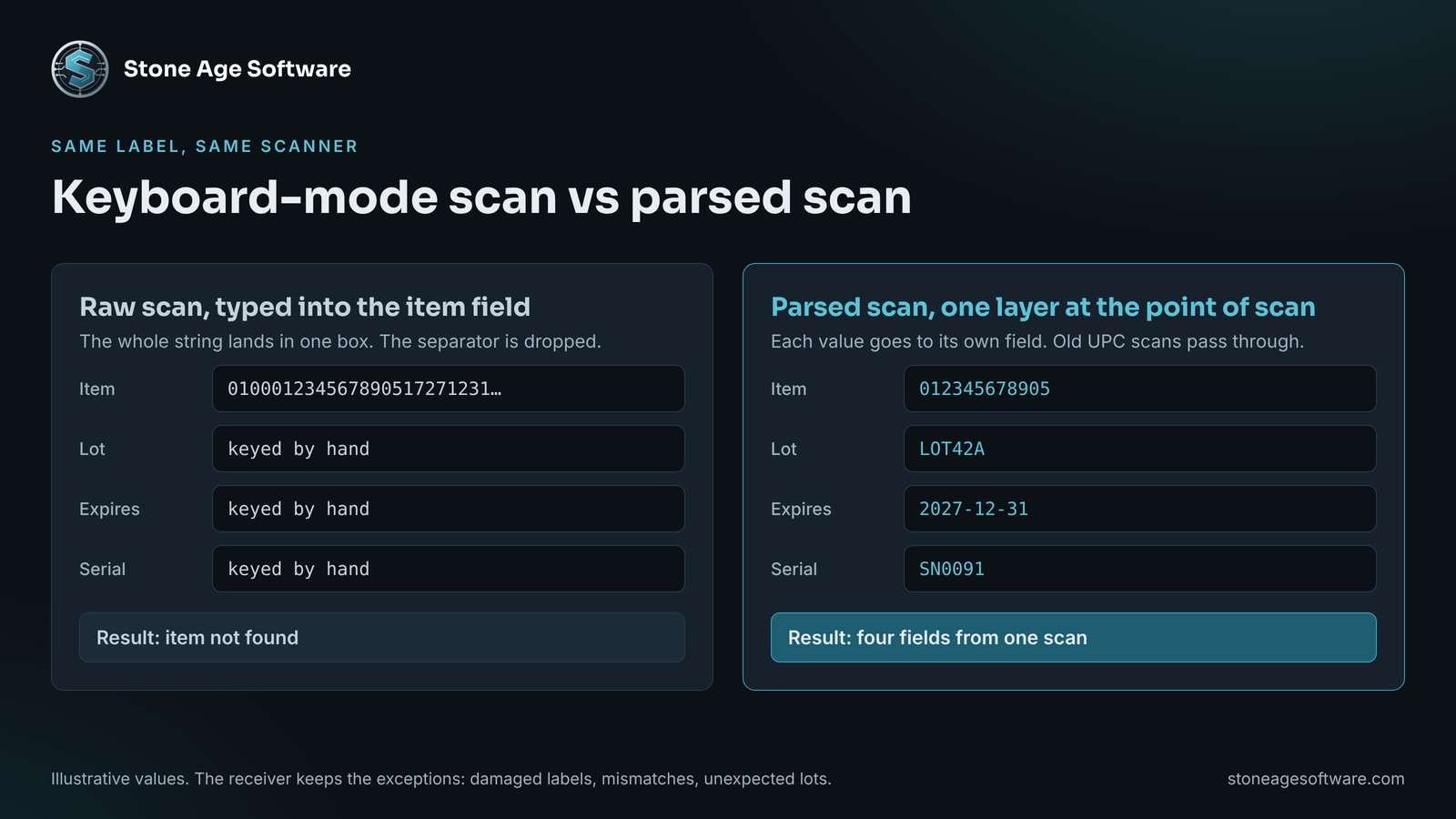
The scanner is typing, not talking. Most handhelds and tethered scanners run in keyboard mode. They type the data into whatever field has focus. The receiving screen expects a short item number. It gets the whole sentence. The lookup fails, or the field truncates and matches nothing.
The separator vanishes. The invisible character that ends a lot number is not a printable key. In keyboard mode it is often dropped. Now the lot and the serial run together as one long value. No one can tell where one ends, including the software.
The GTIN is a different length. Many item masters store the 12-digit UPC. The 2D code sends 14 digits. A correct scan of a known product still misses, purely on leading zeros.
The date has edge cases. The year is two digits, so the standard defines a rule for choosing the century. The day may be 00, which means the last day of that month. A screen that rejects "00" as an invalid day will refuse a valid label.
The human-readable text misleads. People see "(01)" and "(17)" printed under the code. The parentheses are for eyes only. They are not in the scanned data. A quick fix that searches for brackets will never find them.
A URL arrives where a number was expected. A Digital Link QR code hands your screen a web address. The item number is in there. Nothing on the screen knows how to pull it out.
The result on the floor is predictable. Receivers learn to hunt for the old striped code and ignore the square one. That works while dual marking lasts. It also throws away the best data on the package.
What the 2D code gives a 3PL that parses it
Here is the upside. Lot and expiration are already printed on most regulated goods. Today a receiver reads them off the carton and keys them in. The 2D code carries the same facts in machine form.
Parse it once and a single scan can fill four fields:
- Item, matched on the GTIN.
- Lot, with no transcription errors.
- Expiration date, in a real date field.
- Serial, where the client tracks to the unit.
That changes several jobs downstream. Expired stock gets caught at the dock instead of at the packing station. We covered that failure in our piece on warehouse expiration date tracking. Lot-level recall answers come from scans instead of handwriting. Receiving goes faster on the lines that used to need typing.
It also changes what your people spend attention on. Nobody should be reading six-point lot codes under dock lights. The scan handles the routine carton. The receiver handles the damaged label, the mismatch, and the lot that was never on the ASN. That is where judgment belongs.
Where the fix lives without replacing your WMS
You do not need a new warehouse system for this. You need a thin layer at the point of scan.
That layer does four things:
- Reads the symbology identifier, so it knows a GS1 code from a plain one.
- Splits the string by the rules in the standard, including the separator.
- Normalizes the GTIN to the length your item master uses.
- Hands each value to the right field, through whatever interface your WMS offers.
Old UPC scans pass through untouched. Unknown identifiers get logged, not guessed at. A scan the layer cannot parse goes to a person with the raw data attached.
The scanner settings matter as much as the code. Most 2D imagers can be set to transmit the symbology identifier. Most can replace the invisible separator with a visible character. Both settings are usually off out of the box. Without them the parser is working blind.
Printing is the other half. If you relabel or kit for clients, you may soon be asked to print these codes. A 2D symbol packs more into less space, and print quality matters more. Our write-up on stabilizing eight industrial label printers shows the kind of device-level work that sits under reliable labels. The lesson carries over. Know exactly what the hardware receives.
A five-label test you can run this week
You can find out where you stand in under an hour. No vendor call needed.
- Collect five labels. Ask your three largest clients for upcoming packaging samples. Add one GS1 DataMatrix and one QR code from any retail product at home.
- Scan each into a plain text editor. Use a real floor scanner in its normal mode. Write down exactly what appears.
- Look for the separator. Pick a label with a lot followed by a serial. If the two run together, your scanner is dropping the character.
- Scan each into the receiving screen. Note which field takes the data and what the screen says.
- Check your item master. Count the digits in your stored product codes. Twelve, thirteen or fourteen tells you what normalization you need.
- Find one date ending in 00. Type that date into your expiration field by hand. See if the screen accepts it.
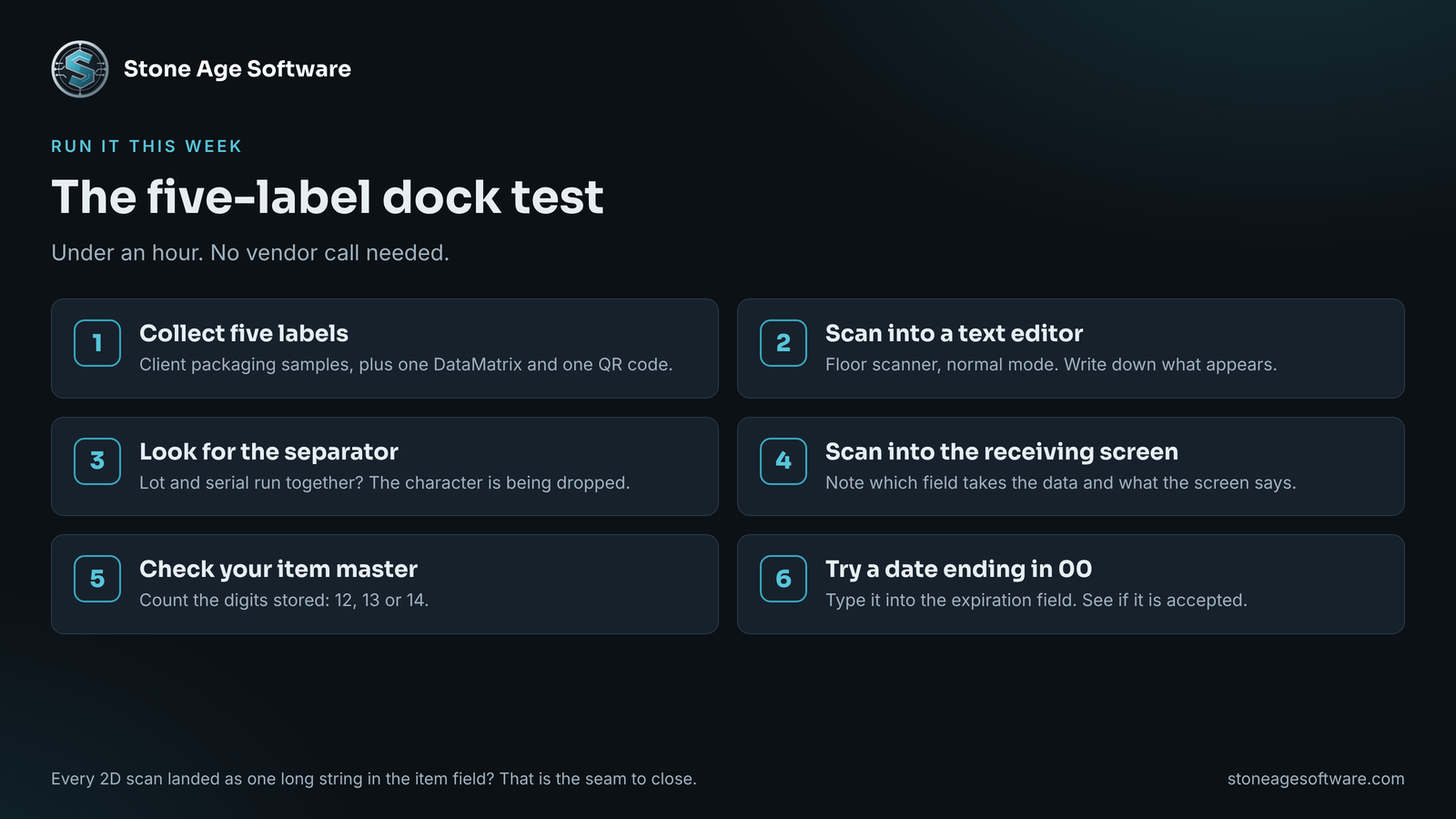
Score it simply. If every 2D scan landed as one long string in the item field, you have the seam described above. If your clients have no 2D packaging planned, you have time. Run the test again each quarter. The answer will change before anyone tells you.
One caution on timing. The cheapest moment to fix this is before the first dual-marked pallet arrives. After that, the workaround becomes habit. Habits on a receiving dock are hard to retire.
We build that parsing layer on top of the WMS you already run, at a fixed price, quoted up front, and you own the code outright. If the five-label test turned up a gap, our 3PL and logistics systems practice is the place to start the conversation.