On October 21, 2026, a poisoned release of LiteLLM reached PyPI. The open-source Python library connects applications to language-model providers and draws 92 million monthly downloads. Its source code was clean. Its release pipeline was not. A key committed to a public repository in May had never been revoked, according to LiteLLM's root cause analysis. That key led attackers to the tokens that triggered and approved the release. Every functional test would have passed. Battle testing software exists for exactly this gap: proving code survives attack, failure and poisoned dependencies, not just that it works.
Executive Summary
Functional testing asks whether software works. Battle testing asks whether it keeps working under attack, outages, bad updates and compromised dependencies. The difference is software resilience. SolarWinds, Log4Shell, Equifax, Colonial Pipeline and the CrowdStrike outage each broke at a seam no QA suite was built to probe.
Generated code raises the stakes, because it arrives faster than most teams can verify it. Yet the standards never asked who typed the code. NIST's Secure Software Development Framework (SSDF), SP 800-53 and ISO/IEC 27001 ask whether code was reviewed, tested, built with integrity and able to recover.
Key Takeaways - Passing QA proves features work. It does not prove the system survives. - NIST and ISO are tool-agnostic: generated code owes the same review and testing as handwritten code. - Five tests cover most real-world failure: adversarial, supply chain, chaos, recovery and abuse. - Track outcomes, not activity: MTTD, MTTR, remediation time and recovery success rate. - An attestation is a claim. A test result is evidence.
Why Software That Passes QA Still Fails
Quality assurance confirms that software meets its requirements. Attackers, outages and bad updates never read them:
- SolarWinds (2020). Malware in the build environment slipped a backdoor into Orion during compilation. Up to 18,000 customers may have installed the signed, tampered updates.
- Log4Shell (2021). One logging library sat inside countless applications. The Cyber Safety Review Board called it endemic and expects vulnerable copies to linger for a decade or longer.
- Equifax (2017). Attackers scanned for an Apache Struts flaw two days after its disclosure. An expired certificate on an inspection device hid them for about 76 days. The GAO counted at least 145.5 million people affected.
- Colonial Pipeline (2021). Attackers entered through a legacy VPN profile without multifactor authentication, its CEO told senators. A 5,500-mile pipeline carrying nearly half the East Coast's fuel stopped for about five days.
- CrowdStrike (2024). A content update defined 21 input fields, but the sensor supplied only 20. A validator bug let it through to every online sensor at once. Microsoft estimated that 8.5 million Windows devices went down.
Each system passed the tests it was given. Each failed at a seam those tests never touched: a build server, a shared library, an expired certificate, a forgotten VPN profile, an update with no staged rollout.
Functional, Security and Resilience Testing Answer Different Questions
- Functional testing asks whether the software does what the requirements say, through unit, integration and acceptance tests.
- Security testing asks whether someone can make it do what the requirements forbid, through code review, scanning and penetration tests.
- Resilience testing asks whether it keeps serving, or recovers cleanly, when parts fail, through failover tests, chaos experiments and restore drills.
Most organizations fund the first, schedule the second and assume the third. Battle testing runs all three under realistic conditions, continuously, and keeps the evidence.
Why Vibe-Coded Software Raises the Stakes
Vibe coding, a term coined in February 2025, means building software by prompting AI coding assistants and accepting the output without close review. It is fast. It also produces working software that nobody has checked for how it fails.
Veracode's October 2026 update found generated code passed security tests 62% of the time. That leaves 38% of tasks producing a known vulnerability. Even the strongest models failed more than one task in four, and cross-site scripting defenses passed just 18% of the time.
In Stack Overflow's 2026 survey, only 6.6% of developers trusted generated output for important decisions. DORA's research ties heavier adoption to higher throughput and higher delivery instability.
In January 2026, Wiz researchers found that Moltbook, a social network for software agents, had opened its production database to anyone. A key sat in client-side JavaScript, and row-level security was off. The exposure covered 1.5 million API tokens, 35,000 email addresses and 4,060 private conversations. One unauthenticated read, the first step of any penetration test, would have caught it.
A prompt-built app usually ships without the layer battle testing supplies:
- A threat model and a code review gate
- Access rules enforced at the data layer
- Vetted, pinned dependencies
- A restore that has been timed, not assumed
- Load and abuse tests against its logins and APIs
The tool is not the problem. Google Cloud's guidance separates responsible assisted development, where a person reviews, tests and understands the code, from pure vibe coding. Battle testing turns that review into evidence. Already inherited a prompt-built codebase? Our vibe coding cleanup guide covers the takeover.
A model can write a login page in seconds. Only a test can show whether that page survives.
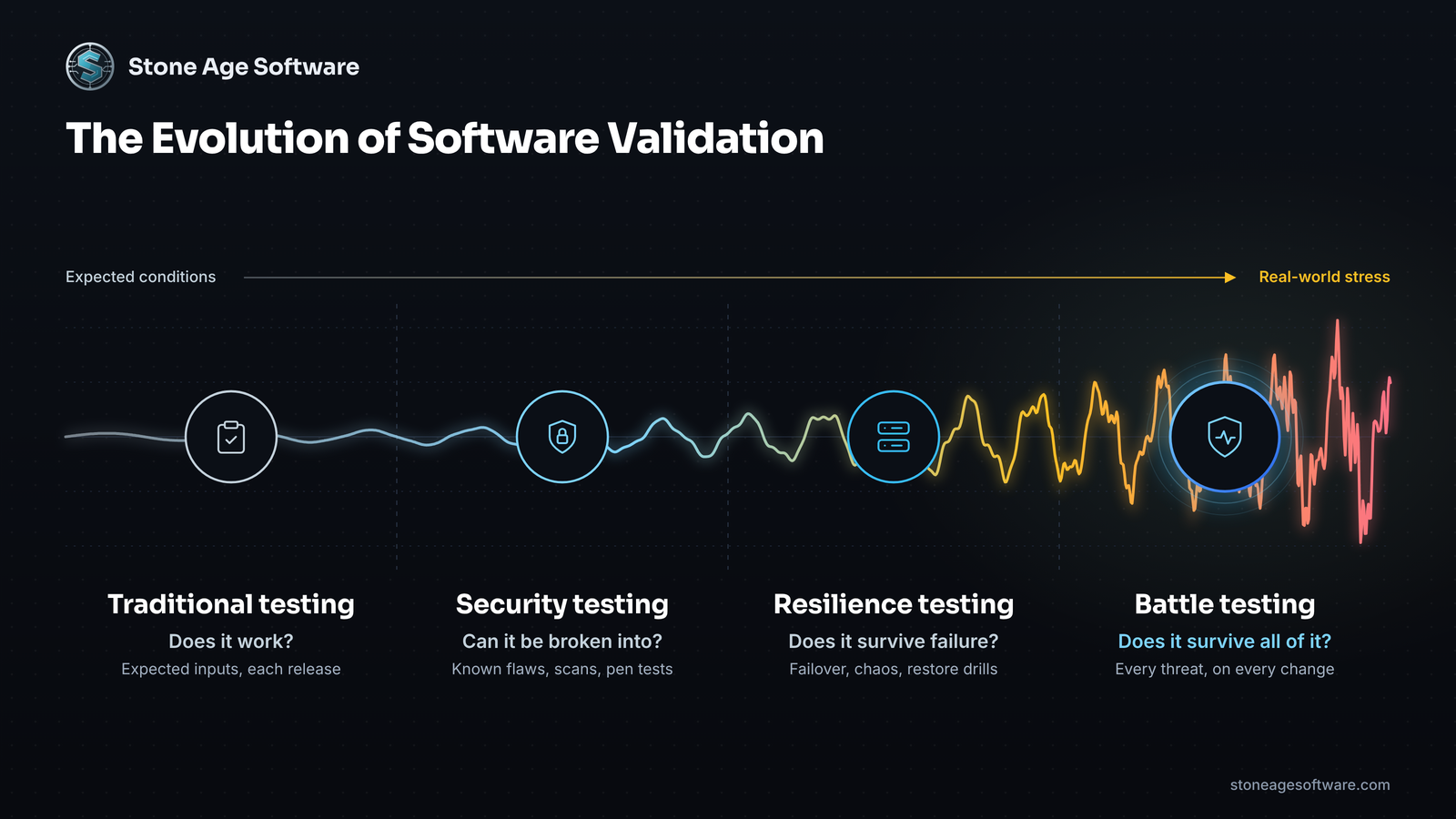
The evolution from quality assurance to resilience assurance.
What Is Battle Testing Software?
Battle testing software means proving, with repeatable evidence, that a system withstands the conditions it will meet in production. Think of it as cyber resilience you can measure. It combines six disciplines:
- Security testing: reviews, scans and code analysis that find flaws before release.
- Adversarial validation: people and platforms that attack the system the way real adversaries do.
- Recovery testing: timed restores and rebuilds measured against recovery objectives.
- Chaos engineering: controlled failure that confirms the system degrades gracefully.
- Supply chain testing: verification of every dependency, build step and release artifact.
- Resilience engineering: design choices that let a system absorb, adapt and recover.
| Dimension | Traditional QA | Battle Testing | |---|---|---| | Core question | Does it work? | Does it survive? | | Inputs | Expected and edge-case data | Hostile, malformed and abusive traffic | | Environment | Clean test environment | Production-like, with failures injected | | Dependencies | Assumed trustworthy | Verified, pinned and monitored | | Adversary | None | Red teams, simulations and automated attacks | | Recovery | Out of scope | Timed against RTO and RPO | | Cadence | Each release | Every change, plus scheduled exercises | | Evidence | Pass or fail report | Control-mapped results and trends |
Why Cloud-Native Systems Need Battle Testing
Cloud-native systems fail differently. One change can reach every region in minutes, and much of the stack belongs to someone else.
- June 12, 2025: a Google Cloud policy change with blank fields hit an unflagged code path, replicated globally and crashed a core service.
- October 20, 2025: a race condition in DynamoDB's DNS automation left an empty record in AWS us-east-1.
- November 18, 2025: a permissions change doubled a Cloudflare configuration file past a size limit, and its core proxy failed network-wide.
None of these was an attack. Each was routine change meeting an untested failure path. Battle testing adds the checks nobody thought to write: malformed configuration, a vanished dependency, a region gone dark.
NIST Foundations for Battle Testing
NIST supplies the vocabulary through three publications.
NIST 800-53: The Controls Assessors Test
NIST SP 800-53 Revision 5 is the federal control catalog, now at Release 5.2.0. Five controls anchor a battle testing program:
- CA-2 Control Assessments. Renamed from Security Assessments in Revision 5, it asks whether controls work as intended, which a battle test shows directly.
- CA-7 Continuous Monitoring. Breach and attack simulation confirms, every day, that detections still fire.
- RA-5 Vulnerability Monitoring and Scanning. Scan what is deployed, not only what is in the repository.
- SI-2 Flaw Remediation. Release 5.2.0 added SI-2(7), root cause analysis after a failed software update.
- SI-10 Information Input Validation. Fuzzing and abuse tests confirm that validation holds against hostile input.
CA-8 adds penetration testing and, in CA-8(2), red team exercises. CP-4 requires contingency plan testing. Release 5.2.0 also added SA-24, Design for Cyber Resiliency, as Industrial Cyber reported.
NIST SSDF (SP 800-218): PW and RV Practices
The NIST SSDF groups its practices into four families. Two carry most of the testing load:
- Produce Well-Secured Software (PW). PW.4 reuses well-secured components, PW.6 hardens the build, PW.7 reviews code, and PW.8 tests executable code, including fuzzing and penetration testing.
- Respond to Vulnerabilities (RV). RV.1 finds and confirms vulnerabilities continuously, RV.2 prioritizes and fixes them, and RV.3 traces root causes.
Security validation requirements live in PO.4, which defines the criteria every security check must meet. A battle test is a security check with consequences.
Revision 1, a draft since December 17, 2025, adds PW.10: test every update, roll out in stages with canaries, and keep rollback working. It reads like the CrowdStrike lesson in standard form. NIST also describes the SSDF as tool-agnostic, so PW.7 applies whether a person, a coding assistant or an agent wrote the code. Our earlier guide covers hardening pipelines for NIST SP 800-218 compliance.
NIST CSF 2.0: Govern Plus Five Functions
NIST CSF 2.0, released February 26, 2024, adds Govern to the five functions most teams know. Battle testing validates all six, and Identify itself calls for improvements drawn from tests and exercises:
| Function | Battle test | Evidence produced | |---|---|---| | Govern | Approve scope, cadence and risk tolerance | Signed test charter | | Identify | Threat model and SBOM review | Ranked attack paths | | Protect | Fuzz inputs and try access without credentials | Blocked attempts, closed gaps | | Detect | Simulate attacker techniques | Alerts fired, time to detect | | Respond | Live incident drill | Time to contain | | Recover | Timed restore to a clean environment | Measured RTO and RPO |
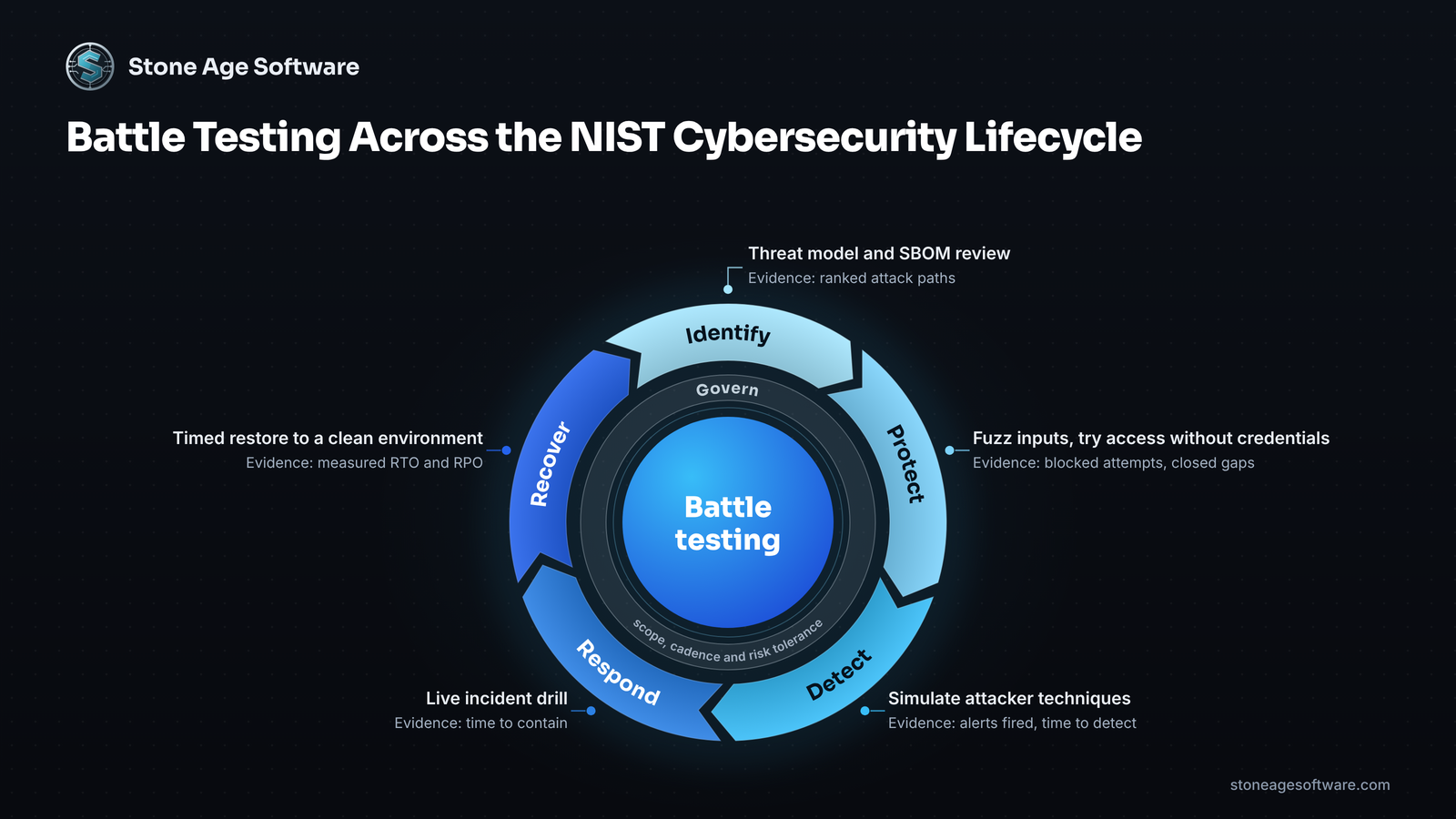
Battle testing validates every phase of the cybersecurity lifecycle.
ISO Standards and Software Resilience
ISO standards ask whether an organization runs a management system that keeps security improving. Battle testing feeds that system with evidence.
ISO/IEC 27001: Risk, Testing and Improvement
ISO/IEC 27001:2022 organizes its Annex A into 93 controls across four themes. Four areas map directly to battle testing:
- Risk management: clauses 6.1 and 8.2 tie every test to an assessed risk.
- Technical vulnerability management: control 8.8 requires finding, evaluating and fixing vulnerabilities.
- Security testing: control 8.29 anchors ISO 27001 security testing, requiring tests during development and acceptance.
- Continuous improvement: clause 10.1 requires continual improvement, and 10.2 requires corrective action.
Controls 5.29 and 5.30 cover security during disruption and ICT readiness for business continuity. Only a rehearsal proves either one.
ISO/IEC 27002: How the Controls Work
ISO/IEC 27002 gives implementation guidance for every Annex A control, including monitoring (8.16), testing (8.29) and change management (8.32). Its cybersecurity concepts attribute tags each control as Identify, Protect, Detect, Respond or Recover. That builds a direct bridge to NIST CSF.
ISO/IEC 27034: Application Security Governance
ISO/IEC 27034 brings the discipline down to each application. An Organization Normative Framework holds approved practices. Each application gets its own Application Normative Framework and a Targeted Level of Trust. Application Security Controls pair secure coding practices with the verification that proves them. Threat-based validation is how that trust gets demonstrated.
Done this way, compliance becomes a byproduct. A restore drill produces a timed record an auditor can accept, and the same drill proves the business can recover. Neither ISO nor NIST asks how the code was written. Both ask for proof that it holds.
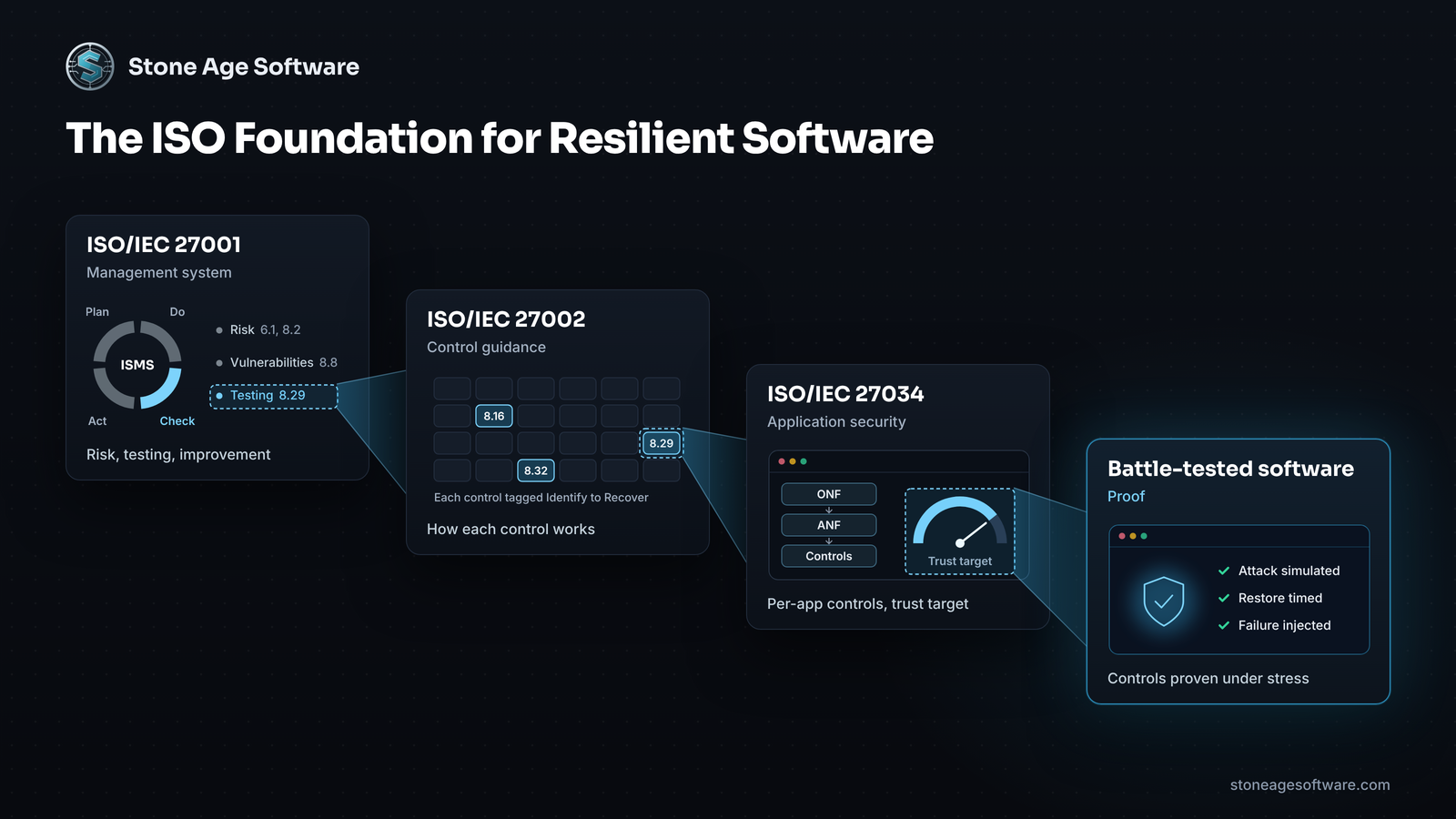
How ISO standards create a foundation for resilient applications.
Five Battle Tests Every Organization Should Run
Test 1: Adversarial Security Testing
Adversarial testing puts a thinking opponent against the system:
- Penetration testing finds exploitable flaws within a defined scope and time box.
- Red teaming pursues an objective, such as reaching customer data, and tests detection and response along the way.
- Breach and attack simulation (BAS) replays known attacker techniques continuously and confirms controls still stop them.
Metasploit and Burp Suite remain standard for exploitation and web testing, while AttackIQ and SafeBreach run BAS at scale. Exploited vulnerabilities are now the leading way into breached organizations, according to Verizon's 2026 breach report. Start with the cheapest question: what can an unauthenticated user read?
Test 2: Supply Chain and Dependency Testing
Most production code arrives as dependencies. Test them like code you wrote:
- SBOM verification confirms the software bill of materials matches what actually shipped.
- Dependency scanning flags vulnerable and abandoned packages on every build.
- Compromised package simulation rehearses the bad day: a poisoned release lands, and the team must find it, pin around it, rebuild and rotate secrets.
Snyk, GitHub Advanced Security (now sold as GitHub Secret Protection and GitHub Code Security) and OWASP Dependency-Check handle scanning. LiteLLM shows what verification buys. Chainguard flagged the poisoned release 16 minutes after publication, and its builds from source never carried the payload. Generated code adds a twist: it can import packages that do not exist, which attackers can then register.
Test 3: Chaos Engineering
Chaos engineering defines a steady state, predicts it will hold, then injects real-world failure to find out. Start in staging, then move to production with a small blast radius:
- Service failures: kill instances and watch failover.
- Database failures: force a primary to fail over mid-transaction.
- Network disruptions: add latency, drop packets and partition zones.
- Cloud outages: remove a region or a managed service.
Gremlin offers a managed platform; LitmusChaos and Chaos Mesh are open-source CNCF projects for Kubernetes. Include configuration, too: an oversized file like Cloudflare's is worth injecting on purpose.
Test 4: Recovery and Disaster Testing
A backup that has never been restored is a hope, not a control:
- Backup validation: restore to a clean environment and verify the data, not just the job status.
- Infrastructure restoration: rebuild from infrastructure as code in a fresh account.
- Data recovery: prove point-in-time restores for the systems that move money and inventory.
Recovery Time Objective (RTO) is how long the business can wait for service to return. Recovery Point Objective (RPO) is how much data it can afford to lose. Measure both in every drill against written targets. In July 2025, a coding agent deleted a production database during a declared code freeze. That is the day a timed restore pays for itself.
Test 5: Performance and Abuse Testing
Abuse testing asks what happens when traffic is hostile or simply enormous:
- DDoS simulations: coordinate with your provider and confirm protection engages.
- API abuse: probe for unrestricted resource consumption, a category in the OWASP API Security Top 10.
- Resource exhaustion: push memory, connections and queues past their limits and watch for graceful refusal.
- Authentication attacks: run credential stuffing and brute force against test accounts, then confirm lockout, rate limits and alerts.
k6, Apache JMeter and Locust script the load. The goal is graceful degradation: the system slows and sheds load instead of falling over.
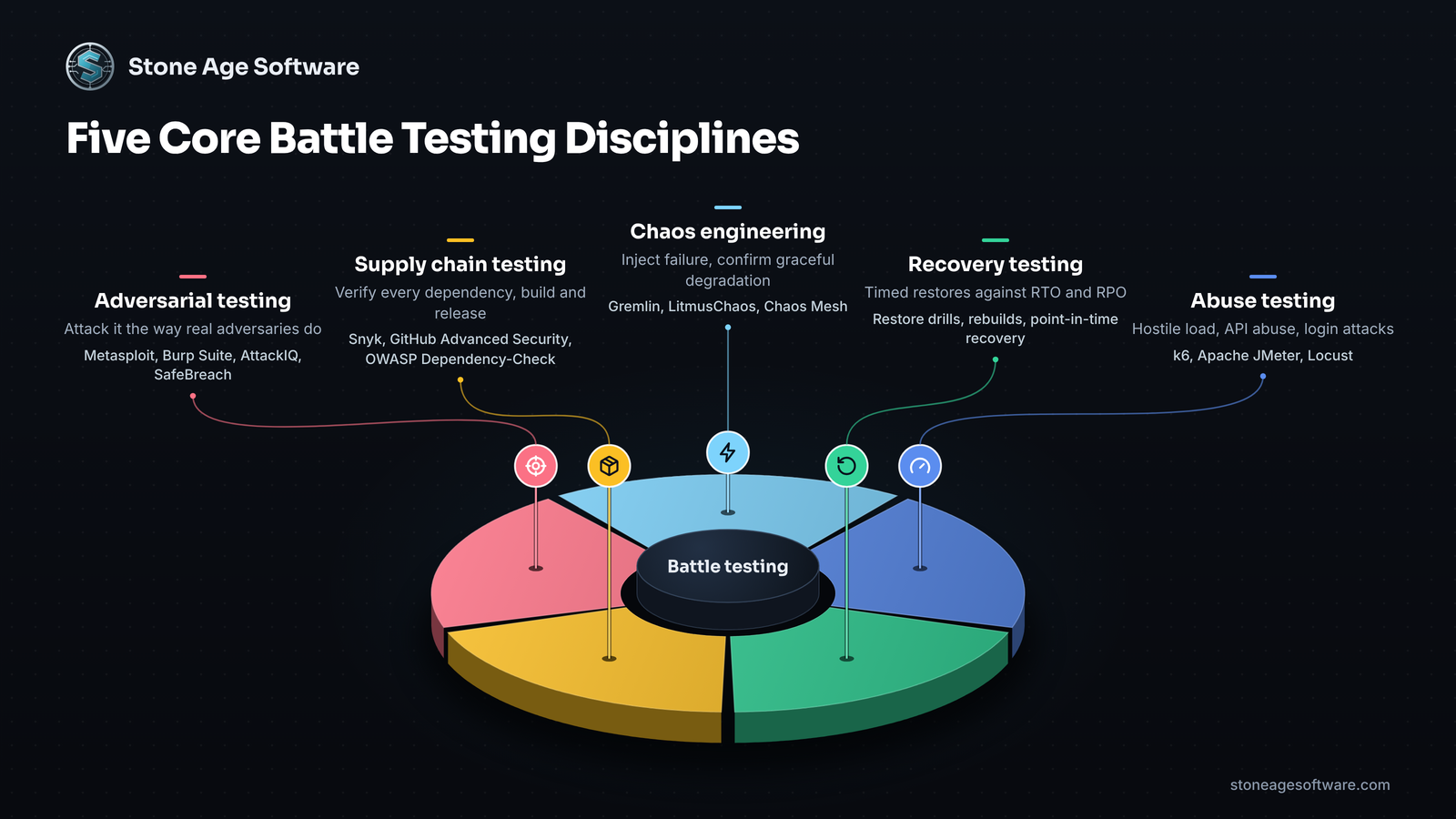
Core battle-testing disciplines for modern software systems.
Building a Battle Testing Program
Most organizations already own pieces of this. A program connects them in four phases.
Phase 1: Risk Mapping
Inventory assets, including dependencies and the build pipeline. Threat model the systems that matter most. Map each planned test to the controls it evidences, so one exercise serves several frameworks.
Phase 2: Automated Validation
Put static testing (SAST), dynamic testing (DAST), software composition analysis (SCA) and infrastructure-as-code scanning in the pipeline. Make the gates fail the build. Add secret scanning, since an unrevoked key started the LiteLLM compromise. This is DevSecOps testing at its core. It is also the layer prompt-built projects skip most often, and the cheapest to add.
Phase 3: Adversarial Exercises
Schedule red team operations, recovery drills and chaos game days. Automation runs the repetitive checks on every build. That frees security engineers for the judgment calls: which finding matters, which exception is acceptable, which failure to rehearse next.
Phase 4: Continuous Monitoring
Track four metrics and trend them quarterly:
- MTTD (mean time to detect): how fast simulated attacks trigger alerts.
- MTTR (mean time to recover): how fast service returns after a failure.
- Remediation time: days from finding to verified fix.
- Recovery success rate: the share of drills that meet RTO and RPO.
Release engineering is where the phases meet. In one of our release-engineering projects, a deploy to a live operations platform completes only when a new process appears within 20 seconds. Otherwise the job fails on purpose and the old version keeps serving. That is draft PW.10 in practice.
If a recovery time has never been measured, it is a guess with a decimal point.
Maturity builds in five levels.
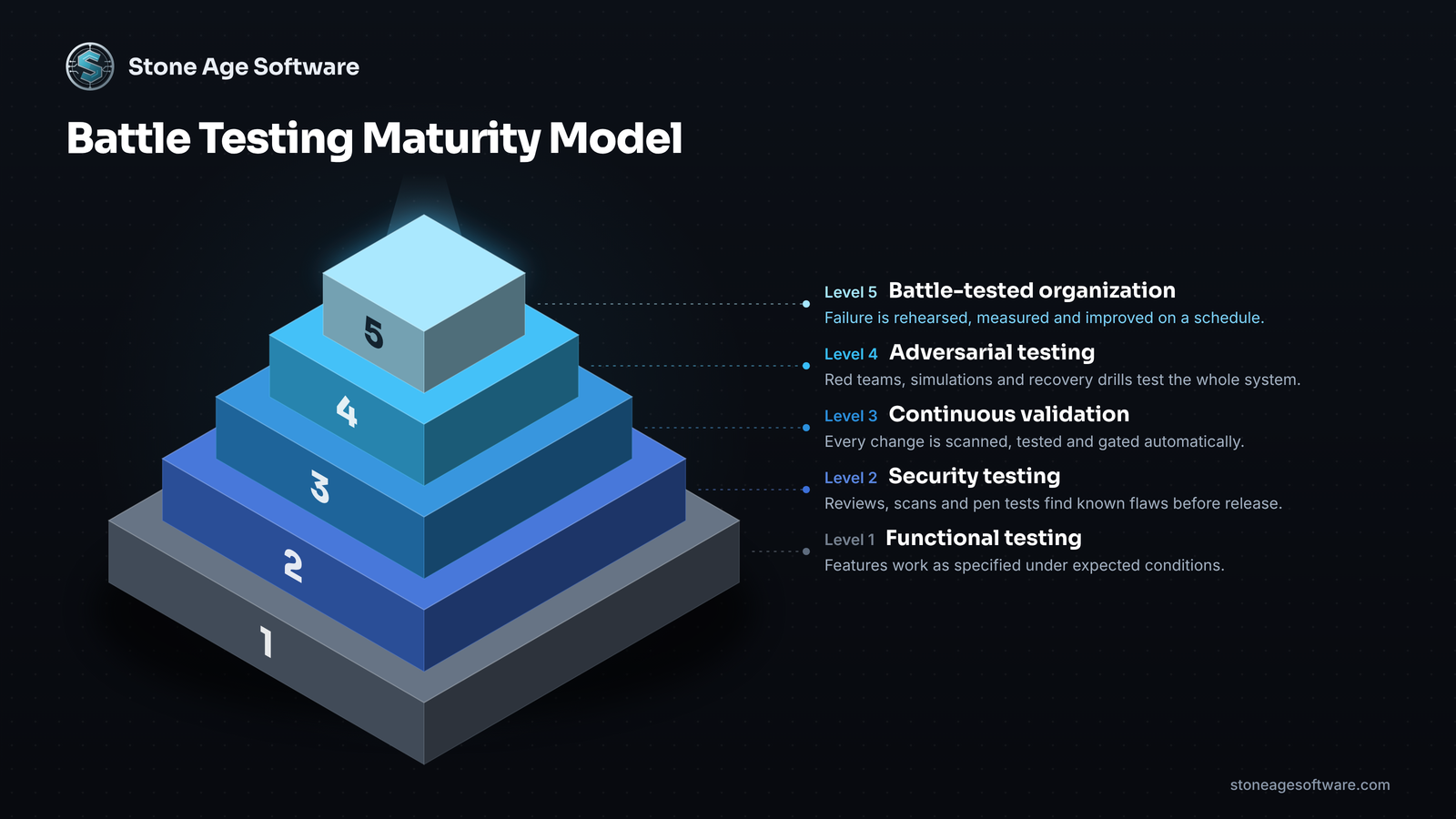
The progression toward software resilience maturity.
Mapping Battle Testing to NIST and ISO Controls
| Battle Testing Activity | NIST SSDF | NIST 800-53 | ISO/IEC 27001 (Annex A) | Business Outcome | |---|---|---|---|---| | Penetration testing | PW.8, RV.1 | CA-8, CA-8(2), SA-11(5) | 8.8, 8.29 | Proof that controls stop a real attacker | | Dependency testing | PW.4, PS.2, RV.1 | SR-3, SR-4, SR-11, RA-5 | 5.19, 5.21, 8.8 | Poisoned packages stopped before production | | Chaos engineering | PW.1, PW.8 | CP-4, SA-24, SC-5 | 5.30, 8.14 | Known blast radius before customers find it | | Recovery exercises | PS.3, draft PW.10 | CP-4, CP-9, CP-10, IR-3 | 5.29, 5.30, 8.13 | Recovery times measured, not assumed | | Abuse testing | PW.8 | SC-5, AC-7, SI-10 | 8.6, 8.29 | Logins and APIs that hold under hostile load | | Continuous monitoring | RV.1, PO.4 | CA-7, RA-5, SI-4 | 8.16, 8.8 | Faster detection and response |
This is a practitioner's crosswalk, not an official mapping, so validate it against NIST's SP 800-53 to ISO/IEC 27001 mapping before an audit.
Validate Controls, Not Paperwork
A policy states intent. An assessment checks design. Only a test shows what happens on a bad day. Equifax had traffic inspection in place, but an expired certificate had blinded it about ten months before the breach. A detection test would have exposed the silence.
Deadlines move. Controls do not. Pentagon officials suspended CMMC Phase 2 in July 2026, months before its November 10 start. Contractors handling controlled unclassified information still owe the same NIST SP 800-171 requirements. In Europe, the Cyber Resilience Act has required manufacturers to report actively exploited vulnerabilities since September 11, 2026. Both reward teams that already hold test evidence.
An attestation is a claim. A test result is evidence.
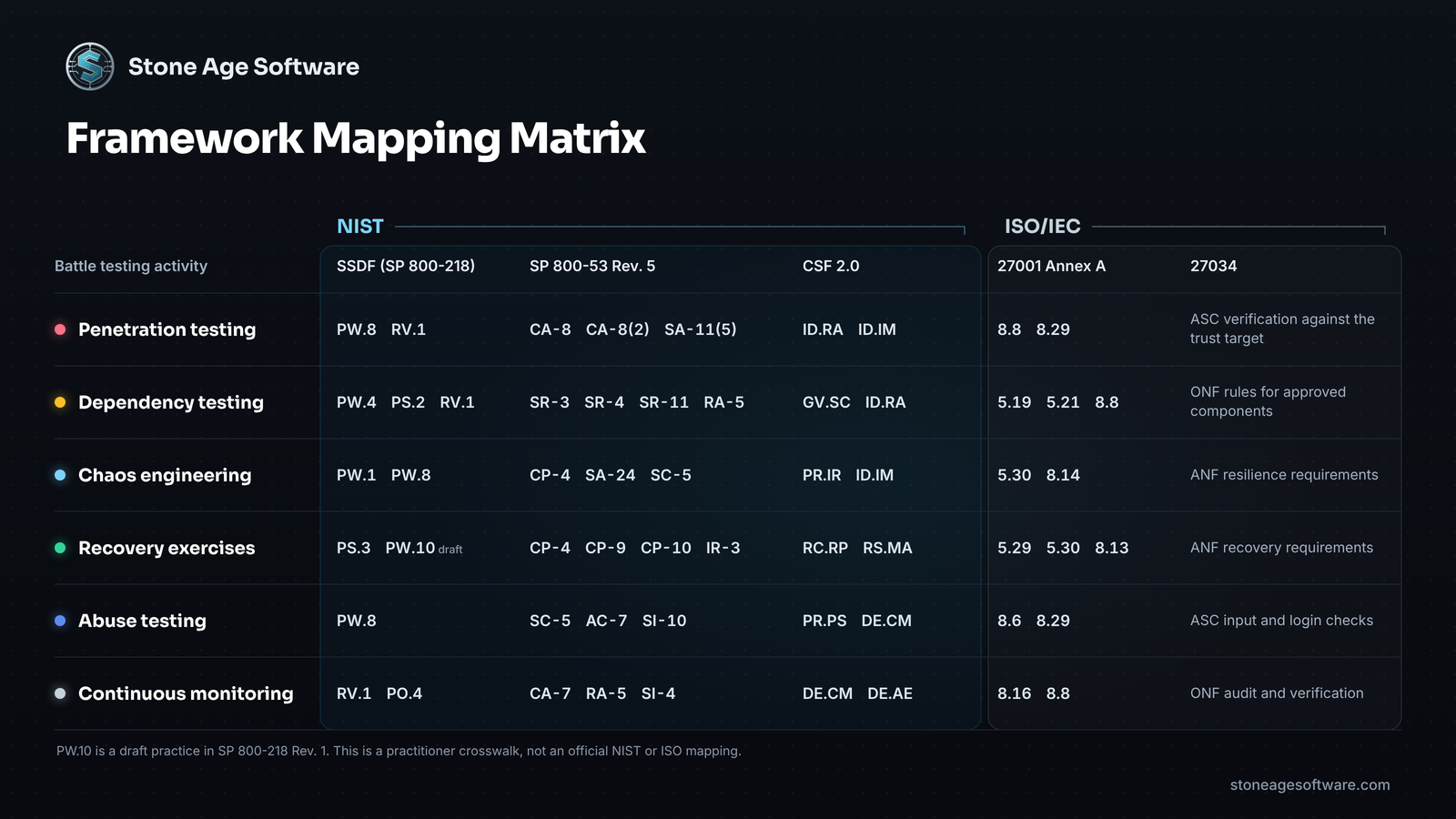
Mapping resilience activities to recognized security frameworks.
A Battle Test You Can Run This Month
Pick one production service that matters. Answer five questions with evidence, not memory:
- Restore last night's backup to a clean environment. How long did it take against the written RTO?
- Fail the primary database in staging under load. Did the application degrade or stop?
- Scan the deployed artifact, not the repository. How many critical findings are older than 30 days?
- Run a credential-stuffing script against staging logins with test accounts. Did rate limiting and an alert both trigger?
- Take your newest dependency release. Can you prove it matches its source?
Two blank answers mark your next sprint.
Frequently Asked Questions
What is battle testing software?
Battle testing software is the practice of proving that a system survives realistic attack, failure and dependency compromise. It combines security testing, adversarial validation, chaos engineering, supply chain testing and recovery drills.
How is battle testing different from penetration testing?
A penetration test is one battle test: it finds exploitable flaws within a scoped window. Battle testing adds recovery, chaos, supply chain and abuse testing, and it runs continuously.
Do NIST and ISO require chaos engineering?
Neither names it. SP 800-53 requires contingency plan testing (CP-4) and includes design for cyber resiliency (SA-24). ISO/IEC 27001 control 5.30 requires ICT readiness for business continuity. Chaos experiments are among the most direct evidence for both.
Is vibe-coded software acceptable under NIST and ISO standards?
It can be, if it meets the same obligations. The frameworks are tool-agnostic. Generated code needs the same review (SSDF PW.7), testing (PW.8) and secure development controls (ISO/IEC 27001 controls 8.28 and 8.29) as handwritten code. Given current security pass rates, it deserves more scrutiny, not less.
How often should we run battle tests?
Scan and gate every change. Run attack simulations weekly and restore drills quarterly. Hold red team exercises and chaos game days at least yearly, and retest after major changes or incidents.
Conclusion
Compliance does not equal resilience. The failures in this article came from seams nobody had tested, not from a shortage of documents. Vulnerabilities must be continuously validated, because code, dependencies and attackers change every week. Battle testing bridges policy and operational reality by turning a control statement into a measured result. And organizations that rehearse failure recover faster, because recovery becomes a procedure they have already run.
Generated code makes this discipline more urgent, not optional. Our custom software and web development practice builds these tests into delivery from the first release, so the evidence exists before anyone asks for it.
“Passing a security assessment proves today's controls. Battle testing proves tomorrow's survivability.”