
On September 1, your warehouse management system got a new owner. On September 2, your pickers scanned the same screens they scanned the week before.
That is the honest summary of the Descartes Extensiv acquisition so far. Nothing on the floor changed. The announcement lists no product changes and no end dates.
So why are so many 3PL owners searching for it? Because the news raised a question most shops have never had to answer out loud. If the platform's direction ever shifts, which parts of this operation are ours?
It is a fair question. It also has a calmer answer than most of what you will read this month.
What the Descartes Extensiv acquisition actually says
Start with the source. Descartes announced the deal in a press release filed with the SEC. It frames Extensiv as a way to add warehouse and inventory tools. It also frames it as a way to win more 3PL and ecommerce fulfillment business.
The release states the goal in plain words. Logistics providers should be able to scale with "a single technology provider versus a patchwork of vendors."
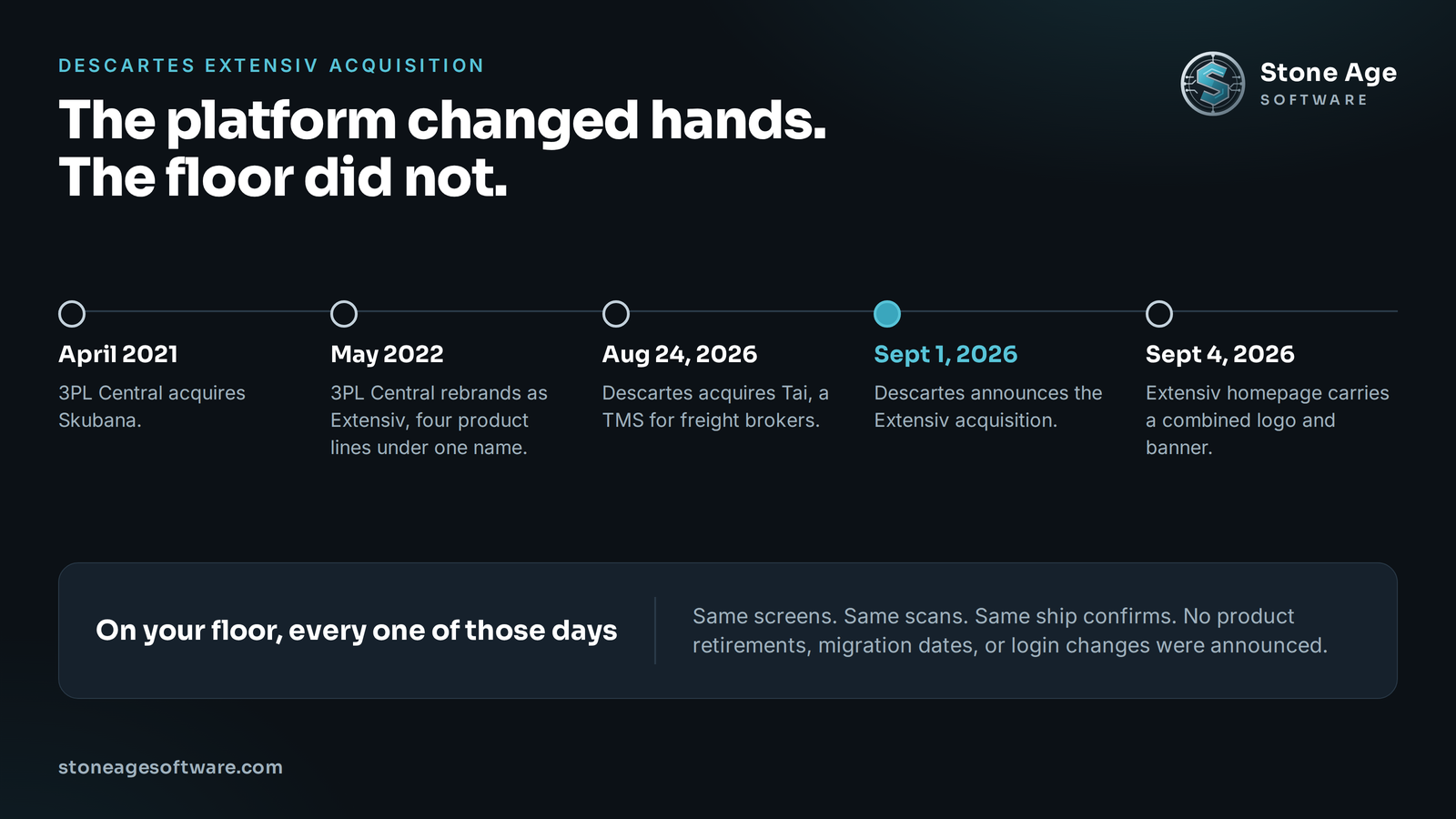
Here is the short history, as Digital Commerce 360 reported it:
- April 2021: 3PL Central acquired Skubana.
- May 2022: 3PL Central rebranded as Extensiv, bringing four product lines under one name.
- August 24, 2026: Descartes acquired Tai, a transportation management platform for freight brokers.
- September 1, 2026: Descartes announced the Extensiv acquisition.
- September 4, 2026: The Extensiv homepage carried a combined logo and a banner about joining Descartes.
Read that list again. Extensiv itself was built from acquisitions. Platforms changing hands is ordinary in this industry. Logistics Manager's coverage frames it the same way, as an addition to warehouse tools Descartes already sells.
What the announcement leaves out matters just as much:
- No product retirements.
- No migration dates.
- No changes to how you log in, scan, or ship.
Read it as written. It is a statement of direction. It is not a change notice.
The platform was always rented
Here is the part worth sitting with. Your WMS was a rented layer before September 1. It is a rented layer now.
That is not a flaw. Renting the platform is the right call for most 3PLs. Someone else maintains the pick logic, the scanner screens, and the updates. Your team gets to run a warehouse instead of a software company.
The exposure sits in everything that grew up around the platform. Over the years, every shop builds a second layer:
- The monthly client report, assembled from three exports.
- The billing file that feeds your invoicing/accounting integration.
- The trading-partner maps that turn an order into a shipment.
- The numbers a client asks for by email every week.
- Years of receipts, picks, and adjustments.
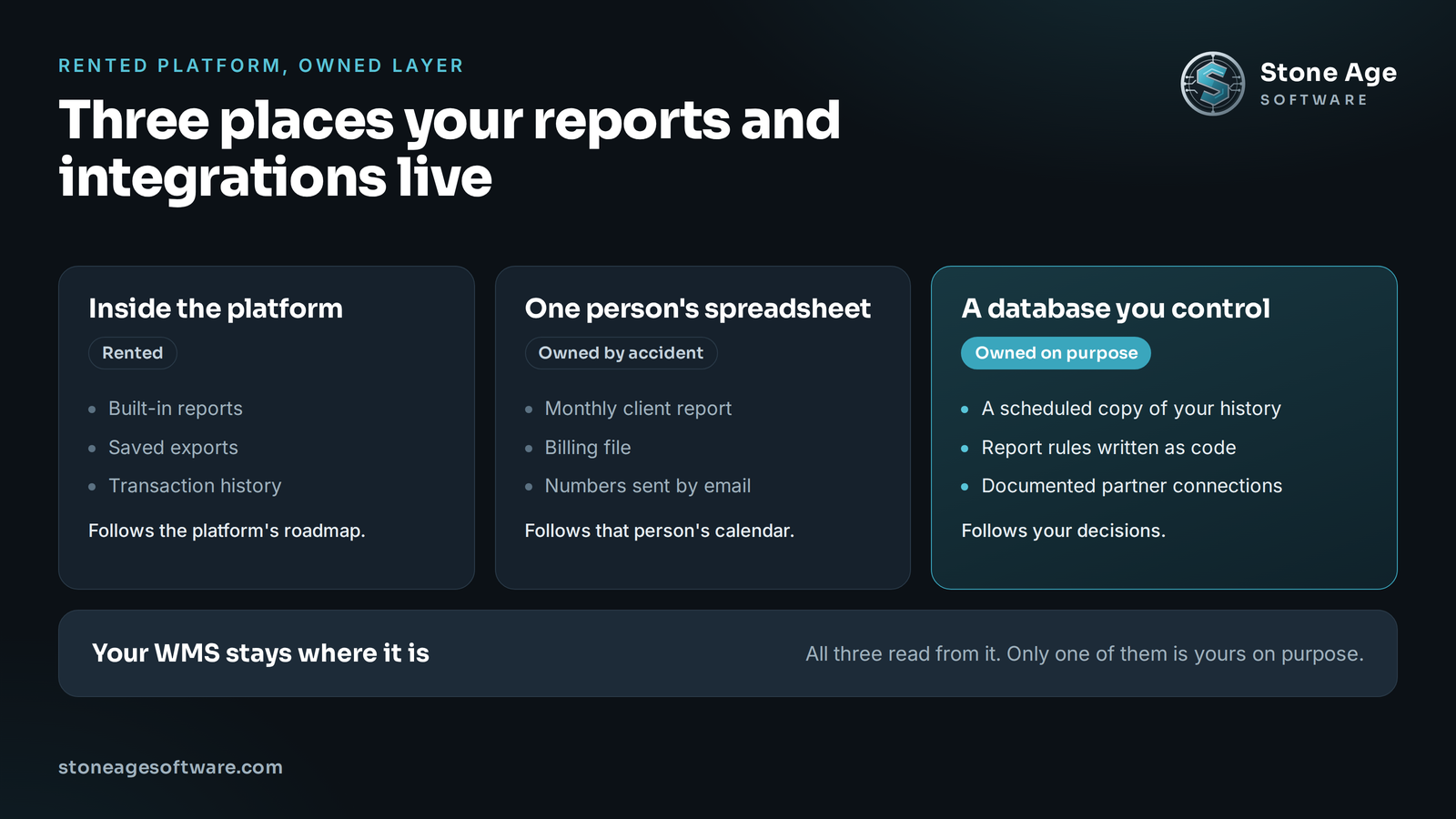
Nobody sat down and decided who owns each of those. They accumulated, one reasonable workaround at a time. Each one now lives in one of three places:
- Inside the platform. Rented. It follows the platform's roadmap.
- In one person's spreadsheet. Owned by accident. It follows that person's calendar.
- In a database you control. Owned on purpose. It follows your decisions.
Most shops have plenty in the first two and almost nothing in the third. That gap is structural. It comes from how warehouse software gets installed, one export button at a time. It has nothing to do with how hard your people work.
Four things worth owning on purpose
You do not need to own the platform. You need to own the pieces that are specific to your business.
1. Your operational history. Every receipt, pick, shipment, and adjustment is a record of work your team did. Today you see it through screens and exports. A scheduled copy in your own database makes it something you can query. It also means the history travels with you, whatever the platform does next.
2. Your report definitions. Each client has their own meaning of "on time." Each has their own cutoffs and exclusions. Those rules usually live in one person's export routine. Written down as code, they become an asset instead of a memory.
3. Your billing inputs. The floor does the work. The invoice needs a line for it. The link between a billable event and an invoice line should be something you can read, test, and change.
4. Your trading-partner connections. The documents themselves are public standards. X12 publishes the transaction sets, including the 940 Warehouse Shipping Order and the 945 Warehouse Shipping Advice. What is not public is each partner's version of them. Those rules are your EDI integration knowledge. They belong in documentation you can reach.
None of this replaces the WMS. All of it sits on top.
Why the seam matters more than the owner
It is tempting to make this story about one company or the other. It is not about either.
A platform vendor has thousands of customers. Its roadmap has to serve all of them. That is true of every vendor, under every owner, and it is the right way to run a platform.
Your Tuesday report serves one business. Yours.
The real exposure is the seam between the two. In most shops, the only door out of the system is an export button. Behind it stands one person who knows which three files to join. That arrangement breaks quietly, whoever owns the platform:
- A release renames a column, and a spreadsheet formula returns blanks.
- The person who builds the report takes a week off.
- A client asks for history older than the export reaches.
An owned layer closes the seam. It reads from the platform on a schedule, through the interfaces the vendor documents. It lands the data in a database that belongs to you. Reports get built there.
When the platform changes a field, one connector changes. The reports downstream do not.
This is also where your people get their time back. The person who rebuilds the same export every month is usually your best exception handler. Software should do the joining. That person should be chasing the odd numbers, not assembling the normal ones.
We have seen this pattern up close. One contract-logistics operation had a warehouse system that held inventory well. It could not answer operational questions. The answers lived in spreadsheets on individual laptops. The fix was one owned application that replaced the spreadsheets, not the warehouse system.
Questions worth asking your account rep
You are a customer with a renewal date. You are allowed to ask plain questions. These four are neutral, and any good vendor will answer them:
- Which interfaces are supported for pulling my own data on a schedule?
- How far back can I export my transaction history?
- How much notice do I get before a report or connector is retired?
- Are my current third-party connections supported as they stand?
Write the answers down with the date. They are useful under any owner.
What we would not do this quarter
Some of the advice going around says to start shopping for a new WMS. We would not.
- Do not migrate during peak. A platform change in the fourth quarter trades an open question for a certain disruption.
- Do not rip and replace over a press release. Nothing announced requires it.
- Do not wait for a roadmap update to learn what you depend on. That inventory is yours to take today.
The useful move is smaller. Find out what you own. Then decide what you want to own.
A five-question ownership check
Set aside an hour. Bring your operations lead and whoever builds the monthly reports. Answer these on paper.
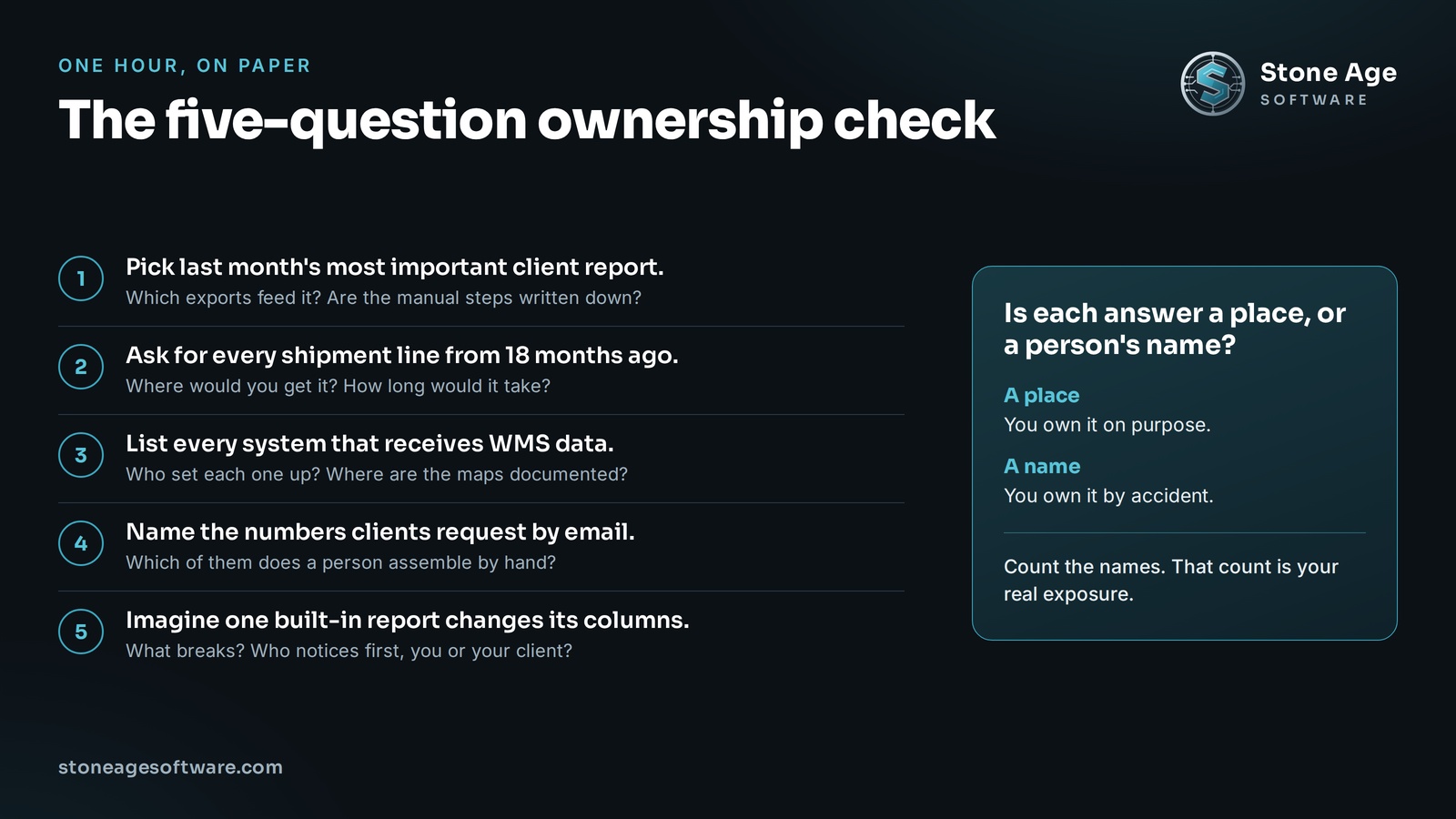
- Pick last month's most important client report. Which exports feed it? Which manual steps? Are those steps written down anywhere?
- Ask for every shipment line from 18 months ago. Where would you get it? How long would it take?
- List every system that receives WMS data. Include your invoicing/accounting integration, EDI, client portals, and carrier tools. Who set each one up? Where are the maps and credentials documented?
- Name the numbers clients request by email. Which of them does a person assemble by hand?
- Imagine one built-in report changes its columns. What breaks? Who notices first, you or your client?
Now score it. Look at each answer and ask one thing. Is the answer a place, or a person's name?
A place means you own it on purpose. A name means you own it by accident. Count the names. That count is your real exposure, and it was the same number on August 31.
If the count is zero, you are in better shape than most. If it is higher, start with the one report that would hurt most to lose. One report, one scheduled extract, one database you control. That is a small, bounded project, the kind we scope at a fixed price, quoted up front.
That is the work our 3PL reporting layer does. The WMS stays where it is. We read from it, land the data in a database you own, and build the reports there. Whoever owns the platform next year, the layer on top stays yours.