A customer emails on a Tuesday. They want pallet storage billed by lot, plus an order-status feed their own system can read. Your warehouse platform does neither out of the box. So somebody builds a spreadsheet, and the spreadsheet becomes part of the operation.
That is usually the week a 3PL owner types "3PL software development services" into a search bar. The results are hard to sort. Product pages, staffing firms, and consultancies all use the same phrase.
This is a plain guide to what those services are. It covers what they include, how consulting differs from development, and who owns the result.
Why the question is louder this fall
The Annual Third-Party Logistics Study gets its yearly unveiling at CSCMP EDGE in Nashville this week, October 4 to 7. Its last edition carried two numbers every warehouse owner should read twice. In it, 74% of shippers said they would switch 3PL providers based on AI capabilities. Half said they were consolidating the number of 3PLs they use.
Read that the way a shipper would. Fewer providers will hold more of the business. Technology is one of the ways they will choose.
The researchers also said what this year's edition would dig into. Their list of barriers opens with data quality and availability. Legacy system integration comes next. Those are not shortcomings of the people on your floor. They are seams between systems that were never built to share.
The service list is growing too. Logistics Management reported on October 1 that 3PLs are being pulled deeper into last-mile delivery and returns. Nearly 20% of e-commerce orders come back each year, the article notes. Every new service means new screens, new feeds, and new billing rules. Your platform ships with some of them. The rest land on your team.
"3PL software" means two different things
Search "3PL software" and most results are products. A warehouse management system. A transportation system. A billing module. You license them, and every customer of that product gets the same features.
That is the rented layer. It is good at the work every warehouse shares: receiving, putaway, picking, and shipping.
The second meaning is the layer around the platform. It holds everything specific to your operation:
- The report one customer wants every morning at six
- The billing rule that exists in one contract only
- The portal that shows a shipper their own stock and nobody else's
- The feed that connects your platform to a system it has never met
That is the owned layer. Nobody sells it in a box, because it differs in every building. This is the layer development services exist to build.
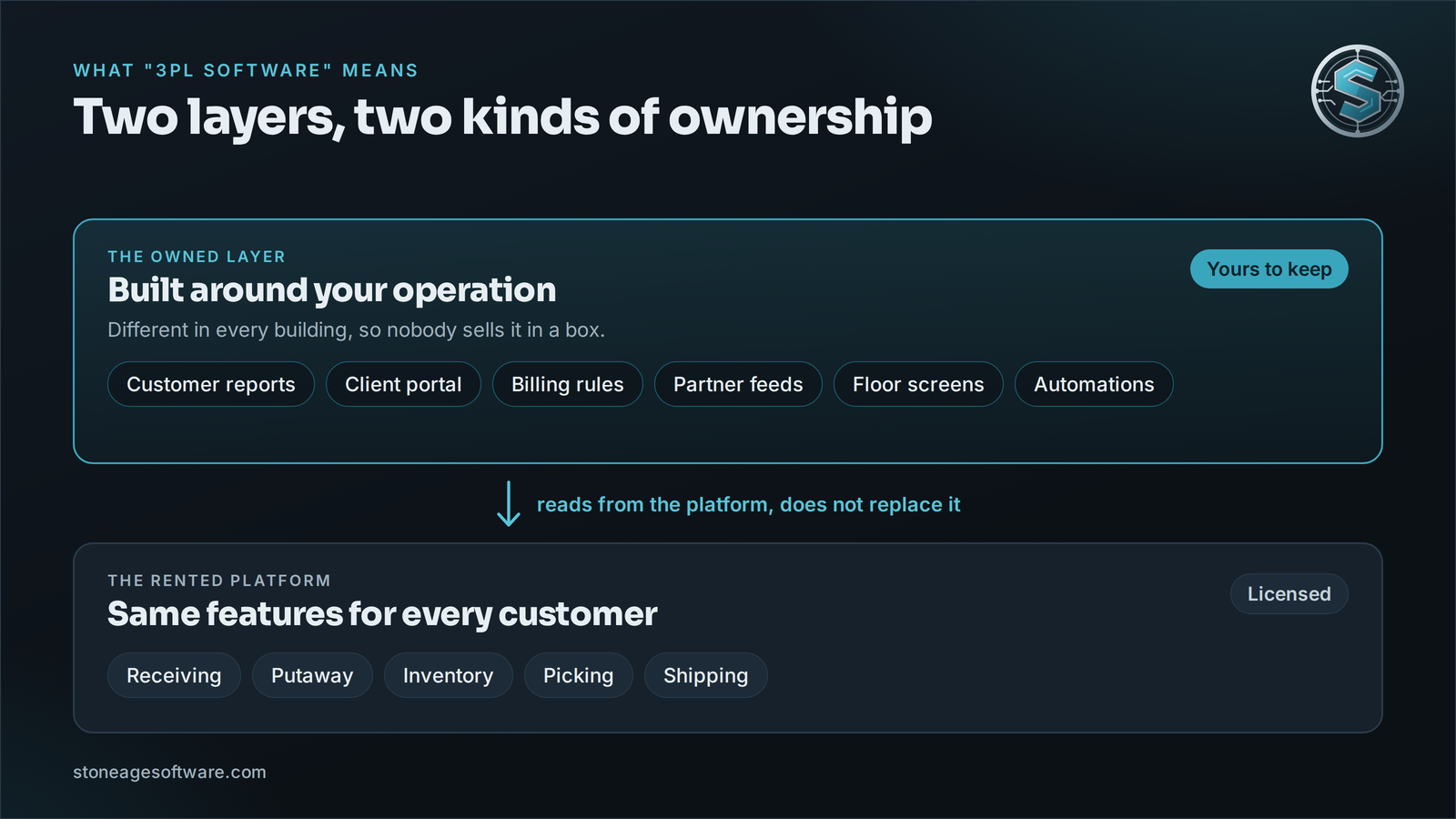
The two layers are not rivals. A good owned layer reads from the platform you already run. It does not replace it. A missing report is rarely a reason to change your whole system.
What 3PL software development services include
Strip away the sales language and the work falls into a short list.
- Reporting layers. Your data comes out of the platform on a schedule. It gets shaped into numbers a customer or manager can use. That is the idea behind a 3PL reporting layer.
- Customer portals. Inventory, order status, and documents sit behind a login, separated by client.
- EDI and API connectors. Trading-partner feeds get mapped to your platform's fields. The X12 940 and 945 warehouse transaction sets are the common pair.
- Billing and rating engines. Storage, handling, and accessorial charges are calculated from activity. Invoicing/accounting integration sits at the far end.
- Scanner and floor workflows. Receiving, counting, and exception screens are built for gloves and dead spots.
- Carrier connections. Rating, labels, and tracking get written back to the order.
- Automation of manual routines. This is the recurring job that lives in one person's morning.
A real engagement often starts with one item and grows. One of our projects began as a way to retire a few workbooks. It became one application that replaced a decade of spreadsheets, with more than fifty operational screens. It kept growing because each new piece cost about the same effort as the one before.
Notice what is not on the list. Nothing replaces the warehouse platform. Nothing replaces the people either. Software takes the re-keying and the lookups. People keep the judgment calls and the exceptions, which is where their experience counts.
3PL software consulting services or development: which do you need?
These two get sold together and confused often. The difference is what you hold at the end.
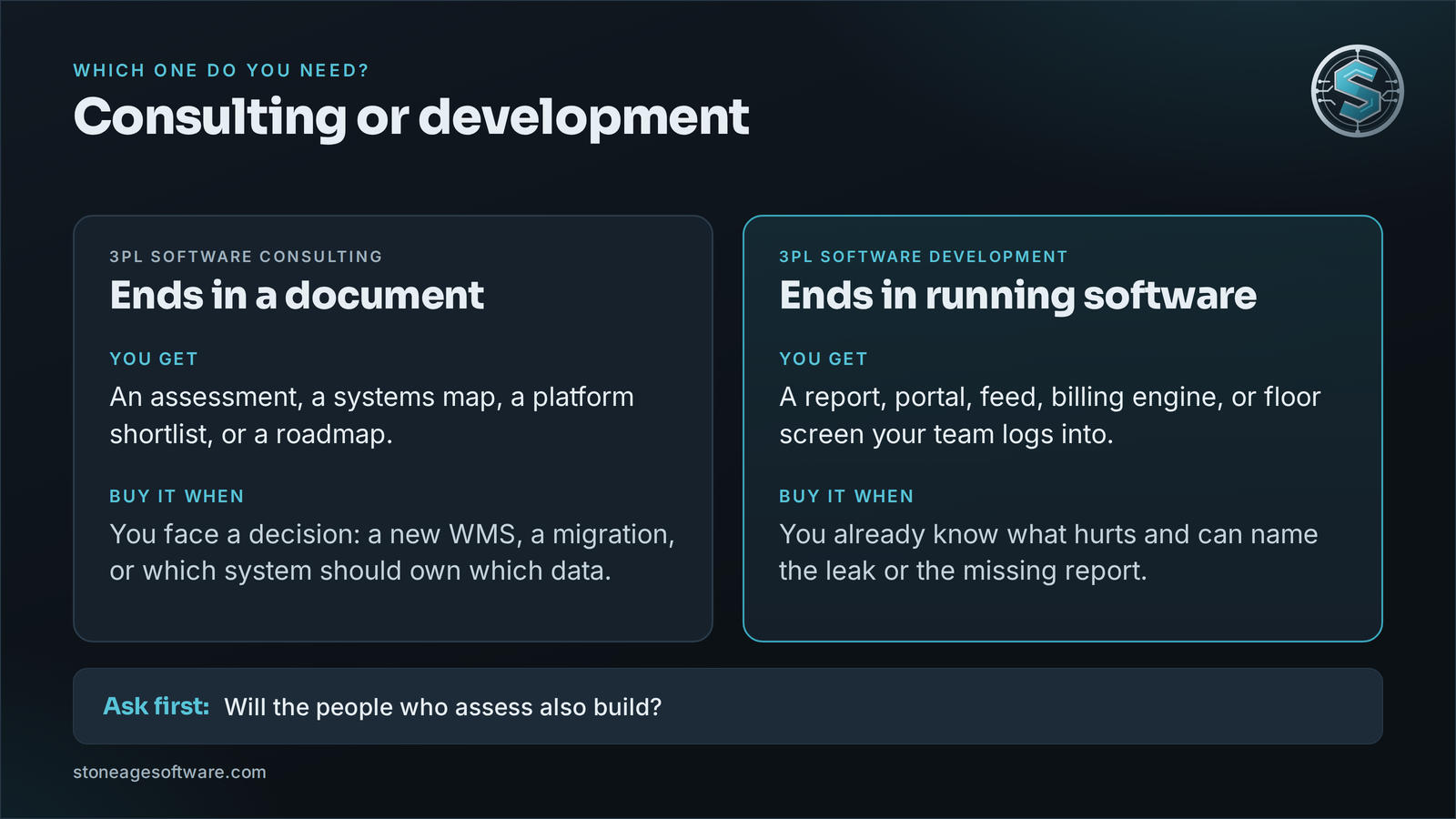
Consulting ends in a document. You get an assessment, a map of your systems, a platform shortlist, or a roadmap. It is the right purchase when you face a decision. Choosing a new WMS is one. Planning a migration is another. So is deciding which system should own which data.
Development ends in running software. You get a tool your team logs into on a normal shift. It is the right purchase when you already know what hurts.
Many operations already know. The billing clerk can name the leak. The customer service lead can name the report. In that case a long study adds delay, not knowledge.
There is one structural risk worth knowing. When one firm writes the recommendation and another builds it, detail falls out at the handoff. The spec says "billing report." It does not say one customer disputes anything rounded to the pallet. That is a gap in the process, not in anyone's effort.
So ask a simple question. Will the people who assess also build? If not, ask how floor detail survives the trip.
Who owns the code when the project ends?
Buyers often skip this question. It matters more than any feature.
Paying for software does not by itself make you its copyright owner. The U.S. Copyright Office explains the rule in Circular 30, Works Made for Hire. Work by your own employee, done as part of the job, belongs to you. Commissioned work from an outside firm is different. It counts as "made for hire" only in nine named categories, and only with a signed written agreement. Custom warehouse software is not named on that list.
So ownership usually has to move by a written assignment in the contract. That is a clause, not an assumption. Have your attorney read it before you sign.
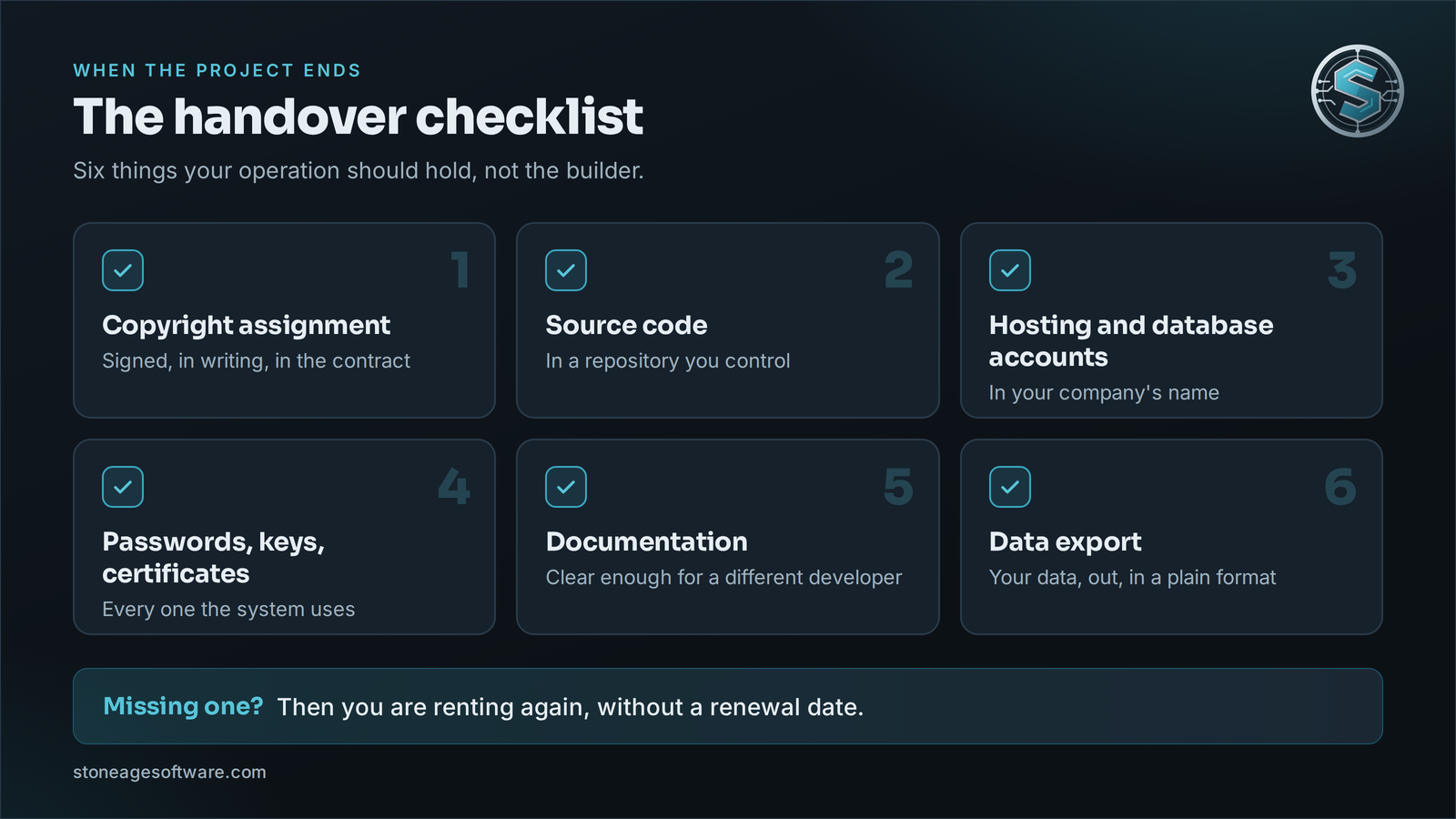
Ownership on paper is half of it. The other half is possession. At handover you should hold six things:
- The copyright assignment, in writing
- The source code, in a repository you control
- The hosting and database accounts, in your company's name
- Every password, key, and certificate the system uses
- Documentation a different developer could follow
- A way to export your data in a plain format
If any item is missing, you are renting again. You just do not have a renewal date.
How a sound engagement gets scoped
Good scoping protects the operation first. Look for these signs.
- The first project is small. Think weeks, not quarters. One report, one feed, or one screen.
- The quote is fixed price, quoted up front. You know the number before work starts.
- It reads before it writes. The first version pulls from your platform and changes nothing inside it.
- Releases can be undone. Each step ships alone and can be rolled back alone.
- Peak is respected. Risky changes freeze before your busy season.
- Training fits a shift. A new hire should learn the screen in an afternoon. If not, the screen needs work.
None of this requires an IT department. It requires a builder who has stood on a dock.
Run the spreadsheet census
Here is a check you can run this week with a notepad.
For five working days, write down every spreadsheet someone opens to do one of three things:
- Answer a customer's question
- Build or check an invoice
- Decide what the floor does next
For each file, note four facts. Who owns it. Where its data comes from. How often it gets opened. What happens when its owner takes a week off.
At the end, sort the list by how often each file is opened. The top line is your first project. It marks the spot where your platform stops and your people start carrying the load by hand. Nobody failed there. The software simply ends at that spot.
If the census turns up more files than you expected, that is normal. Our 3PL and warehouse software practice starts from exactly that list and builds the first piece small.