
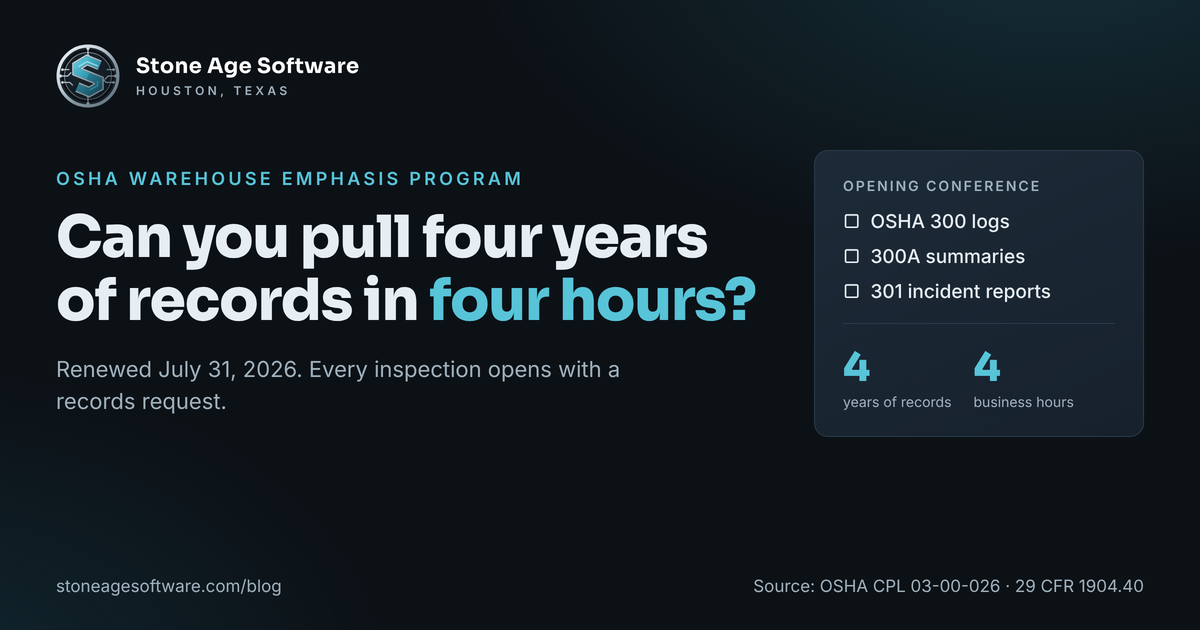
An OSHA compliance officer walks into your front office on a Tuesday morning. Nobody filed a complaint. Before anyone walks the floor, the opening conference starts with a records request. Under the renewed OSHA warehouse emphasis program, that request covers the current year plus the three before it.
Most 3PLs have every one of those records. The trouble is where they live. The injury log sits in a spreadsheet. Forklift certifications sit in a binder. Pre-shift truck checks sit on clipboards at the charging station. Nobody did anything wrong. The records simply never had one home.
This article covers what changed on July 31, what the officer asks for first, and how to time your own retrieval.
What changed in the OSHA warehouse emphasis program
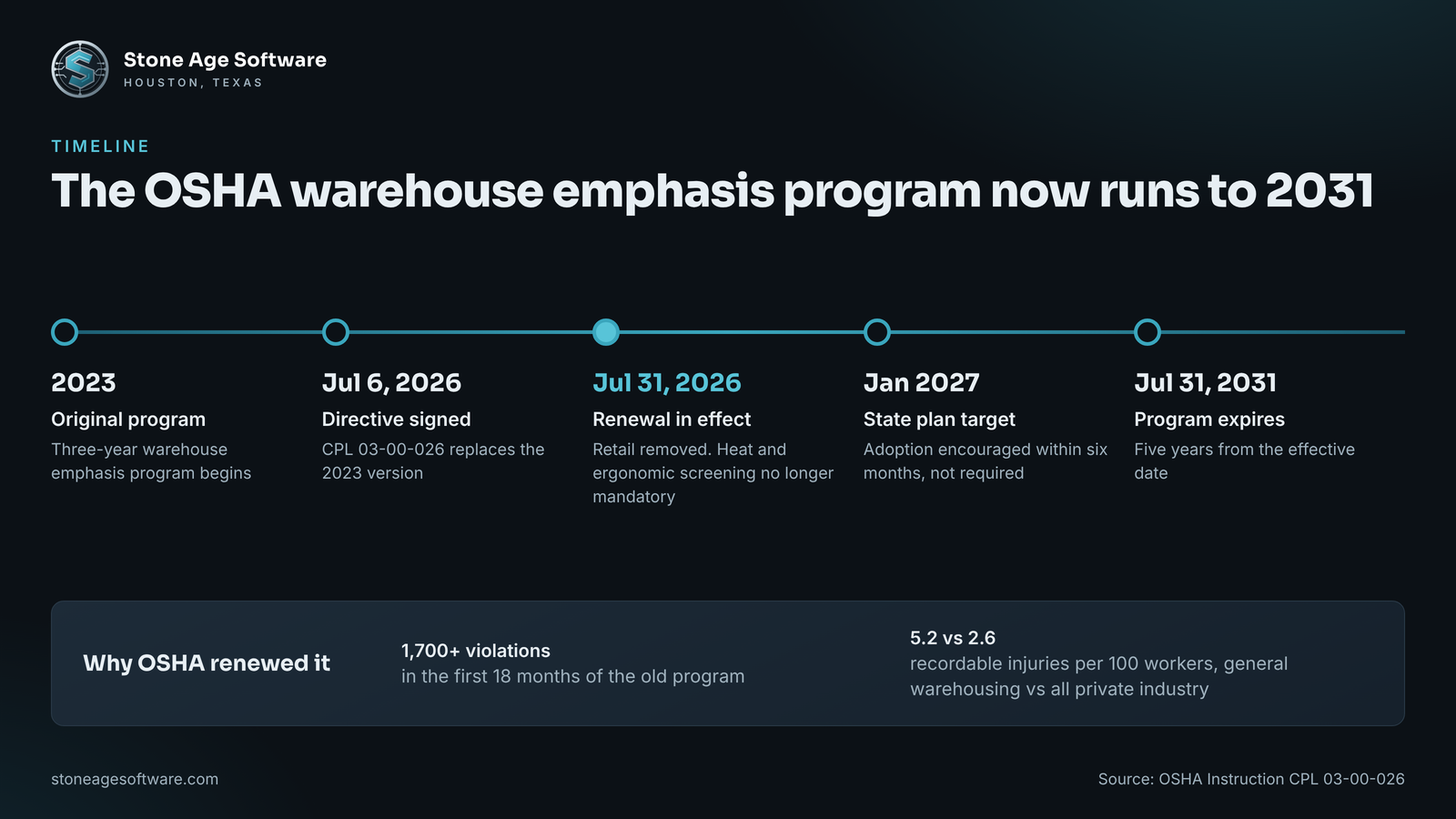
OSHA signed the revised directive on July 6, 2026. It took effect on July 31. The document is CPL 03-00-026, the National Emphasis Program on Warehousing and Distribution Center Operations. It replaces the 2023 version and expires five years from its effective date. That puts the end at July 31, 2031.
Four changes matter to a warehouse operator:
- A longer run. The 2023 program lasted three years. This one lasts five.
- Retail is out. High injury rate retail establishments were removed. The program now points at warehousing, parcel, and delivery.
- Heat and ergonomic screening is no longer mandatory. Both remain on the list of focus hazards. An officer can still pursue them when the records or the floor point that way.
- Expansion is discretionary. An area office "may" expand a complaint or referral inspection into a full one.
Seven industry codes are covered. Four are warehousing codes:
- 493110, general warehousing and storage
- 493120, refrigerated warehousing and storage
- 493130, farm product warehousing and storage
- 493190, other warehousing and storage
The other three cover postal processing centers, couriers, and local delivery.
OSHA gave its reasons in the directive. The first 18 months of the old program produced more than 1,700 violations. General warehousing averaged 5.2 recordable injuries per 100 workers over five years. All private industry averaged 2.6. Warehousing employment roughly doubled between December 2015 and December 2025. The ASSP summary for safety professionals walks through the same figures.
How a warehouse lands on the inspection list
These are programmed inspections. No complaint is required.
OSHA builds a master list for each area office from the covered industry codes. Software assigns every establishment a random number. The office then works the list in that order.
An establishment drops off the list in a few cases. One is a comprehensive inspection on these same hazards within the previous three years. Another is a site that has closed.
Three details are worth knowing:
- Every inspection is comprehensive. The directive says so in its first paragraph. The officer is not limited to one hazard.
- The officer verifies the site. That includes the industry code and the total number of employees.
- State plans decide for themselves. They are strongly encouraged, but not required, to adopt the update. The directive asks for adoption within six months. That lands at the end of January 2027.
Texas is a federal OSHA state, so the program applies here directly. If you run buildings in several states, check each one. The Fisher Phillips analysis of the renewal recommends confirming coverage facility by facility. A company's primary industry code does not settle it.
What the officer asks for first
Section XII.B of the directive is specific. At the opening conference, the officer reviews three things:
- OSHA 300 logs
- OSHA 300A annual summaries
- OSHA 301 incident reports
The window is the current year and the previous three calendar years. The stated purpose is to find recorded injuries tied to the program's hazards.
The clock comes from a different rule. Under 29 CFR 1904.40, you must provide copies within four business hours of the request. The same part requires you to keep those records for five years.
So the log works as a map. A forklift strike recorded in 2024 sends the officer to your forklift records. The powered industrial truck standard, 29 CFR 1910.178, sets what those should show:
- A certification for each operator. It names the operator, the training date, the evaluation date, and who did the training or evaluation.
- An evaluation of each operator's performance at least once every three years.
- An examination of each truck before it goes into service. That means daily, or after each shift in a round-the-clock operation.
The standard does not say the daily examination must be written. Without a record, though, the only proof is someone's memory. Most operations keep a checklist for exactly that reason.
Where the records actually live
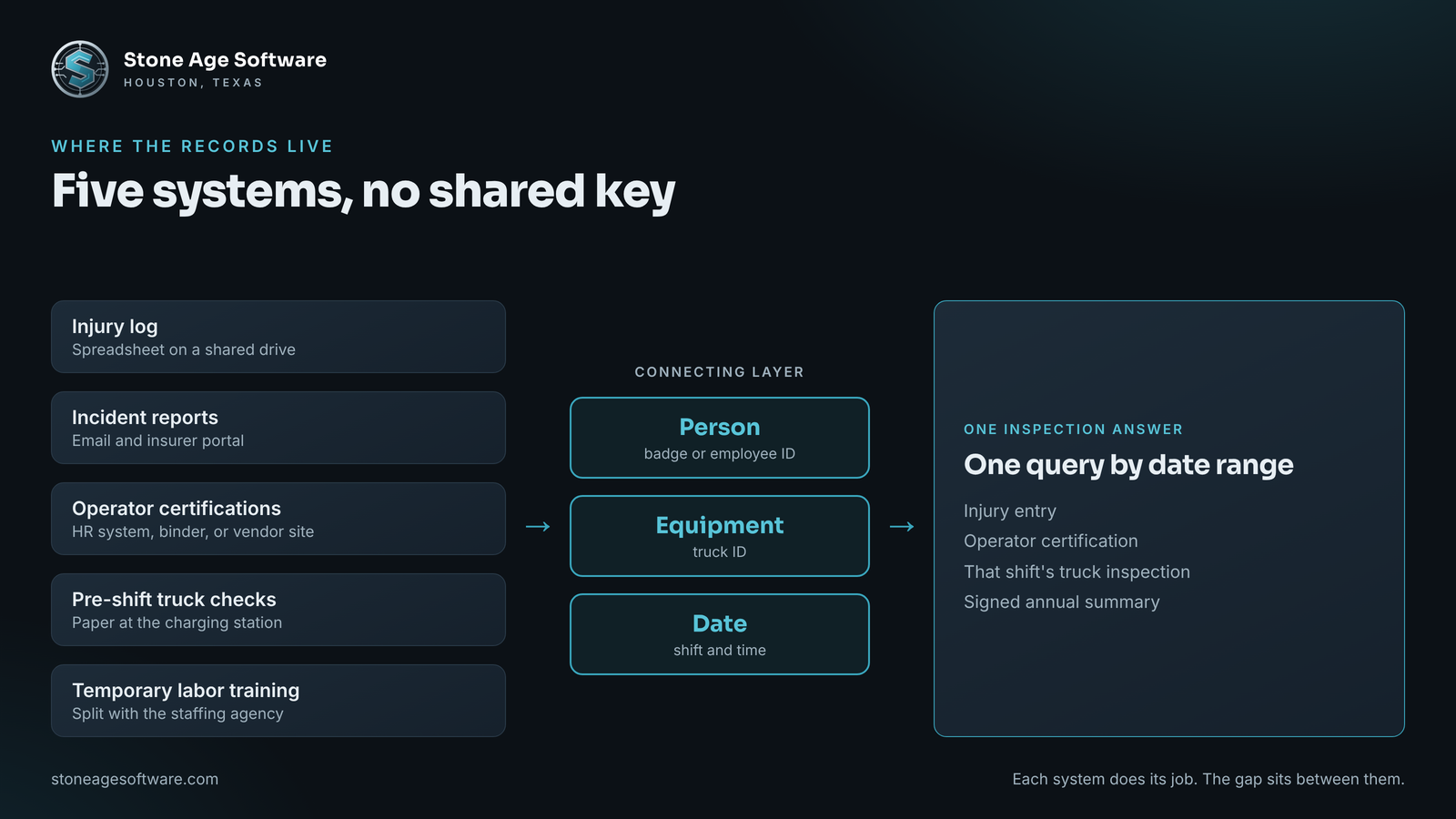
Walk through a typical building and the records spread out fast:
- Injury log. A spreadsheet on a shared drive, kept current by one person.
- Incident reports. Scanned forms in email or in an insurer's portal.
- Operator certifications. An HR system, a binder, or a training vendor's website.
- Pre-shift truck checks. Paper at the charging station, boxed up each month.
- Temporary labor. The staffing agency holds some training records. The host site holds others.
- Rack and dock inspections. Maintenance work orders.
- Equipment identity. The fleet list says truck 14. The paper checklist says "the reach truck by door 6."
None of this is a people problem. Each system does the job it was built for. Your WMS was built to move inventory, not to hold an evaluation date. The gaps sit between the systems. There is no shared key for person, equipment, and date.
Here is what tends to break under a four-hour clock:
- The log row has a name. The certification binder is filed by hire year.
- A temporary worker's badge number is not in the HR system.
- The checklist from that shift is in a box at offsite storage.
- The one person who knows the spreadsheet is on vacation.
Every item on that list is a seam. No one caused it. It grew as the building grew.
What a connected record looks like
Closing the seam does not mean replacing anything. It means a thin layer on top of what you run today. That layer ties three keys together: person, equipment, and date.
In practice it works like this:
- A badge scan starts the truck check-out. That ties operator to truck to shift.
- The system reads the operator's evaluation date before it releases the truck.
- The pre-use inspection happens on a screen at the kiosk. The truck type decides which points apply.
- A failed point locks the truck out of the pool until a supervisor clears it.
- An injury entry links to the operator's certification and that shift's inspection.
- One query by date range returns the whole chain.
We built this pattern for a contract-logistics site. You can read the case study on equipment check-out that locks a truck out when it fails inspection. It enforces 28 inspection points. A nightly sweep reconciles anything still checked out.
The software handles the gate and the filing. People keep the judgment calls. Is this truck safe to return to service? Does this operator need retraining? What does a pattern in the log mean? Supervisors spend their time on those questions, not on chasing clipboards.
If this sounds familiar, it should. We covered a similar records clock in our piece on the warehouse quota law and work speed data. The agency is different. The seam is the same.
You own what gets built. It sits on your servers or your cloud account, with the source code. The work is fixed price, quoted up front.
Run the four-hour drill yourself
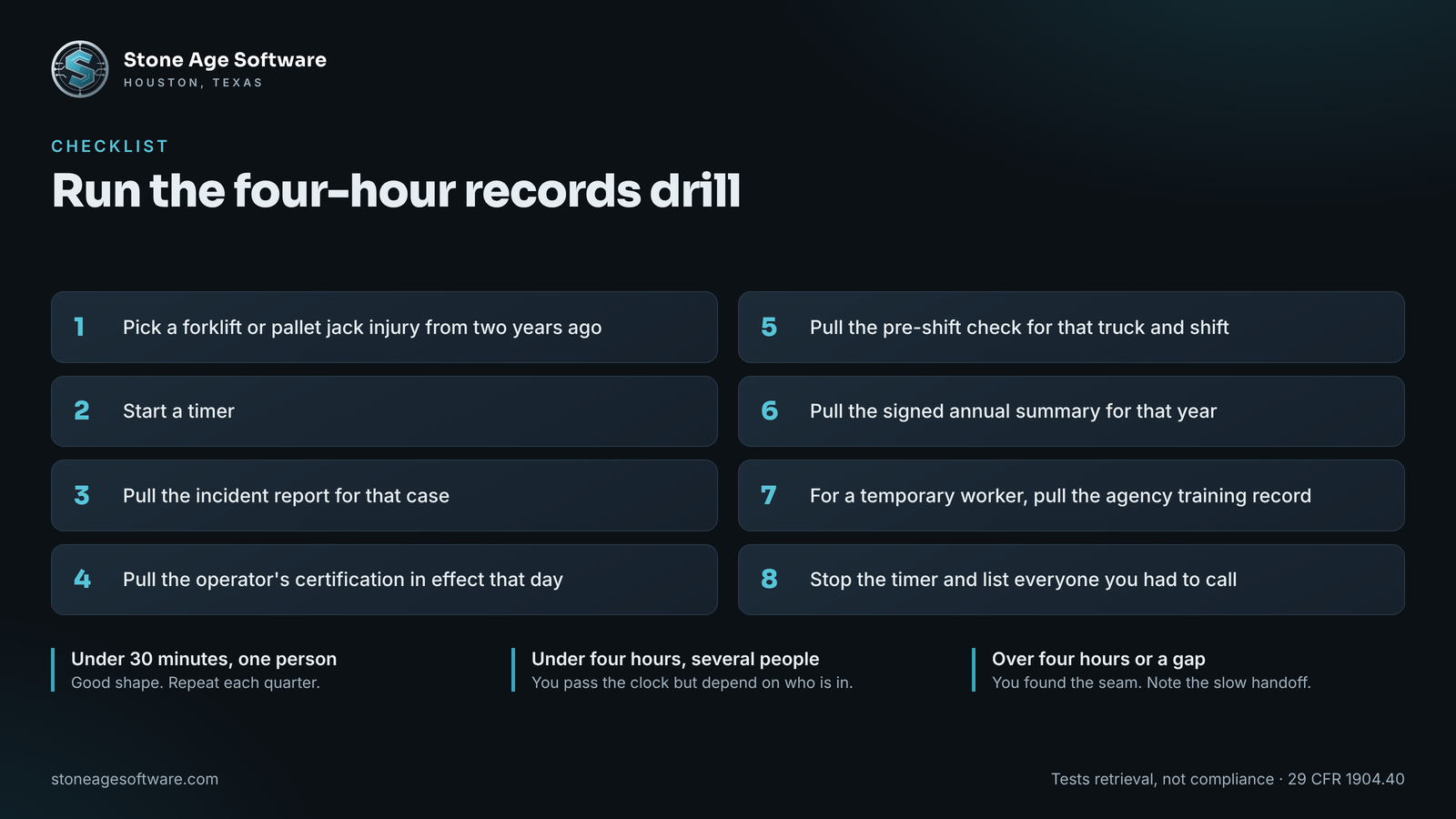
You can test this in one afternoon. It needs no new software and no consultant.
- Pick one recordable injury from two years ago. Choose one that involved a forklift or pallet jack.
- Start a timer.
- Pull the incident report for that case.
- Pull the operator's certification that was in effect on that date. Check for the training date, evaluation date, and evaluator name.
- Pull the pre-shift check for that truck on that shift.
- Pull the signed annual summary for that year.
- If the operator was a temporary worker, pull the agency's training record.
- Stop the timer. Write down every person you had to call.
Then read the result plainly:
- Under 30 minutes, one person. Your records are in good shape. Run the drill again each quarter.
- Under four hours, several people. You would pass the clock. You also depend on those people being in the building.
- Over four hours, or a missing piece. You found the seam. Note which handoff was slow.
That last note is the useful part. It tells you exactly which two systems need to talk. It is also a much smaller project than it feels like on inspection day.
One caution. This drill tests retrieval, not compliance. Whether your program meets the standard is a question for your safety lead or counsel. What software can do is make sure the proof is there when they need it.
If the drill turned up a slow handoff, that is the kind of work we do. Our custom software and web development practice builds the connecting layer on top of the systems you already run, and you own it outright.