
A picker on your second shift gets written up for missing rate. Two days later a written request lands on your desk. She wants the rate she was held to, in writing. She wants her own numbers for the last 90 days. She wants to know how the people beside her did.
In seven states that request now starts a clock. A warehouse quota law gives the worker a right to those records. It gives the employer a short window to hand them over. Rhode Island is the newest. Its Warehouse Worker Protection Act takes effect January 1, 2027.
Most 3PLs can answer the request eventually. The numbers exist. The trouble is that they exist in four places, and no screen joins them. This article covers what the laws ask for, where the data really sits, and how to test your own building this week.
One note first. This is an operator's read of the records problem, not legal advice. Your employment counsel decides what applies to you.
What a warehouse quota law actually requires
The laws share a template. California wrote it in 2021, and MH&L covered the California quota law when it passed. Other states adapted it. Rhode Island's governor signed the Warehouse Worker Protection Act in July. His office counted it as the seventh state. The others it lists are California, Minnesota, New York, Oregon, Washington, and Connecticut.
The Rhode Island bill text, H 7364 Substitute A, is short and worth reading. It does four things:
- Written quotas. Each worker gets a written description of every quota at hire. It names the tasks or volume, the time period, and what happens on a miss.
- Notice of changes. A new or changed quota must be disclosed in writing at least two days ahead. No discipline can follow from it until two days after disclosure.
- Protected time. A quota cannot crowd out meal breaks, rest breaks, or bathroom trips. Travel time to the restroom counts.
- Records on request. A worker can ask for the written quota and their own work speed data. They can also ask for aggregated data on comparable workers in the building.
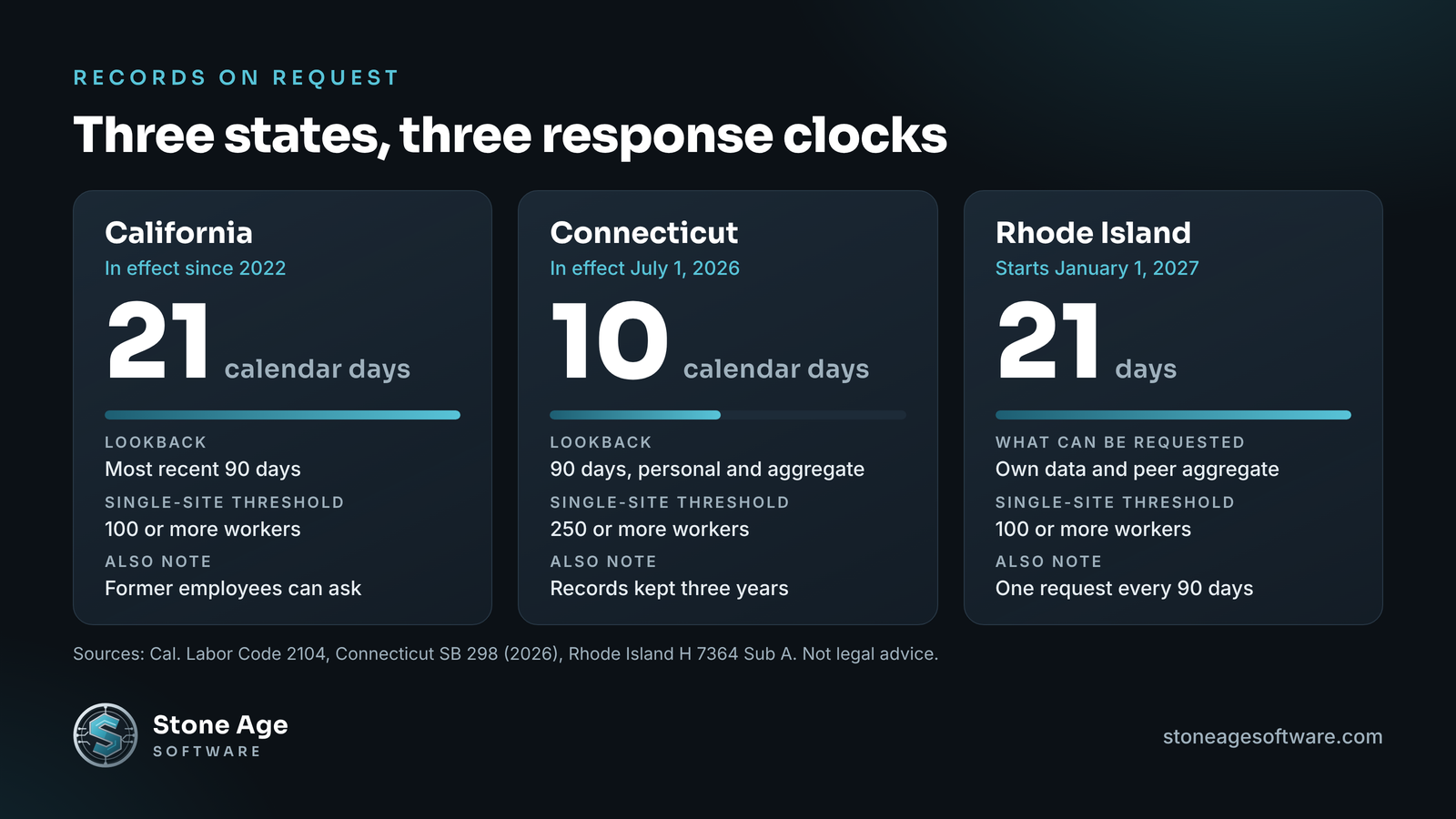
The employer has 21 days to answer the data request. A worker can ask once every 90 days. The limit lifts when discipline is pending or a review is underway.
The other states vary the numbers, not the idea. California Labor Code section 2104 gives 21 calendar days and covers the most recent 90 days. Former employees can ask too.
Connecticut's law took effect July 1, 2026, and it is tighter. Per Ogletree's summary of the Connecticut act, the response is due within ten calendar days. Records must be kept three years. The copy must be in English and the worker's primary language.
Who is covered, and why a Texas 3PL should still care
Coverage runs on headcount. Rhode Island and California cover an employer with 100 or more workers at one warehouse. They also cover 1,000 or more across the state. Connecticut sets the single-site line at 250.
Two details catch 3PLs off guard.
First, the count includes people you direct but do not payroll. The Rhode Island text reaches anyone who "directly or indirectly" controls wages, hours, or working conditions. It names temporary services and staffing agencies. Picture a building with 60 employees and 50 agency workers at peak. It is closer to the line than it looks.
Second, the definition follows the industry code, not the sign on the door. Rhode Island lists general warehousing and storage, merchant wholesalers, and mail-order houses. That describes most contract warehouses.
Texas has no law like this today. So why read on from Houston? Three reasons:
- You may run, or plan to run, a building in a covered state.
- Large customers write standards like these into contracts and audits, whatever the state.
- The record these laws describe is the same record you need in any dispute about rates.
That third point matters most. A rate you cannot show in writing is hard to defend, in any state.
Where work speed data actually lives
The statutes define work speed data broadly. Rhode Island's version covers information an employer "collects, stores, analyzes, or interprets" about a worker's quota performance. Think task counts, rates, and time on or off task.
Here is the catch. The laws do not force you to monitor anyone. If you collect nothing, you owe nothing. But nearly every warehouse system collects it by default. Every scan carries a user, a task, and a timestamp. Once a supervisor uses those numbers to coach or discipline, you hold work speed data.
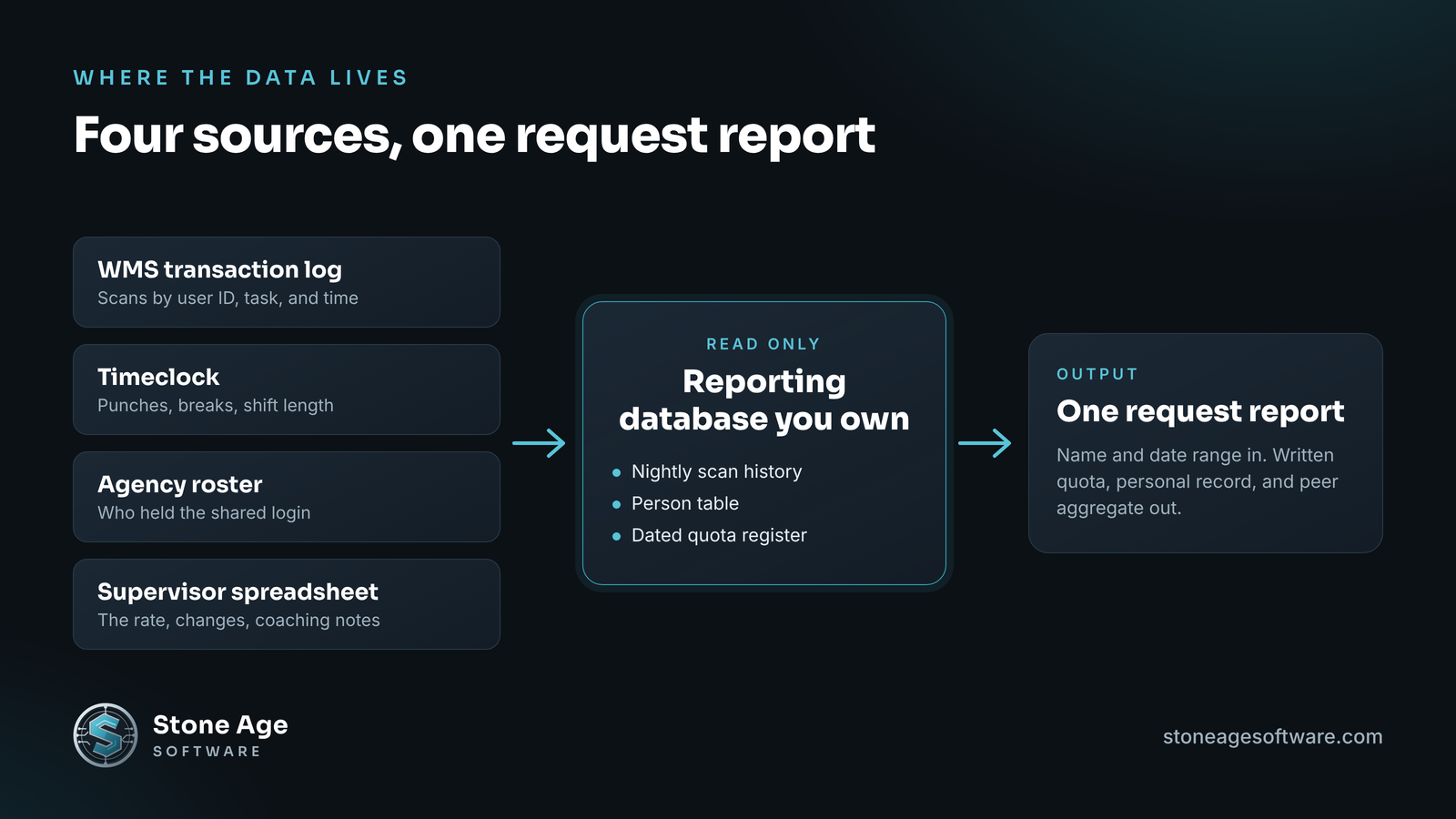
In a typical 3PL it sits in four places:
- The WMS transaction log. Picks, putaways, and counts by user ID and time. This is the raw record.
- The timeclock. Punches, breaks, and shift lengths. Without it, a rate has no denominator.
- The staffing agency's roster. It says who actually held the scanner logged in as TEMP04.
- A supervisor's spreadsheet. The rate itself, the adjustments, and the notes on who got coached.
None of these is wrong. Each does its own job well. The gap is the seam between them. No single system was built to answer one question. Show me this person's 90 days, and the group's.
The four seams that break the 21-day answer
When we map this for an operator, the same seams show up.
Shared logins. Scanners get handed off mid-shift. Agency workers share generic IDs. The WMS records the scan faithfully, under the wrong name. The fix is a login practice plus a roster join, not a new system.
Quotas with no version history. The rate changed in March. Which rate applied on the day of the write-up? Often the only copy lives in a spreadsheet cell that was overwritten. Then nobody can say. The law asks for the written quota and its effective date. That needs a dated record.
History that ages out. Many systems archive or purge transaction detail to stay fast. That is sound engineering for running the floor. It becomes a gap when Connecticut asks for three years. Check your retention before someone asks.
No definition of "comparable." The aggregate request needs a peer group. Same job function? Same shift? Same zone? Pick the rule once and write it down. Apply it the same way every time.
Notice what is not on this list. Nobody on your team did anything wrong. Your WMS is doing what it was built to do. The request simply asks a question that crosses system lines.
There is also a people point here. A supervisor should spend those 21 days on judgment. Was the rate fair that week? Was the slot layout the real cause? Was the worker pulled to another task? Those are human calls. Pulling three exports and matching names by hand is not.
What a request-ready record looks like
You do not need a labor management suite to answer these requests. You need a small reporting layer beside the WMS. It reads from the system. It never writes to it. It has four parts:
- A nightly copy of scan history. It lands in a database you own. You keep it as long as your strictest state requires.
- A person table. It maps every scanner login to a real person, a job function, and an employer of record.
- A quota register. It holds each rate, its task, its time period, and its effective date. It also holds the date each worker was told.
- One request report. It takes a name and a date range. It returns the personal record and the peer aggregate.
The same layer answers the fairness questions before a request ever arrives. You can see whether most of a shift meets a rate, or almost nobody does. You can see whether break time gets squeezed on heavy days. That is an operations finding first and a compliance record second.
We built something close to this for a contract-logistics site with quality reporting duties to its customer. The audit and compliance platform project replaced paper forms with records that show who did what, and when. The principle carries over. Evidence should be a by-product of the work, not a scramble after the fact. We made the same argument about traceability in our piece on FSMA 204 warehouse records.
Run the 90-day pull test this week
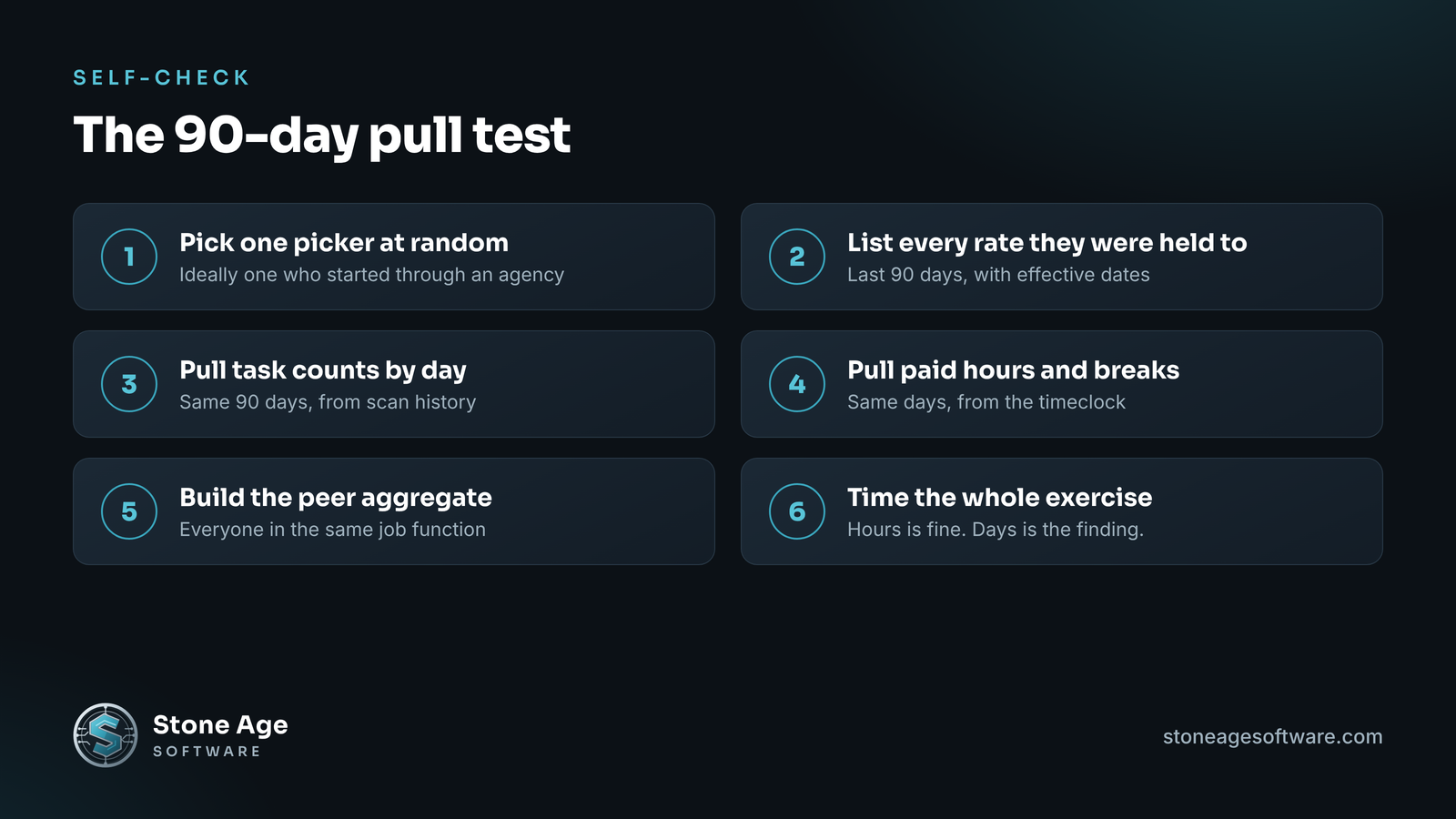
You can find out where you stand in one afternoon. Do not announce it. Just try it.
- Pick one picker at random, ideally one who started through an agency.
- Write down every rate that person was held to in the last 90 days, with dates.
- Pull that person's task counts by day for the same 90 days.
- Pull their paid hours and breaks for the same days.
- Build the same numbers for everyone in the same job function.
- Time the whole exercise, start to finish.
Then score it honestly:
- Did the rates come from a dated document, or from memory?
- Did any scans sit under a shared or generic login?
- Did the WMS still hold all 90 days of detail?
- Could a second person repeat your steps and get the same numbers?
- Did it take hours, or days?
If it took an afternoon and the numbers held, you are in good shape. Write the steps down and move on. If it took three days and two people, that is your answer. Ten calendar days is a short clock when the first three go to finding the data.
The laws are spreading one state at a time, and the request is the same in each. Building the record once beats rebuilding it for every request. If the pull test exposed a seam, that is what our 3PL reporting layer is for. We read from the WMS you already run and land the history in a database you own. Then we build the request report at a fixed price, quoted up front.