
An FDA investigator calls on a Tuesday afternoon. A leafy greens lot is tied to an outbreak. They want every receipt and every shipment of that lot from your building, in a sortable spreadsheet, within 24 hours. Your client is the brand. The pallets sat in your racks. Who builds the file?
That is the practical question behind FSMA 204 3PL warehouse records. The compliance date moved to July 20, 2028. The work did not get smaller. It only got a longer runway, and most of that runway is data work, not floor work.
This article covers what the rule asks of a warehouse that holds listed foods, what changed this year, and where the records usually break. It is not legal advice. Your food safety counsel decides how the rule applies to your accounts.
What changed in 2026, and what did not
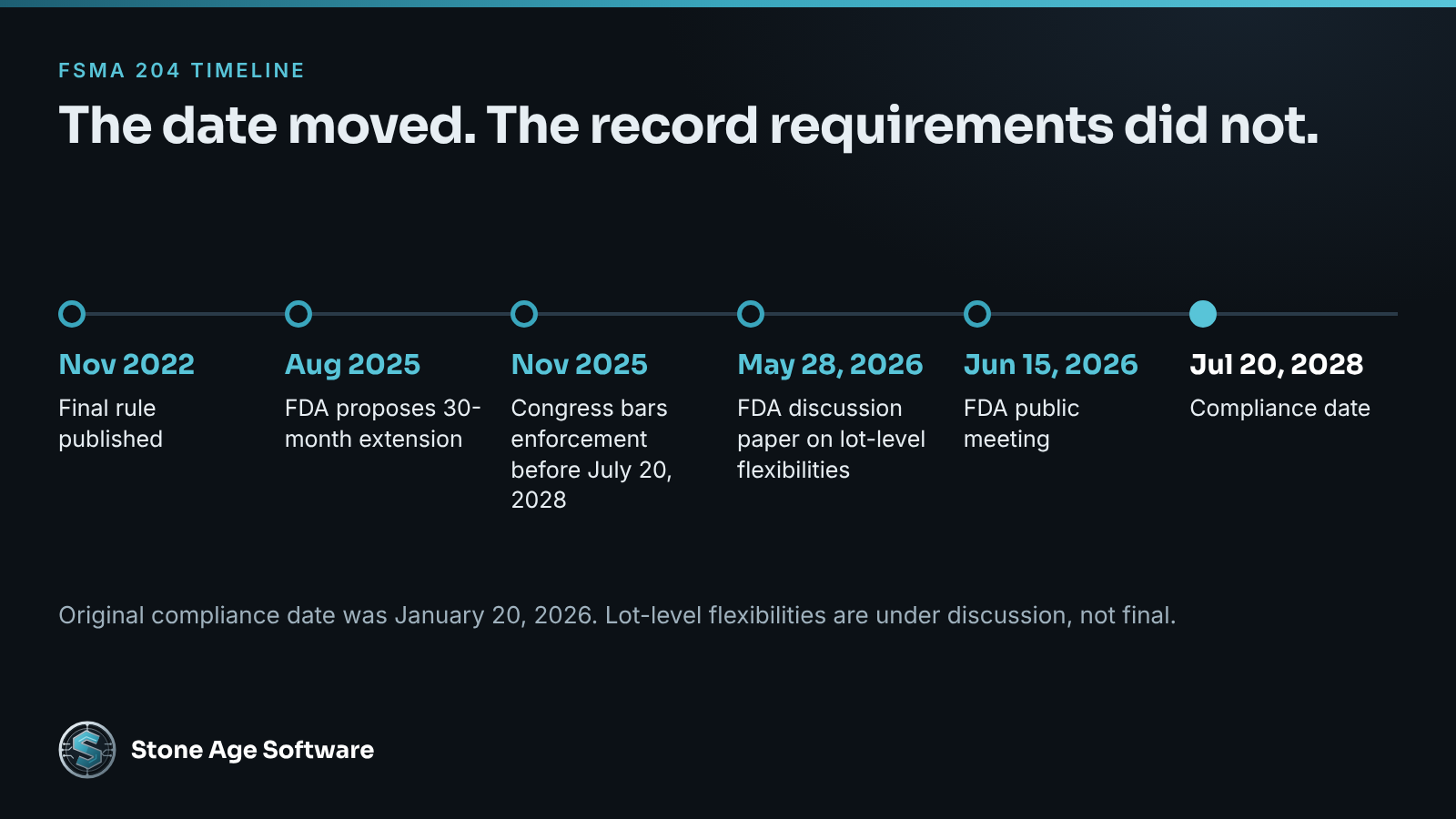
The Food Traceability Rule was finalized in November 2022. The original compliance date was January 20, 2026. That date is gone.
Here is the sequence that matters:
- August 2025: FDA proposed a 30-month extension.
- November 2025: Congress barred FDA from enforcing the rule before July 20, 2028.
- February 2026: FDA announced draft guidance and quarterly listening sessions.
- May 28, 2026: FDA released a discussion paper on lot-level tracking flexibilities.
- June 15, 2026: FDA held a public meeting on the same subject.
- July 15, 2026: the comment period on that paper closed.
FDA keeps the current dates on its Food Traceability Rule page. The Congressional Research Service lays out the directives from Congress in its overview of the rule. Congress told FDA to meet quarterly with affected groups, and it named warehouses that distribute to retail and restaurants.
The discussion paper is the part to watch. Trade coverage in Cheese Reporter lists the ideas on the table. They include lot code ranges for mixed pallets, inferred lot codes instead of case scans, and simpler records for returns and intracompany moves.
None of it is final. FDA said the paper is not an exhaustive list. So the core of the rule stands today as written. Plan against the text, and treat any relief as a bonus.
What FSMA 204 3PL warehouse records must contain
The rule covers people who manufacture, process, pack, or hold foods on the Food Traceability List. Holding means storage and the activities incidental to storage. That is the definition of a warehouse.
A storage and distribution building usually touches two critical tracking events: receiving and shipping. Each one has a set of key data elements. The text is in 21 CFR Part 1, Subpart S.
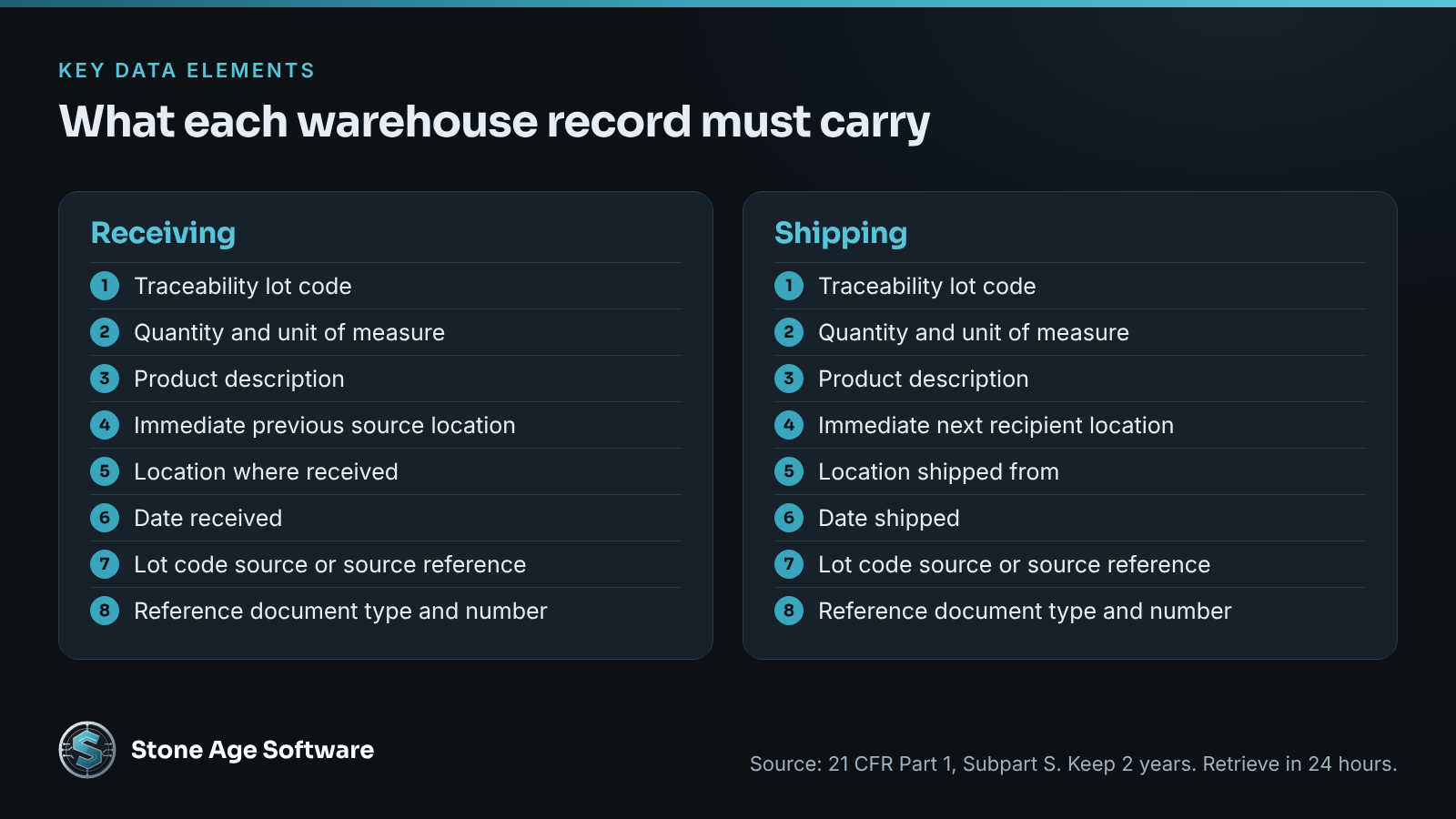
For every receipt of a listed food, the record carries:
- The traceability lot code.
- Quantity and unit of measure.
- Product description.
- The immediate previous source location.
- The location where you received it.
- The date received.
- The traceability lot code source, or a reference to it.
- The reference document type and number.
Shipping records mirror that list. The previous source becomes the immediate next recipient. The receive date becomes the ship date. The ship-from location is added.
Three other requirements shape the software side:
- Records are kept for 2 years.
- Records must be available within 24 hours of a request.
- In an outbreak or recall, FDA can ask for an electronic sortable spreadsheet.
One more line matters to every 3PL. The rule lets a covered business have another entity keep records on its behalf. The covered business stays responsible for retrieval within 24 hours. Your clients will read that sentence and send you a questionnaire. Many already have.
Where the records break
Most warehouse systems capture a lot number. That is not the gap. The gaps sit in the seams between systems, and they are structural. Nobody on your floor caused them.
The lot field holds the wrong lot. A WMS lot field was built for inventory rotation. It often carries a production date, a vendor batch, or a receiving tag. The traceability lot code is a specific value assigned upstream. If the inbound notice does not carry it, the field gets whatever is printed on the case.
The lot code source has no home. The rule wants the location that assigned the lot code, or a reference to it. Few item masters or receipt screens have a column for that. It arrives in an EDI segment or a PDF, and then it stops.
Mixed pallets blur the outbound. A pick pulls cases from two lots onto one pallet. The shipment record shows the order line and a quantity. Which lot went to which store is known only if the scan was captured at the case level. This is exactly why FDA is discussing lot ranges and inferred lots.
The reference document lives elsewhere. The bill of lading number is in the transportation system. The purchase order number is in the client's ERP. The receipt number is in the WMS. One traceability record needs them joined.
History ages out. Some hosted systems archive closed transactions on a schedule. Two years of retention is a longer window than many standard report screens reach.
The export is per screen, not per lot. You can export receipts. You can export shipments. A single file that follows one lot through both, sorted and labeled, is a join. Somebody builds that join by hand today.
Each of these is a missing column or a missing join. That is good news. Columns and joins are solvable without touching how the floor works.
Why the answer is a reporting layer
You do not need a new WMS to pass a 24-hour request. You need the data out of the one you run, in a place you can query.
The pattern is simple:
- Pull receipts, shipments, lot attributes, and document references on a schedule.
- Land them in a database you own.
- Add the fields the WMS has no room for, such as the lot code source.
- Join them into one traceability view per client.
- Add a lot search that returns a sortable spreadsheet.
The floor keeps scanning the way it does now. The reporting layer does the assembly. It also keeps history for as long as you decide, independent of the vendor's archive schedule.
The same layer flags the exceptions people should look at. A receipt of a listed item with a blank lot code. A shipment with a lot the building never received. A lot code source that does not match the supplier. Software surfaces those each morning. Your inventory lead decides what to do about them. That judgment is the part no system should take over.
Evidence matters as much as data. We built an audit and compliance platform for a contract logistics site with quality reporting obligations to its end customer. The lesson carried over. A record is only useful if you can show who captured it, when, and from what source.
What to ask your food clients now
The extension gives you time to sort out responsibilities before they become urgent. Three conversations are worth having this quarter.
Which SKUs are on the list? Clients know their products. Ask for a flagged item list. Then mark those items in your item master so reports can filter on them.
Who assigns and sends the lot code? Ask for the traceability lot code and its source on the advance ship notice. If the inbound EDI does not carry it, agree on where it will come from.
Who answers FDA? Put it in writing. Many brands will name the warehouse as record keeper. That is a billable service with a defined scope, and it is better to define it than to inherit it.
Clients are also getting pressure from their own customers. Large retailers and foodservice distributors set supplier deadlines of their own. Those dates do not move when the federal date moves.
Run a 24-hour trace drill this week
You can test your position without buying anything. Pick one food client and one lot that shipped at least 60 days ago. Start a timer.
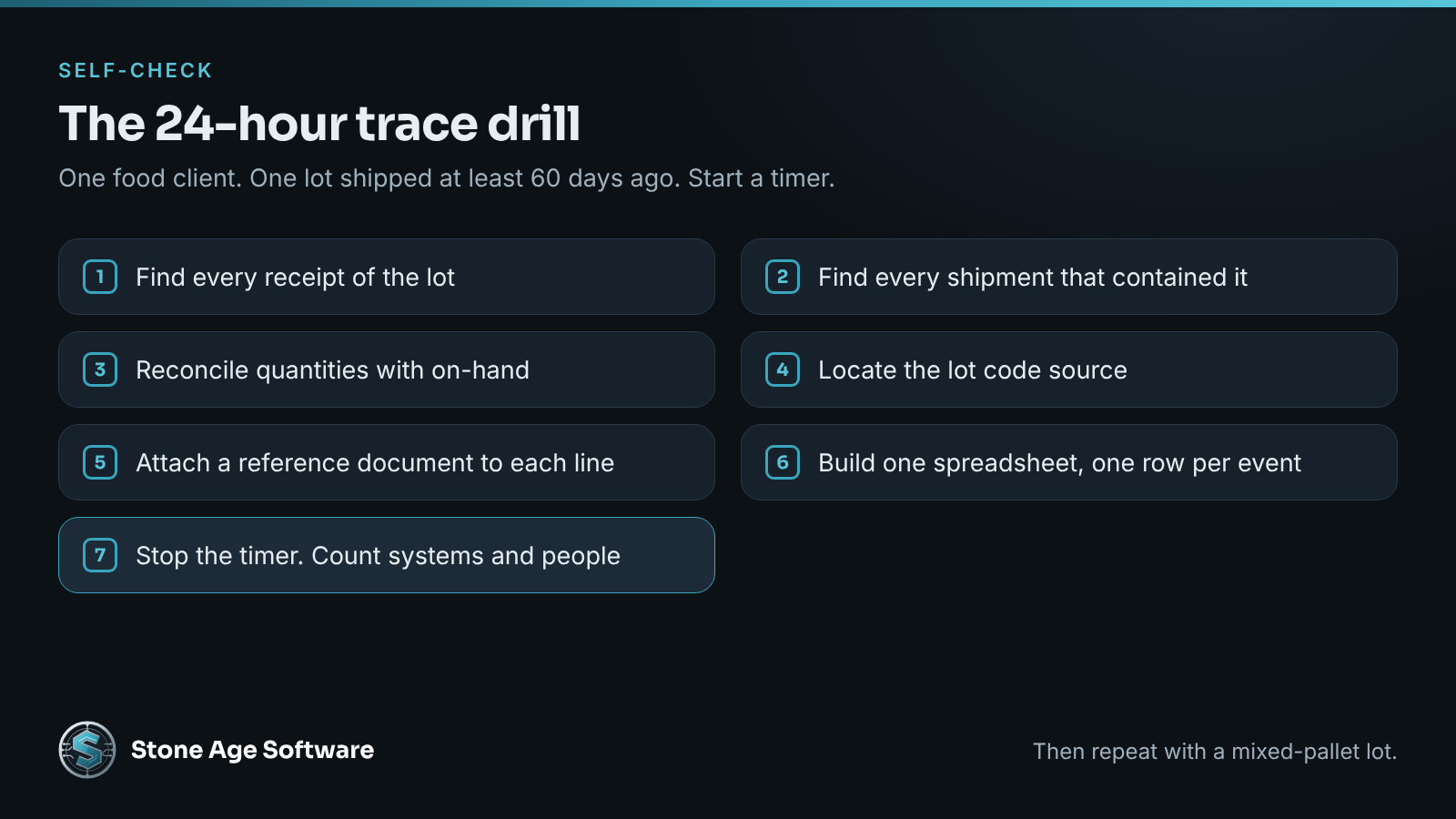
- Find every receipt of that lot. Note the date, quantity, and source location.
- Find every shipment that contained it. Note the date, quantity, and recipient.
- Confirm the quantities reconcile with what is still on hand.
- Locate the lot code source for that lot. Write down where you found it.
- Attach a reference document number to each line.
- Put it all in one spreadsheet with one row per event.
- Stop the timer. Count how many systems and people it took.
Then score it honestly. If one person finished in an hour from one screen, you are in good shape. If it took three exports, two phone calls, and an email to the client, you have found your seams. Write down each one. That list is your project scope.
Repeat the drill with a lot that went out on mixed pallets. That is the hard case, and it is the one a real request will pick.
Stone Age Software builds this kind of view on top of the WMS you already run. You own the database and the code. The work is fixed price, quoted up front. See how the 3PL reporting layer works, and bring your drill results to the first call.