
The truck left on time. Every carton was right. Six weeks later a deduction shows up anyway, coded as a ship notice defect. That is how EDI 856 ASN chargebacks usually arrive at a 3PL: late, small, and attached to a shipment nobody remembers.
October is when this gets expensive. Retail order volume climbs, wave sizes grow, and more freight leaves in the last hour of the shift. The notice has to keep up with the dock. Often it cannot, and the reason is rarely the people on the floor.
The reason is a seam. The warehouse system knows what was picked. The label printer knows what was labeled. The EDI translator knows what it was told. Those three things are supposed to match. Nothing in most stacks checks that they do.
What the 856 promises the retailer
The 856 is the Ship Notice/Manifest. It is one of the transaction sets published by X12, the body that maintains the EDI standard. In plain terms it tells the receiver what is on the truck before the truck arrives.
It does that in layers. A typical retail 856 nests like this:
- Shipment: carrier, bill of lading, ship date, ship-to location
- Order: the purchase order the freight belongs to
- Tare: each pallet, when pallets are used
- Pack: each carton, with its own serial number
- Item: the product, quantity, and unit of measure in that carton
The carton serial number is the Serial Shipping Container Code. GS1 US describes the SSCC as an 18-digit identifier that acts as a license plate for a logistics unit. The same number is printed on the carton label and sent in the 856.
That pairing is the whole point. The retailer scans the label at the dock door. Their system looks up the number in the notice. If it finds a match, the carton is received without anyone opening it. If it does not, someone has to stop and sort it out by hand.
So the notice is a promise with three parts. It will arrive before the freight. It will describe the freight exactly. And every label on the freight will point back to it.
Where EDI 856 ASN chargebacks actually come from
Retailers publish the ways that promise can break. Walmart's program is a useful example because the categories are public. A breakdown of ASN defects in the Supplier Quality Excellence Program lists five:
- No ASN label on the case
- ASN not downloaded
- No ASN received
- ASN error, meaning the data failed the retailer's validations
- Late ASN, meaning it was sent after the order arrived at the receiving DC
Other retailers word it differently. The shape is the same everywhere. Either the notice was missing, it was late, or it was wrong.
The bar has also moved over time. Supply Chain Dive reported Walmart tightening its on-time, in-full target to 87% back in 2019. Scorecards have only grown more detailed since. A defect that was tolerated five years ago is now a line item.
Notice what is not on that list. Nothing says the wrong product shipped. Nothing says the carton was damaged. These are data defects. The physical work can be perfect and the shipment still fails.
That matters for where you look. Retraining pickers will not fix a late notice. Neither will a stern email to the dock. The fault sits between systems.
The three seams behind most defects
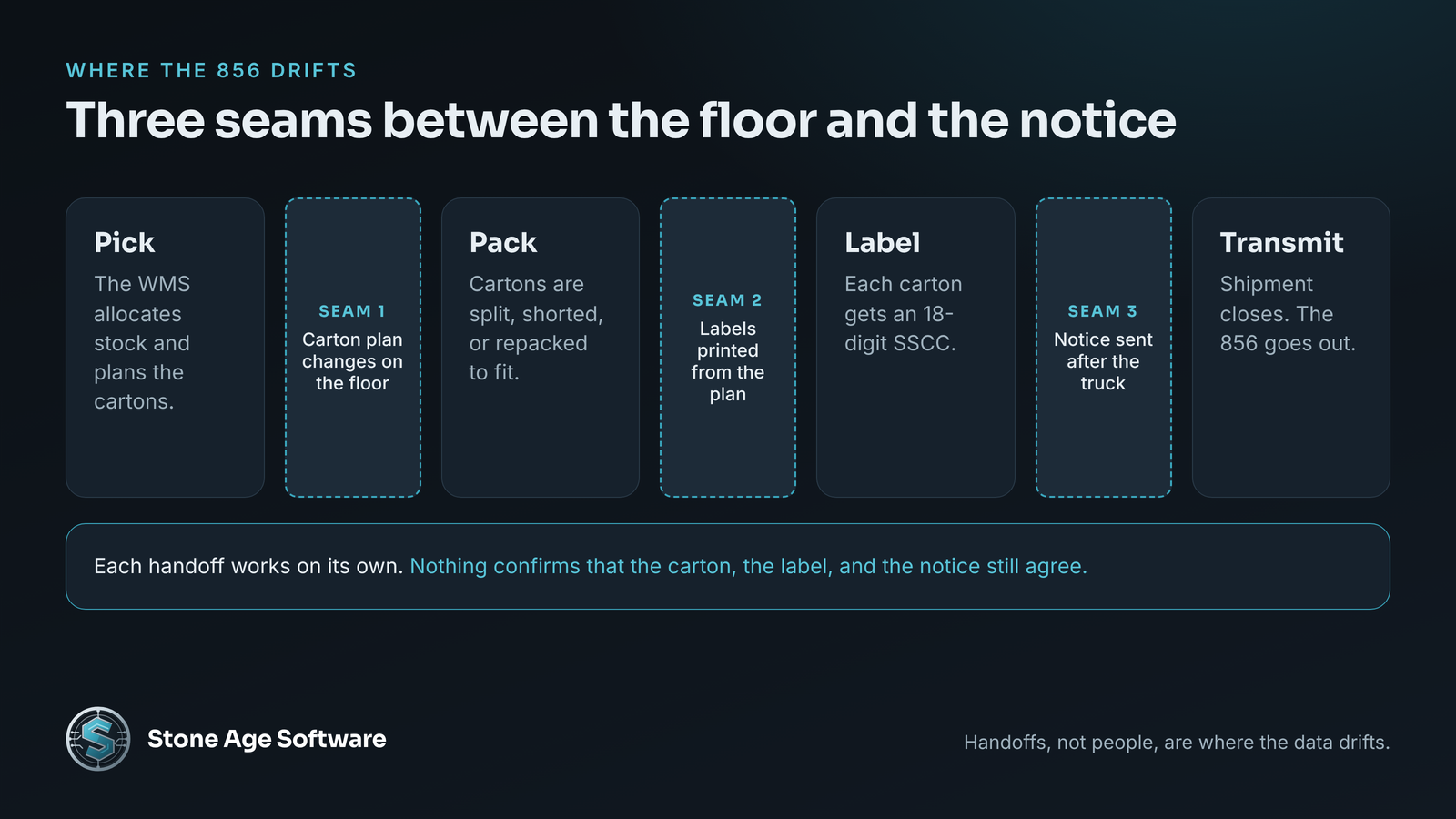
The same three gaps show up again and again. None of them is anyone's mistake. Each is a place where two systems hand off without confirming.
Pick to pack. The WMS allocates stock and plans cartons. Then reality intervenes. A case will not fit. An item is short. A packer splits one planned carton into two. The floor does the sensible thing. The carton plan in the system does not always follow.
Pack to label. Labels are often printed in a batch before packing finishes. That is efficient. It also means the label was generated from the plan, not from the packed carton. When the plan changes, the label and the contents part ways. A reprint creates a new serial number. The old one may still be in the notice.
Close to transmit. The 856 is usually triggered by a status change. Someone closes the shipment, and the translator picks it up on its next cycle. If closing happens after the driver leaves, the notice starts late. If the translator runs on a slow schedule, it starts later. On a short haul, the truck wins the race.
There is a fourth gap that sits above these. When the translator rejects a notice, where does that rejection go? In many setups it lands in a mailbox or a portal that nobody watches during a busy shift. The shipment looks closed. The notice never left.
Peak makes every one of these worse. More substitutions. More split cartons. More reprints. More trucks pulling out at the end of the day. The process that held up in July bends in November.
What a check at the dock door looks like
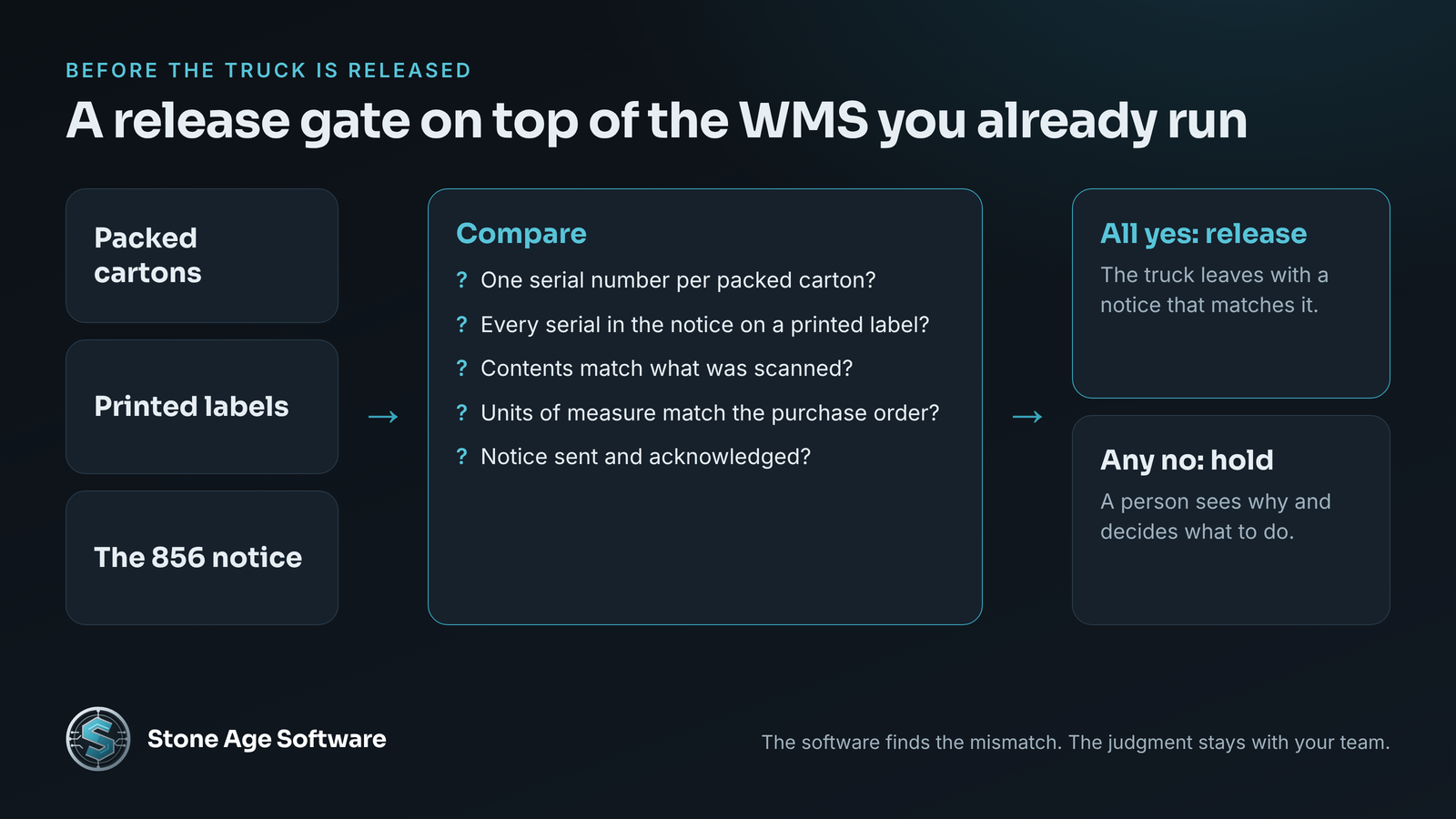
The fix is not a new warehouse system. The WMS you run already holds the data. What is missing is a small layer that compares three things before the truck is released.
It asks plain questions:
- Does every packed carton have exactly one serial number?
- Does every serial number in the notice exist on a printed label?
- Do the carton contents in the notice match what was scanned into the carton?
- Do the units of measure match what the purchase order asked for?
- Has the notice been built, sent, and acknowledged?
If every answer is yes, the shipment releases. If any answer is no, the shipment holds and a person sees why. That person decides what to do. Repack, reprint, correct the notice, or call the customer. The software finds the mismatch. The judgment stays with your team.
Acknowledgment deserves a note. The retailer's system returns a functional acknowledgment for each notice. It says the file was received and whether it passed structural checks. A layer that watches for it can raise a flag within minutes. Without that, the first signal is the deduction itself.
This is the kind of work we build. It sits on top of the WMS, reads what is already there, and writes nothing back that the WMS does not expect. The client owns the code outright. It is scoped as a fixed price, quoted up front.
Keeping a record of every disagreement
Catching defects before the truck leaves is half the job. The other half is the ones that got through.
Deductions arrive weeks later, usually as a report or a portal export. Each one is a snapshot. It does not say whether this is the fifth defect on the same customer or the first. It does not carry the note your team wrote last time. So the same cause gets investigated from scratch.
A register changes that. Every defect becomes a record with a cause, an owner, and a status. Records persist from one report to the next. Patterns surface on their own. You can see that one trading partner's defects are all late notices on short hauls. That points at the transmit schedule, not the packing line.
We built that pattern for a different disagreement between trading partners. Our B2B quantity variance reconciliation project turned emailed reports into a persistent register with history and attribution. The same structure fits ship notice defects well.
It also gives you something to dispute with. Some deductions are wrong. A notice was on time and the retailer's download failed. With the sent time, the acknowledgment, and the carrier's delivery scan in one place, a dispute takes minutes.
A ten-shipment check you can run this week
You do not need new software to find out where you stand. Pull the last ten retail shipments for one trading partner. For each one, write down five things:
- The time the shipment was closed in the WMS
- The time the 856 was actually transmitted
- The time the truck left the yard
- Whether an acknowledgment came back, and when
- Whether the carton count in the notice matches the carton count on the bill of lading
Then pick two cartons from one shipment still on your dock. Scan each label. Look up the serial number in the notice that was built. Open the carton and compare.
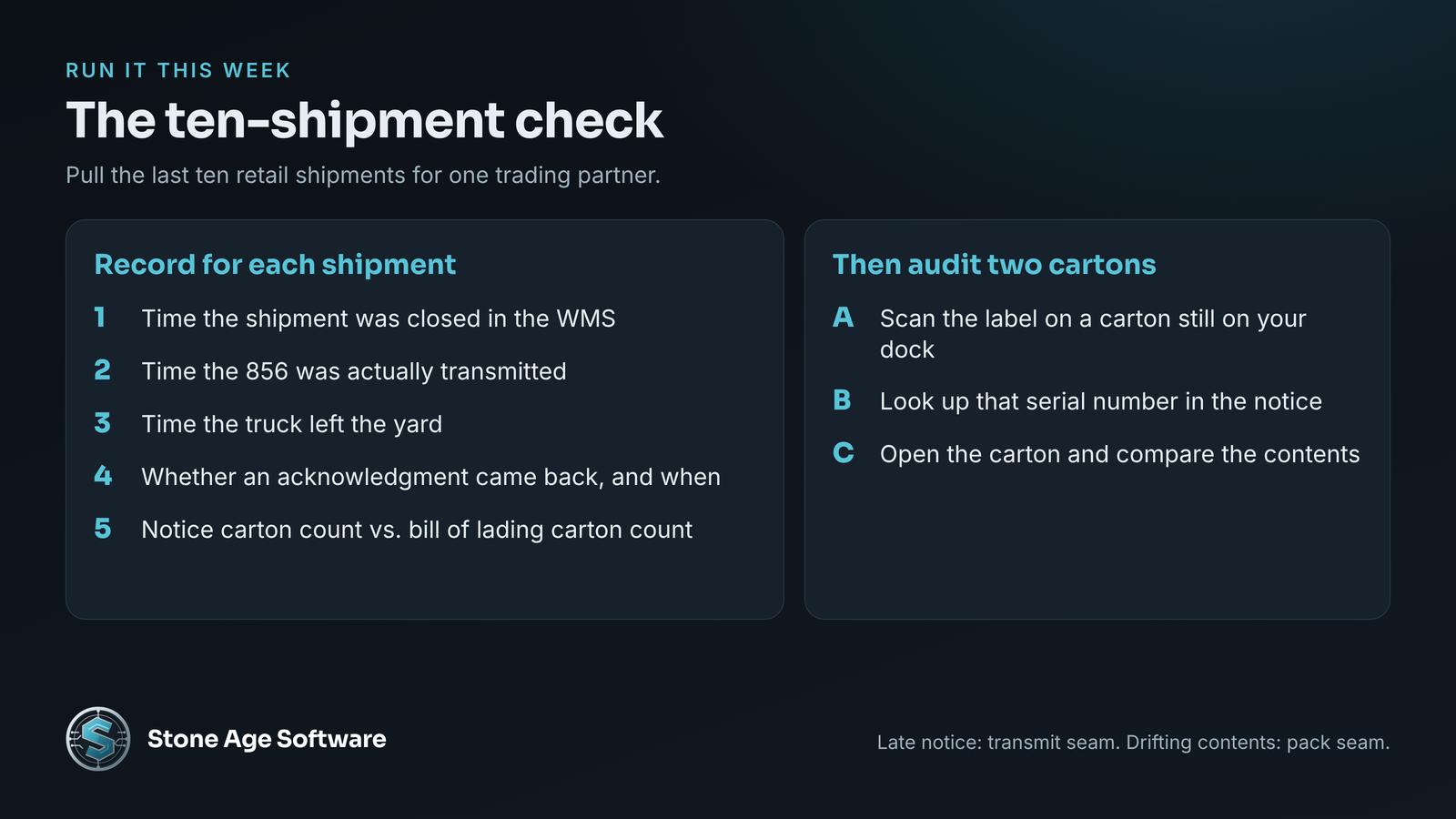
Read the results honestly. If the notice routinely goes out after the truck, you have a transmit seam. If the carton contents drift, you have a pack seam. If nobody can find the acknowledgments, you have a visibility gap. Each has a different fix, and none requires replacing what you run.
If the check turns up more than you expected, that is normal for this time of year. Our B2B EDI and trading-partner integration practice builds the layer that closes these seams on top of your current WMS. Start with the ten shipments. The pattern will tell you where to look first.