

A mixed pallet leaves your dock with six SKUs, one weight, and one line on the bill of lading. Today that pallet usually rates at the class of its highest-classed article. A proposal in front of the freight classification board would change that. Under it, mixed pallet freight class would come from the density of each handling unit. Density needs dimensions. Most outbound paperwork does not carry them.
The proposal is not final yet. The data gap it exposes is real either way. This is a good month to find out where your pallet dimensions live, and whether they reach the bill of lading at all.
What the proposal says
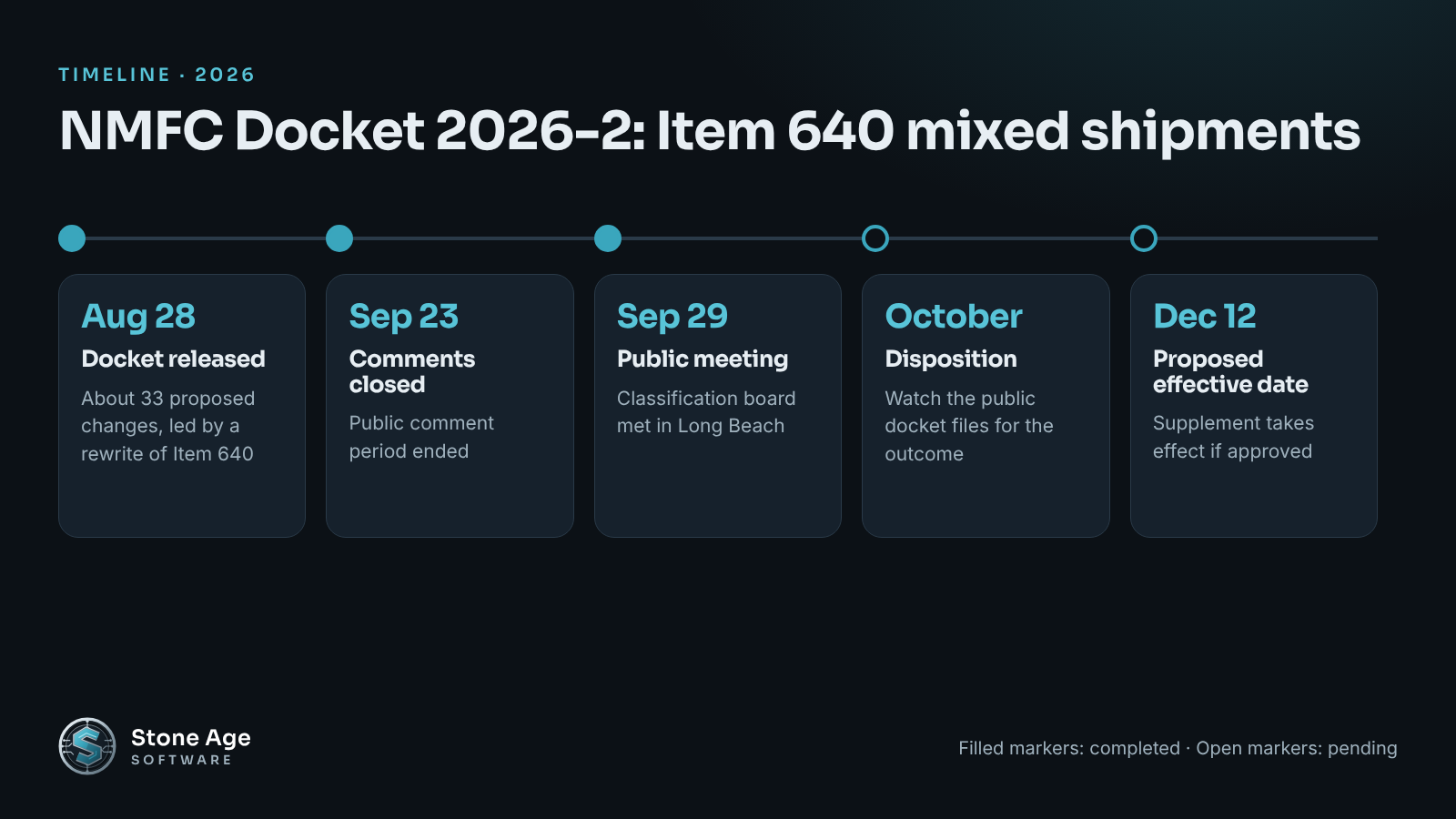
The National Motor Freight Traffic Association publishes the classification rules that LTL carriers rate against. It released Docket 2026-2 for public review on August 28, 2026. The docket carries about 33 proposed changes. The first subject is a rewrite of Item 640, the rule for mixed shipments.
The docket text itself is the primary source. Read Subject 1 before you read anyone's summary, including this one. Three points matter for a warehouse:
- The bill of lading must specify each article separately.
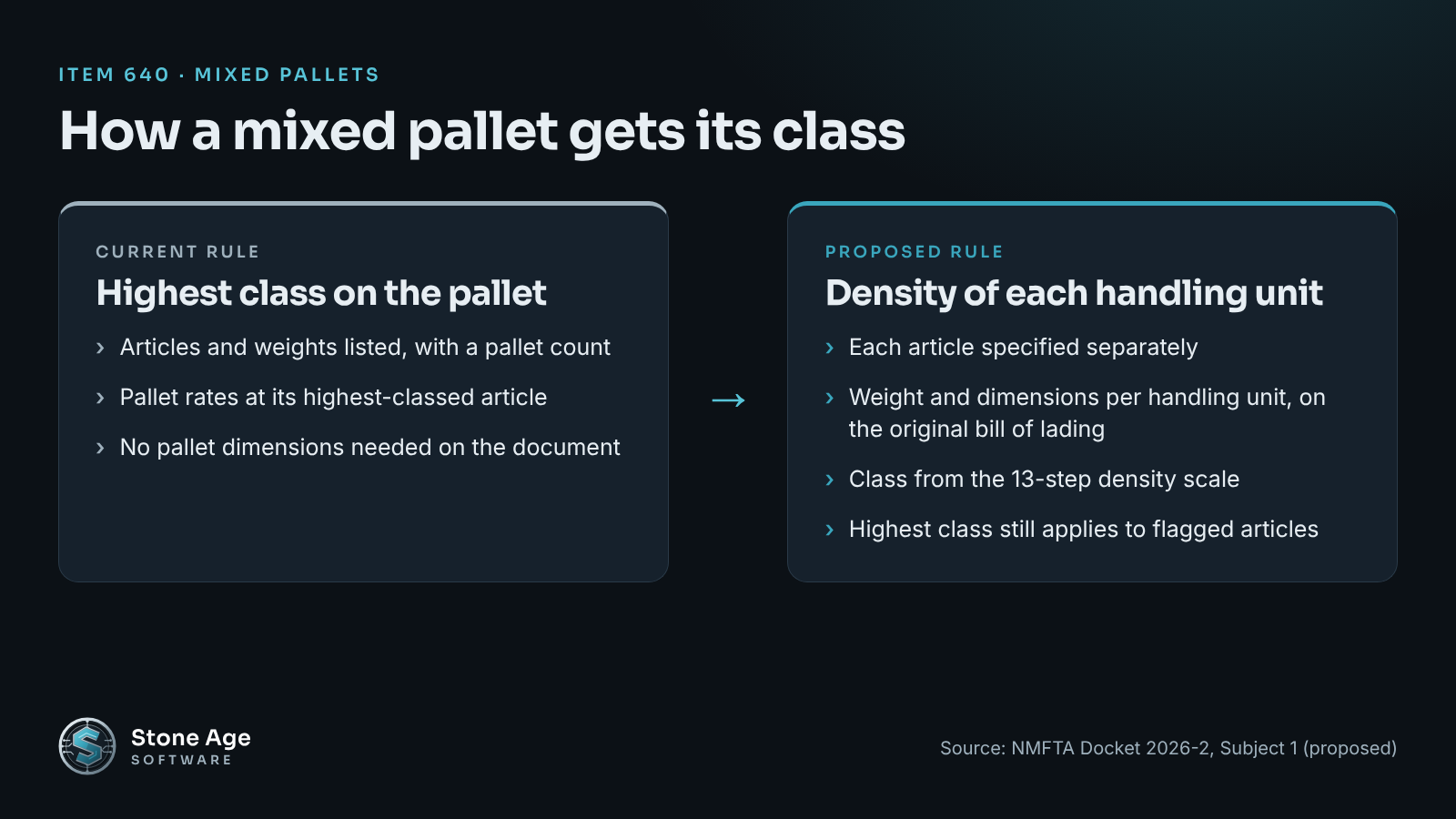
- Each handling unit is classed on the 13-subprovision density scale when the shipper gives weight and dimensions for it on the original bill of lading.
- The highest-class rule narrows. It applies when a unitized handling unit holds an article with a handling, stowability, or liability flag, a hazardous-material indicator, or a class set by packaging, greatest dimension, or another factor besides density.
Comments closed on September 23. The public meeting was held on September 29 in Long Beach. If the proposal is approved, the docket lists December 12, 2026 as the effective date of the supplement.
How mixed pallet freight class works today
The current rule is simple and blunt. A pallet holding differently classed articles rates at the class of the highest-classed article on it. One light, bulky carton can pull a dense pallet up to its class.
That bluntness has one advantage. It asks very little of the paperwork. The bill of lading lists the articles and their weights, then notes how many pallets they ride on. No one needs to know how tall pallet three was.
So most shipping workflows never capture pallet height. The WMS knows item weights. It often knows carton dimensions from the item master. It rarely knows the built dimensions of a finished pallet. That number exists for a few seconds, in the eyes of the person wrapping it.
What changes on the dock
NMFTA's own summary of the proposal, published in FleetOwner on September 24, puts the requirement plainly. Shippers would provide accurate weights and dimensions for each handling unit, subject to carrier verification.
Read that sentence as a data specification. It has four parts:
- Per handling unit, not per shipment.
- Weight and all three dimensions.
- On the original bill of lading, not on a correction.
- Checked by the carrier's dimensioner at the terminal.
The density scale then does the rest. It runs across 13 steps, from class 50 for the densest freight up to class 400 for freight under one pound per cubic foot. A pallet's class becomes arithmetic: weight divided by cube.
For many 3PL clients this is good news. A dense mixed pallet no longer inherits the class of its lightest carton. The catch is the condition. The density treatment depends on the dimensions being on the original document. A bill of lading with no dimensions gives the carrier nothing to rate against except its own measurement.
Where the seam is
None of this is a people problem. Your shipping team already builds good pallets. The gap sits between systems that were never asked to pass this number along.
Follow one pallet through a typical outbound flow:
- The order drops into the WMS with lines and quantities.
- Picks are confirmed and cartons are staged.
- The pallet is built, wrapped, and weighed at the dock scale.
- The bill of lading prints from the WMS, a TMS, or a carrier portal.
- The carrier picks up, measures the pallet at its terminal, and rates it.
Dimensions are created at step three. The document is created at step four. In many buildings nothing connects the two. The weight may be typed in from the scale display. Height is often a default, or a blank.
There is a second seam on the item side. The proposal keeps the highest-class rule for flagged articles. So the system that builds the bill of lading must know which SKUs carry such a flag. That is an item master question. Client item files that hold a class per SKU often hold nothing about why that class applies.
There is a third seam after the truck leaves. When a carrier's measurement differs from the document, a reclassification follows. Disputing one takes evidence: the scale weight, the measured dimensions, a timestamp, ideally a photo. If that evidence was never recorded, there is nothing to send.
What a fix looks like on the WMS you already run
This does not call for a new WMS. It calls for one more record and two connections.
The record is the handling unit. Each built pallet gets an ID, a weight, a length, a width, a height, and a time. A dimensioner can supply the numbers. So can a tape measure and a handheld prompt. The capture method matters less than the fact that the record exists and is tied to the shipment.
The first connection carries that record to the document. Whatever prints your bill of lading reads the handling unit records. It lists each article separately and prints weight and dimensions per unit. If you tender electronically, the same fields ride in the tender message.
The second connection carries it to billing and to disputes. Your client sees the density and class that were declared. When a reclassification arrives, the comparison is already on file.
A small rules layer sits on top. It calculates density per unit and looks up the class. It checks the item master for articles that fall under the highest-class exception. It stops a bill of lading from printing with blank dimensions. The software does the arithmetic and the checking. Your people handle the odd pallet, the overhang, and the call to the carrier.
We built something close to this for a returns operation. The receiving system there accepted a document only when every field matched its template exactly. The project write-up, return paperwork the receiving system accepts first time, covers how the document was generated from records instead of typed by hand. The principle transfers directly. A document is only as good as the record behind it.
What to do before the rule is settled
Do not rebuild anything on the strength of a proposal. Do find out what you would need. Three steps are safe now:
- Read Subject 1 in the docket and watch the public docket files for the disposition.
- Ask your LTL carriers how they plan to apply the rule in their own tariffs.
- Ask your clients which of their SKUs ship on mixed pallets most often.
The capture work pays back even if the final text changes. Carriers already measure freight at the terminal. A warehouse that records its own dimensions has an answer when the two numbers differ.
A check you can run this week
Pull the last 20 LTL bills of lading that covered mixed pallets. For each one, answer six questions.
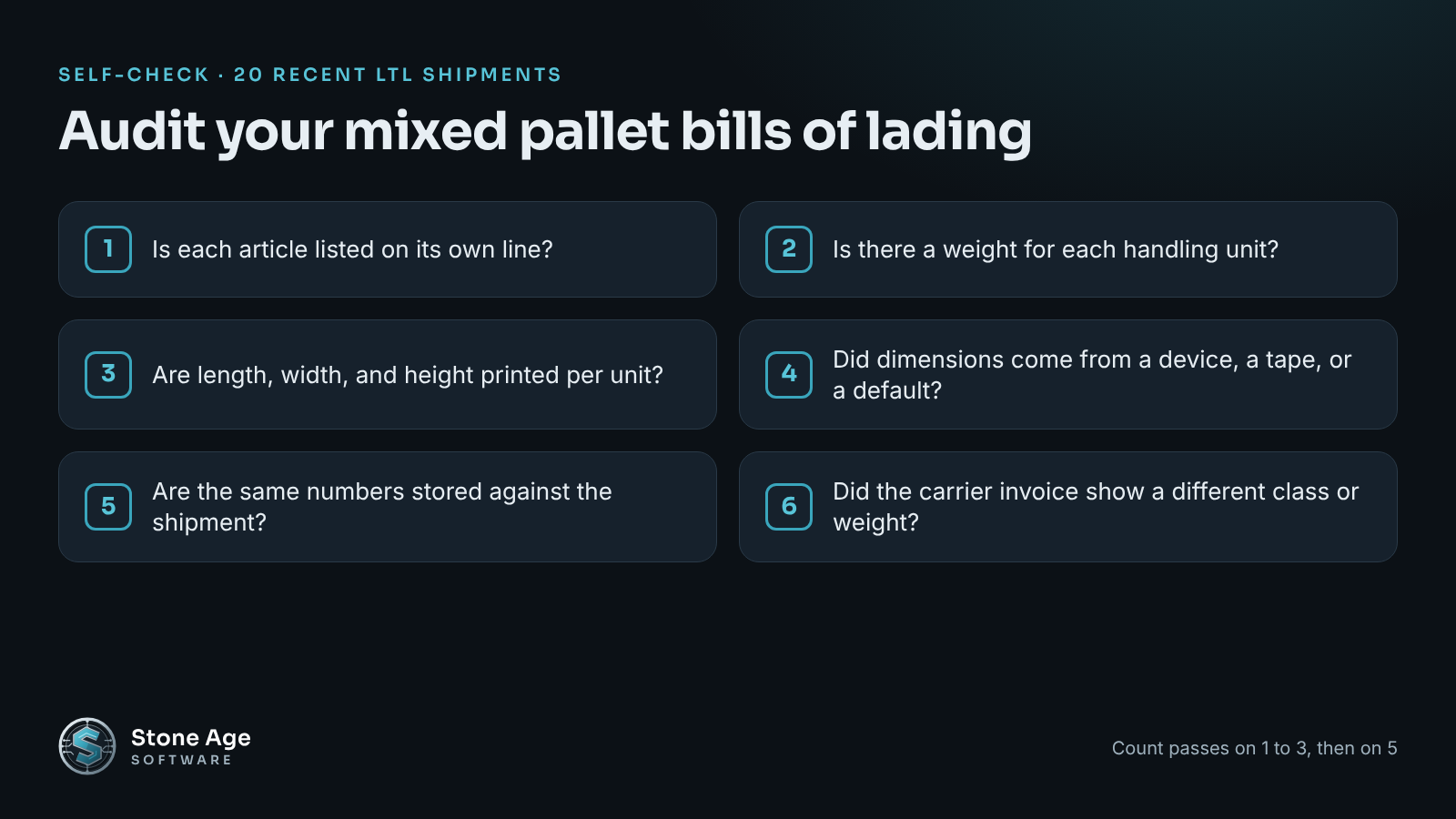
- Is each article listed on its own line?
- Is there a weight for each handling unit, or one total?
- Are length, width, and height printed for each handling unit?
- Where did those dimensions come from: a device, a tape, or a default?
- Can you find the same numbers in a system today, tied to that shipment?
- Did the carrier's invoice show a different class or weight than the document?
Score it simply. Count how many of the 20 pass questions one through three. Then count how many pass question five. The first number shows how ready your paperwork is. The second shows how ready your records are. A low second number is the one to act on, because documents can only print what a system holds.
Note question four as well. A default height that repeats across every pallet is easy to spot. It tells you the field exists but nothing is feeding it.
If the count is low, that is a seam to close, not a system to replace. We build that handling-unit layer on top of the WMS you already run, and you own it outright. The work is fixed price, quoted up front. See how we approach 3PL and logistics systems, or send us your 20 documents and we will walk through them with you.