
The requirements document said the receiving screen needed six fields. It did not say the receiver wears gloves, stands at an open dock door in August, and holds a scanner in one hand and a bill of lading in the other.
Nobody left that out on purpose. It is just not the kind of detail that survives a conference call.
There is a name for the engineer who would have caught it. A forward deployed engineer builds software at the customer's site, inside the customer's systems, next to the people who will use it. The title is suddenly everywhere in tech. The idea fits a warehouse better than almost anywhere else.
Here is where it came from, what it looks like in a 3PL, and how to tell the real thing from a label.
Where the forward deployed engineer came from
Palantir made the term famous. Its annual report filed with the SEC describes engineers sent out to overseas bases and Midwest factories to get its platforms running. The filing explains why the travel matters. In the field, "they observe users' challenges firsthand."
That sentence is the whole model. The engineer goes to the work. The work does not get summarized and sent to the engineer.
For years this was one company's habit. Then it became the most copied job in software. Fortune reported on September 3 that postings for forward deployed roles rose more than 1,000% between January and August 2026. That is measured against the same months a year earlier. Tech postings overall grew 13%. The figures come from Lightcast.
The reason is simple. AI companies found that a strong product still stalls at the customer's door. Someone has to connect it to the systems, data, and habits already in place.
Popularity has a cost. A hot title gets stretched, and some of those postings are support or sales roles under a new name. So it helps to pin the meaning down. The real thing does three jobs at once:
- Works where the work happens. On site, or as close to it as the job allows.
- Works in your real systems. Not a demo environment. Your WMS, your data, your printers.
- Ships working software. Code that runs, not a slide deck about code.
Take away any one of the three and you have something else.
Why a warehouse is the natural place for it
Most software gets specified in one place and used in another. In an office, that gap is small. On a warehouse floor, it is wide.
Think about what a written spec cannot carry:
- The dead spot in aisle 14 where the scanner drops its connection.
- The label printer that jams when two waves release together.
- The shift change that lands in the middle of the nightly batch.
- The workbook a supervisor opens every morning before trusting any screen.
- The reason wave three always runs late on Thursdays.
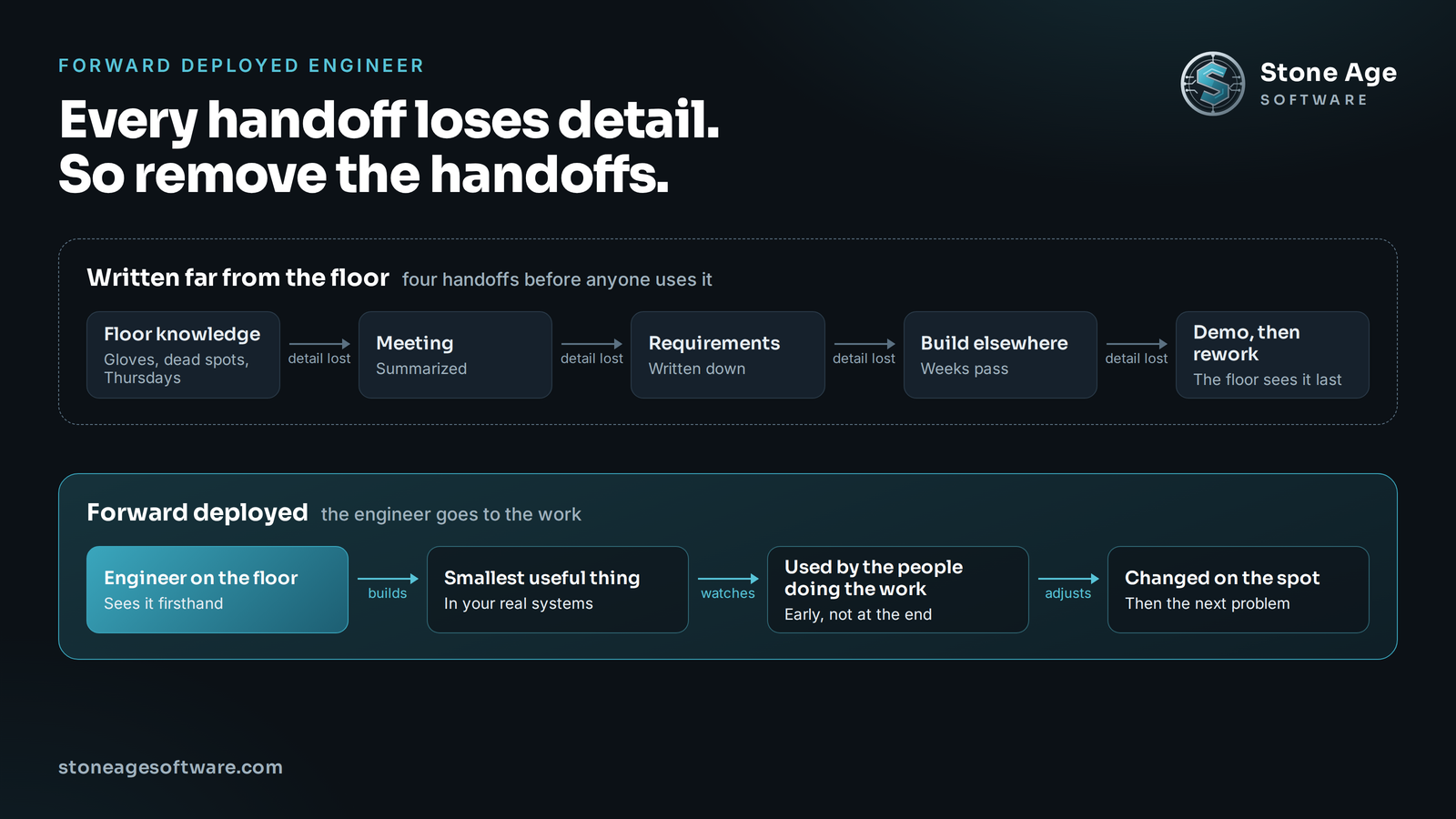
None of that is anyone's failure. Your team knows all of it. Your WMS does its job. The trouble is structural. The knowledge lives on the floor, and the software gets written somewhere else. Every handoff between those two places loses detail.
Take the receiving screen from the top of this page. On paper, six fields is a small form. On the dock, it is six chances to put the scanner down. An engineer standing there sees that in ten minutes. The fix is not clever. A scan fills four of the fields. The other two get large buttons a gloved thumb can hit.
That fix never appears in a spec. Nobody thinks to write "the user is holding something."
A forward deployed engineer removes the handoffs. That is the entire trick.
What forward deployed work looks like in a 3PL
This is how we work, so we can describe it plainly. We are based in Houston and work on site across the metro, warehouses included. Some of this work only makes sense standing on the floor.
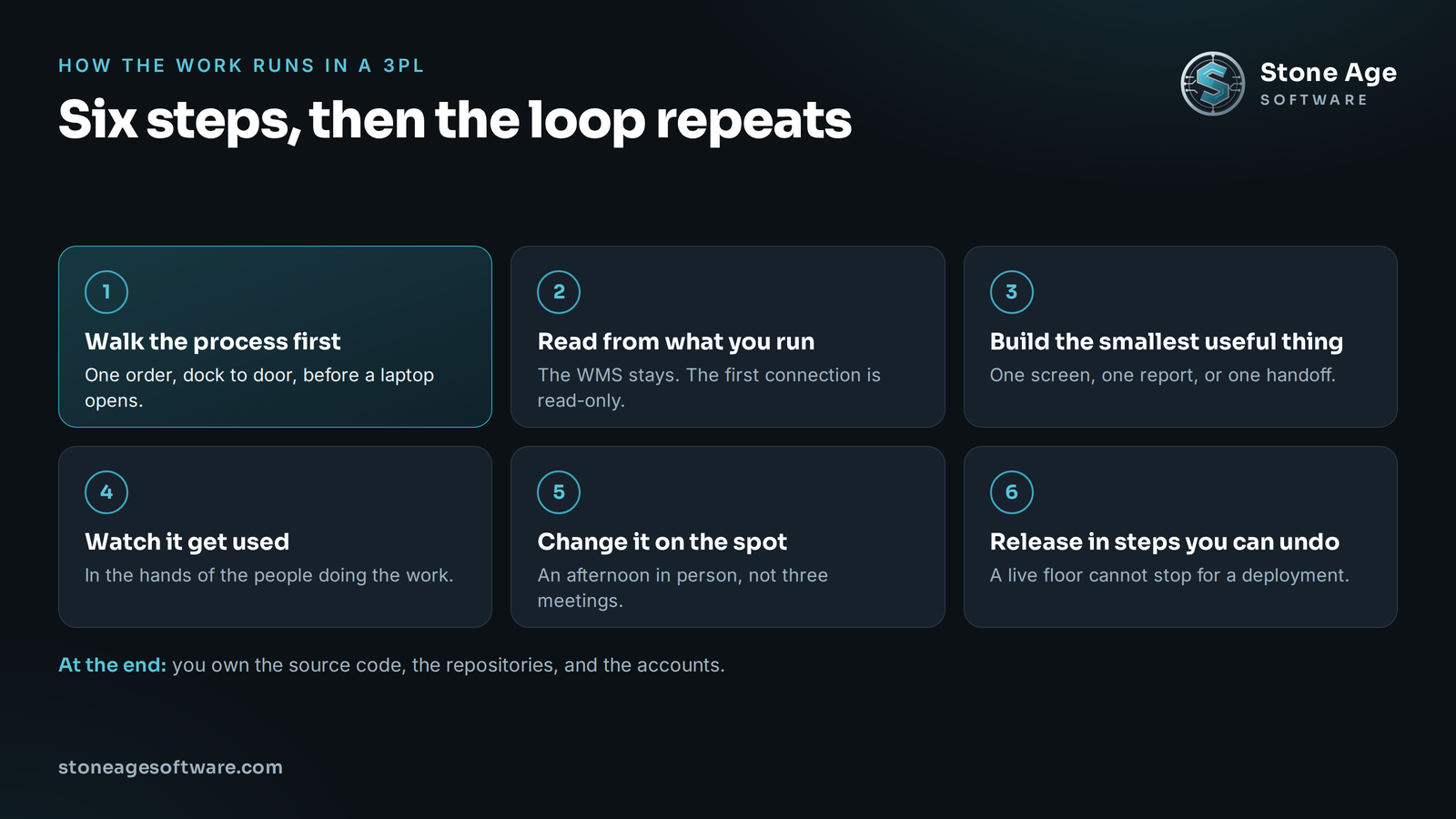
The loop has six steps:
- Walk the process first. Follow one order from the dock to the door before opening a laptop. Note every place someone writes on paper, opens a spreadsheet, or walks over to ask.
- Read from what you already run. The WMS stays. The first connection to it is read-only.
- Build the smallest useful thing. One screen, one report, or one automated handoff. Something a person can use this month.
- Watch it get used. Put it in the hands of the people doing the work. Then stand there.
- Change it on the spot. A fix that takes three meetings by email takes an afternoon in person.
- Release in steps you can undo. A live floor cannot stop for a deployment. Releasing to a system nobody can stop using is its own discipline.
Then the loop repeats on the next problem.
That is how one application came to replace a decade of spreadsheets at a contract-logistics operation. It did not arrive as a grand design. It grew one module at a time. Each module answered a problem someone on that floor actually had.
What it is not
The label gets confused with three older arrangements. Each has its place. None is the same thing.
- It is not staff augmentation. That rents you a pair of hands. Forward deployed work owns an outcome.
- It is not a consulting report. A report describes the problem. This work ends with software running on your floor.
- It is not a vendor's implementation team. That team configures the product it sells, which is exactly its job. Forward deployed work builds what sits between products.
It is also not a replacement for your people. The supervisor who knows why Thursdays run late is the source material. Software should take the re-keying and the reminding. Your people keep the judgment and the exceptions.
Why this fits a small operation
The companies in those job postings embed whole teams with their largest customers. A 40-person 3PL is not going to get that treatment from a software giant. It is not going to hire a full-time engineer either.
It does not need to. The method scales down well:
- The work is bounded. One process, one handoff, one deliverable.
- The terms are plain. Fixed price, quoted up front.
- The result stays. You own the source code, the repositories, and the accounts. When the engineer leaves, nothing leaves with them.
That last point is the difference between help and dependence. Software built on your floor should belong to your building.
Five questions for anyone who says they forward deploy
Ask these before you sign anything.
- Will the person writing the code see my floor before writing it?
- Does your plan build on the WMS I run, or begin by replacing it?
- What is the first thing my team can use, and when?
- Who owns the source code and the accounts when you leave?
- How do you release a change while my floor is running, and how do you undo it?
Good answers are specific. They name a person, a system, a date, and a rollback. Vague answers mean the title is doing the work.
Run the one-order walk
You can do the first step yourself this week. It takes about an hour.
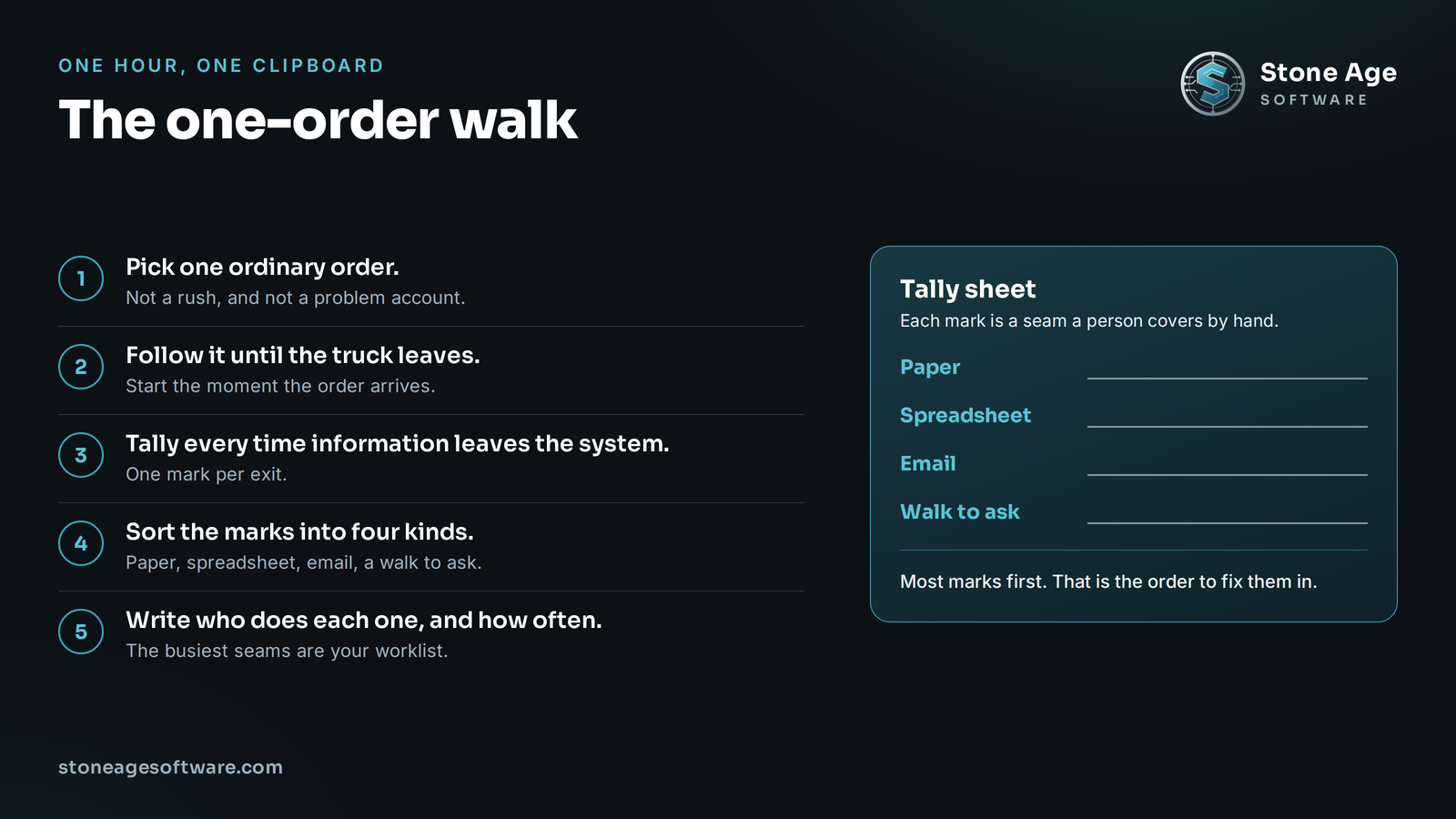
- Pick one ordinary order. Not a rush, and not a problem account.
- Follow it from the moment it arrives to the truck leaving.
- Carry a clipboard. Make a tally mark every time information leaves the system.
- Count four kinds of exit: paper, a spreadsheet, an email, and a walk to ask someone.
- Next to each mark, write who does it and how often.
Now look at the page. Each tally is a seam between systems that a person is covering by hand. The seams with the most marks are your worklist, in order.
That list is what a forward deployed engineer would write on day one. You now have it for the cost of an hour.
When you want the top item closed, that is the work our custom software practice does. We build on the warehouse systems you already run, on your floor, and you own the result outright.