Prime Big Deal Days ran on October 6 and 7. Black Friday is five weeks out. In the latest Logistics Management peak survey, 52% of logistics professionals expect a busier peak than last year, nearly double the 27% who said so in 2025. Every one of those orders lands in a building that serves more than one client. That is the test a custom 3PL warehouse management system has to pass. Not "can it ship an order." Can it ship forty clients' orders, under forty contracts, from the same aisle, and bill every touch? This article is the architecture that passes that test: four pillars, a build-versus-buy horizon, and a rollout path that never stops the floor.
The Multi-Client Breaking Point
A traditional enterprise warehouse serves one owner. One SKU catalog, one rulebook, one definition of "received." Its software can assume all of that. A 3PL cannot.
A third-party warehouse holds Client A's lot-tracked supplements next to Client B's apparel. Client A wants rotation by expiry date and a custom insert in every carton. Client B wants a two-day SLA and a ship notice in their retailer's EDI dialect. Client C sends orders as spreadsheets by email. Each contract is a different rulebook running on the same racks and the same labor.
Off-the-shelf software fails here in one specific way. Its data model was designed for a single owner. Client-specific rules have nowhere to live, so they move into people's heads, spreadsheets, and side systems. Every workaround is a step the software never sees. Every unseen step is a touch nobody bills. Margin leaks through the seams, not through anybody's effort.
This is why the strongest 3PLs are building custom built software systems around their operations. Custom does not have to mean greenfield. It means the parts of the system that encode your contracts belong to you. That is the gold standard in logistics software: operational agility you control, and margin defended by design.
What a Custom 3PL Warehouse Management System Looks Like at a Glance
Three words describe the shape: modular, event-driven, headless.
Modular means every domain has a boundary and an owner: ingestion, allocation, rate shopping, metering. Draw those boundaries as modules first. Whether they deploy as one process or several is a scaling decision you can defer. A modular monolith is often the right first shape.
Event-driven means the modules talk through a stream, not through direct calls. A scan, an order, a carrier response: each becomes an event on a bus such as Apache Kafka or a managed equivalent. Producers write and move on. Consumers read at their own pace. When Black Friday triples order intake, the queue absorbs the spike. The allocation engine never has to answer the web in real time.
Headless means the core has no screen of its own. It exposes services. The RF scanner app on the floor, the client visibility portal, and the central ops console are three clients of the same core. Each can change without touching the others. That is how a wave planning tool can sit beside a customer-owned planning system and a customer-owned WMS, and still give the floor one button to press.
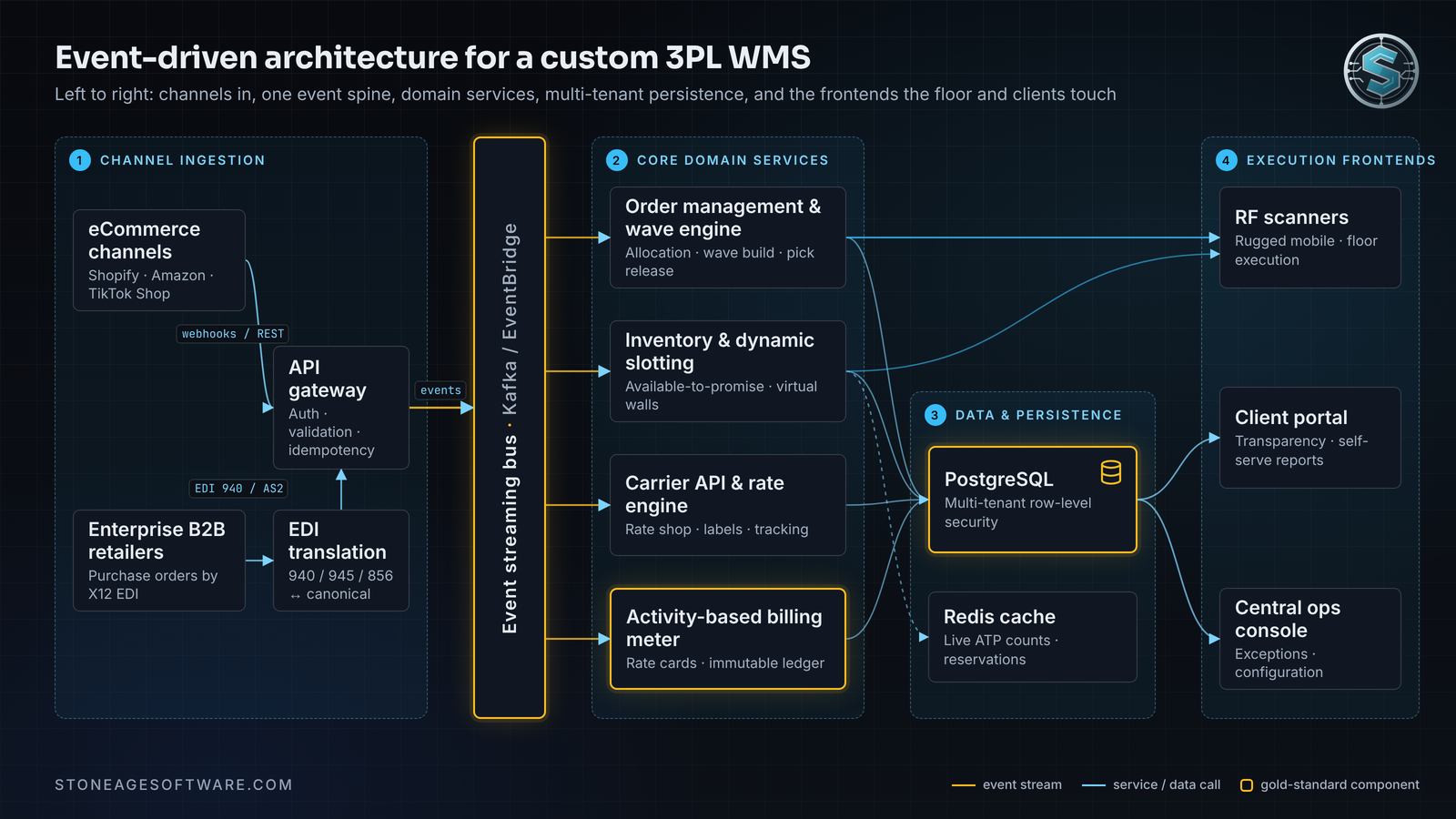
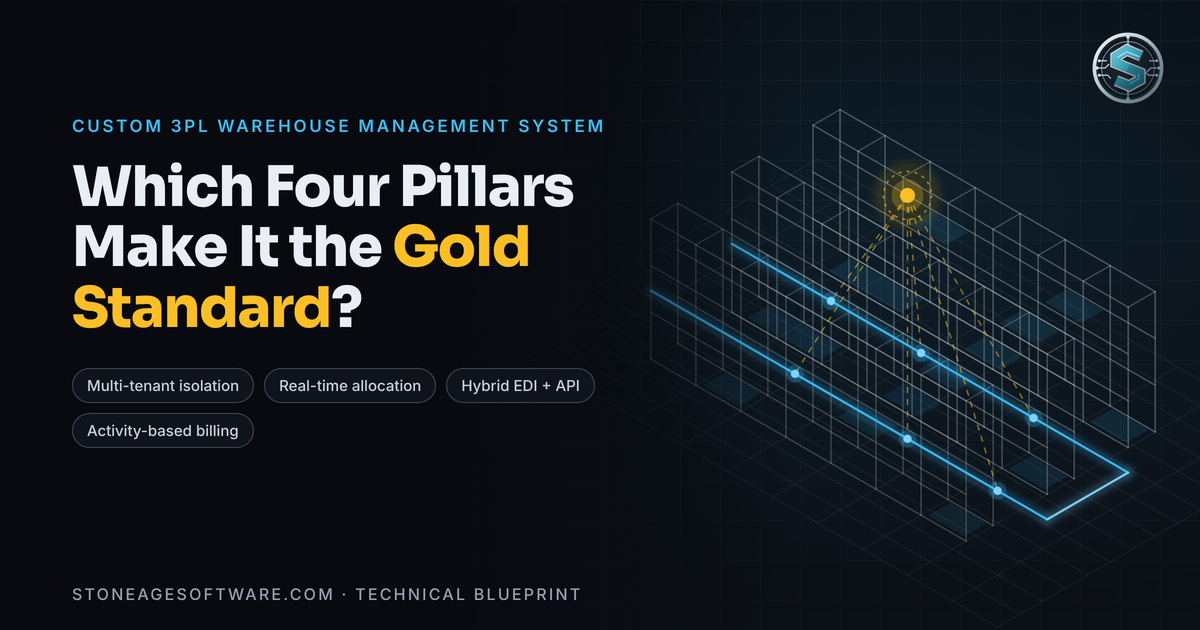
The diagram above is the whole system on one page. The next four sections are the pillars that hold it up.
Pillar I: Multi-Tenant Data Isolation Without Physical Silos
Every client must see only their own data. Every client shares the same building. The database has to hold both facts at once.
There are three ways to do it:
- Database per tenant. Strongest isolation, highest cost. Forty clients means forty databases to migrate, back up, and patch. Cross-client reporting becomes a project.
- Schema per tenant. Lighter, but every schema change runs forty times. Connection pools fragment. Shared reference data gets duplicated.
- One database with row-level security. Every tenant-owned table carries a
client_id. PostgreSQL row-level security policies filter every query by the session's tenant, inside the engine, before application code runs.
Single-database row-level security is the gold standard for a shared footprint. One schema, one migration, one backup. The isolation is enforced where it cannot be forgotten. An application bug cannot leak Client A's inventory into Client B's portal, because the database refuses to return the rows.
Inventory segregation follows the same principle. The physical rack is shared. The virtual walls are rows. A location record says what may live there: ambient or chilled, hazmat class, one client or any. A client record says how stock rotates: first in first out, first expired first out, or last in first out for a specific program. A lot record carries the dates a regulator will ask about. The allocation engine reads all three before it reserves a unit. The floor never has to remember which aisle is whose.
Pillar II: Real-Time Inventory Sync and High-Throughput Allocation
Here is the flash-sale failure. One client sells the same SKU on Shopify, Amazon, and TikTok Shop. A promotion fires. Three channels sell the last twelve units in the same second. Two of those orders will oversell unless the allocation engine says no, fast.
That is a race condition, and there are two ways to handle it:
- Pessimistic locking takes a row lock on the bin before reserving. Correct, but every request waits in line. Under a spike, the line is the bottleneck.
- Optimistic concurrency reads the bin with a version number, decides, then writes only if the version is unchanged. Collisions retry. Most requests never collide, so throughput stays high.
For bin-level reservations, optimistic control wins at peak. The retry loop costs microseconds. The lock queue costs the sale.
The second half of this pillar is where the truth lives. During a spike, the system of record is too slow to be the referee. So the live available-to-promise count sits in a distributed in-memory store, with Redis transactions guarding the decrement. The reservation is confirmed from memory in single-digit milliseconds. An event then persists it to PostgreSQL asynchronously. Memory answers the channel. The database remembers it. If the cache ever disagrees with the ledger, the ledger wins and the cache rebuilds from it.
Every channel also receives the same update at the same time. A sale on Amazon lowers the count on Shopify within the same second. Oversells stop being a peak-season tax.
Pillar III: The Hybrid Integration Layer, EDI and Modern APIs Together
A 3PL lives in two integration worlds at once. Enterprise retailers speak X12 EDI. The 940 Warehouse Shipping Order, 945 Warehouse Shipping Advice, and 856 Ship Notice/Manifest have carried retail replenishment for decades, and they are not leaving. Direct-to-consumer brands speak REST, GraphQL, and webhooks, and they change payloads without notice.
The architecture bridges the gap with one rule: translate at the edge, standardize in the middle. Every inbound message, EDI or JSON, becomes the same canonical order event before it touches the bus. Every outbound confirmation starts as the same canonical shipment event. It is rendered into a 945, an 856, or a webhook on the way out.
Each client's format lives in a small, versioned adapter. An adapter maps fields, applies the partner's quirks, and validates. Onboarding a new enterprise account means writing one adapter and running the partner's test file through it. That is days of work, not a quarter of change requests against a monolith. Our EDI and trading-partner integration page covers the retailer side in more depth.
Fault tolerance is built in, not bolted on:
- Idempotency keys on every event. A retailer that resends a 940 three times creates one order, not three. The same discipline let a variance register absorb the same partner report ten times without creating a single duplicate.
- Dead-letter queues for messages that fail validation. The bad message waits in a queue with its error attached. A person reviews it with full context instead of hunting through logs at month-end.
- Exponential backoff with jitter on retries to carrier and partner endpoints. A partner outage becomes a delay, not a loss.
Pillar IV: An Automated Activity-Based Billing Engine
Ask where 3PL margin goes and the answer is almost always the same: into work that happened but was never captured. Custom packaging. Split-case handling. A pallet re-wrapped after a damaged shrink layer. Oversized storage billed at standard rates. None of it is anyone's fault. The billing system simply had no place to record the touch.
The fix is to make the floor the meter. Every scan that completes a billable action emits an event. The billing engine subscribes to those events and matches each one against the client's contracted rate card. Then it appends a line to an immutable ledger. The ledger is append-only and keyed by the event's idempotency key. A duplicate scan can never double-bill. A correction is a new line, never an edit.
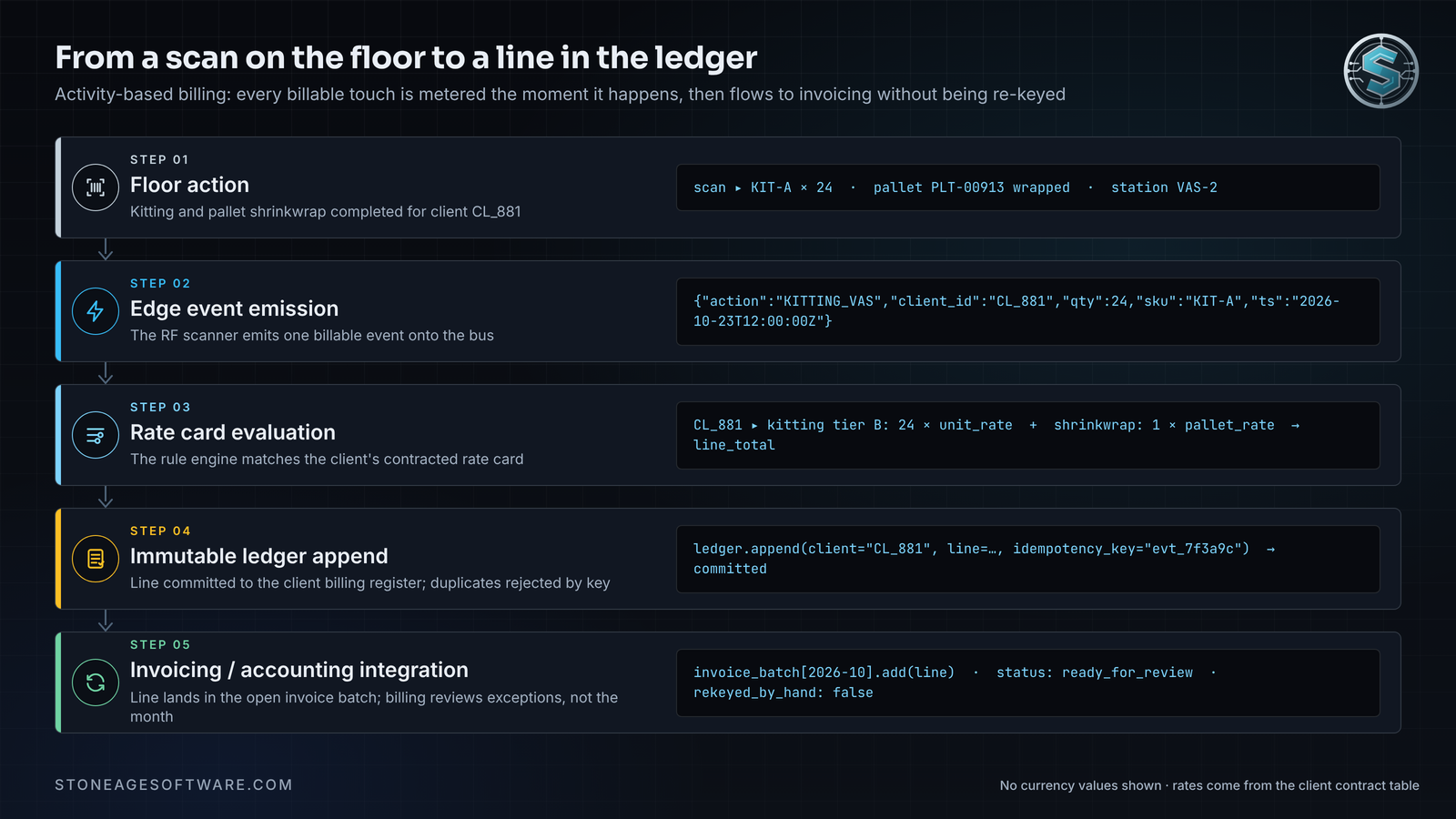
The rate card itself is data, not code. Tiers, minimums, surcharges, and per-client exceptions live in tables the account team can read. When a contract renews with new terms, the change is a row with an effective date. The engine applies it from that date forward and the history stays intact.
The last step is the invoicing/accounting integration. Ledger lines flow into the client's invoice batch as they are created. Month-end stops being a reconstruction. The billing team reviews exceptions and approves, instead of rebuilding four weeks of activity from scan logs and memory. The software does the counting. People keep the judgment.
Build vs. Buy Over a Three- to Five-Year Horizon
Make the decision on a five-year sheet, not a demo. Lay out every cost line for each option over 60 months. Compare the shape of the curve, not the first-year number.
The lines look different for each option:
- Tier-1 enterprise WMS. Licensing that scales with orders, users, or sites. A professional-services cycle to configure it. A change-request budget for every client contract the configuration cannot express.
- Mid-market SaaS WMS. A low entry fee. Per-label or per-order overages that grow with your success. The side systems you build when a client's logic does not fit the template.
- Custom build. A fixed price, quoted up front, for each phase. A predictable cloud bill. A care plan.
The matrix below compares the three on the dimensions that decide 3PL margin.
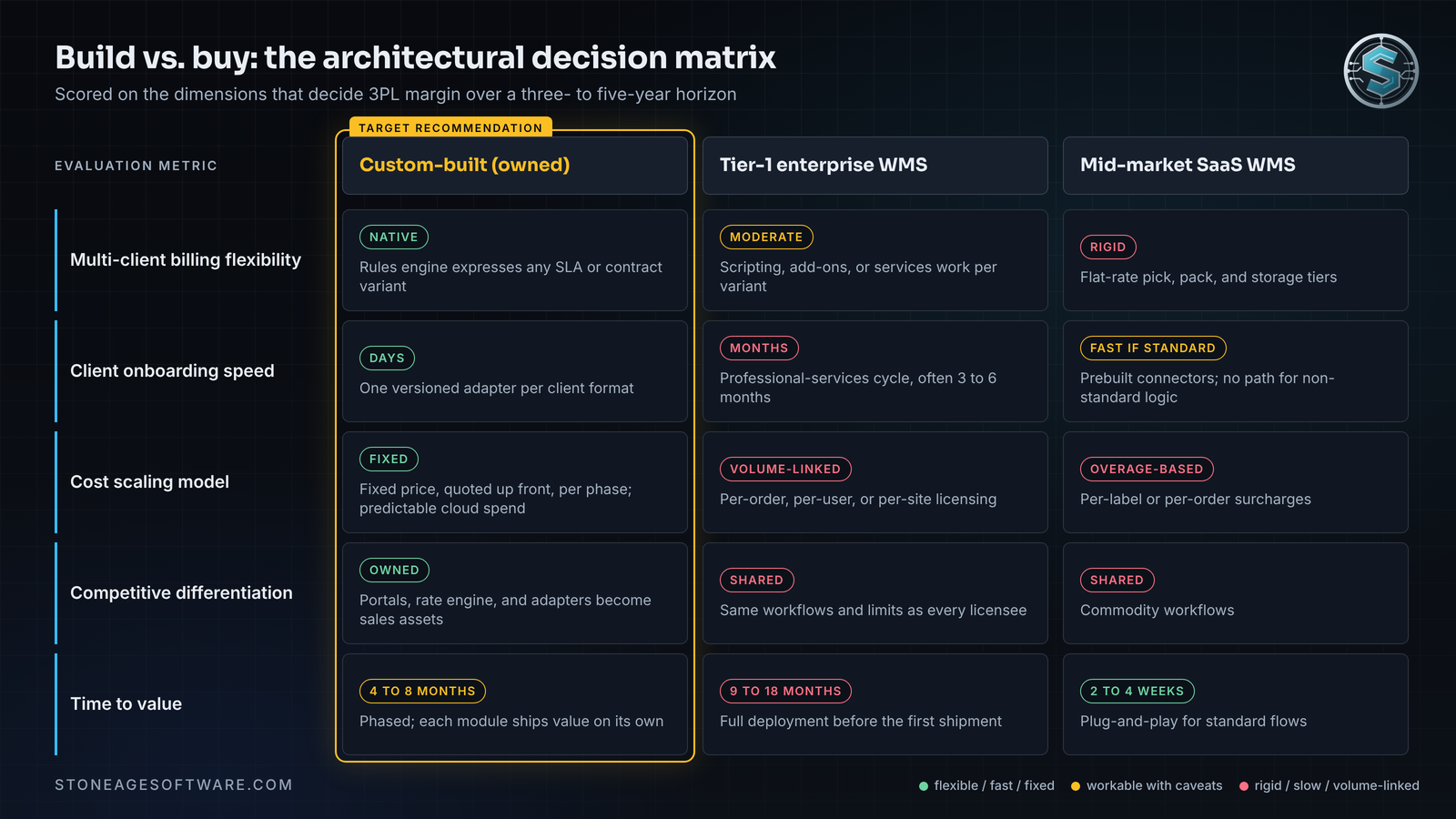
Read it without a thumb on the scale. SaaS wins time-to-value, and it is the right answer for a single-client operation with standard flows. The custom build wins everything that compounds: billing flexibility, onboarding speed, and a cost curve that does not rise with your volume.
Then add the line most sheets forget. A rented platform is an operating expense that disappears when you stop paying. An owned platform is an asset. Your client portal, your rate engine, and your adapters are capabilities a competitor on the same vendor product cannot offer. When the business is valued, proprietary systems that run the operation count in your favor. A subscription does not.
Implementation: Greenfield or the Strangler Fig
Nobody can stop a live warehouse to install software. The rollout has to happen while trucks are at the dock. The pattern that works is the strangler fig: the new system grows around the old one and takes over one function at a time. The old one is retired when nothing calls it anymore.
A practical phase order:
- Ingestion and billing capture first. Put the adapter layer in front of the current WMS and start emitting billable events from existing scans. You begin recovering margin before any floor process changes.
- Outbound wave fulfilment second. Move allocation and wave building onto the new engine while the legacy system still prints labels. Run both for a few weeks, compare, then cut over.
- Physical slotting and robotics last. Once the new core owns inventory truth, dynamic slotting and automation integrations have a clean data model to work against.
This is how one platform replaced forty small systems, module by module, with no single cutover day. Each module started where the old tool ended. The floor never had a Monday where everything was new.
Greenfield still has a place: a new facility, or a new business unit with no legacy to protect. Everywhere else, the fig wins.
The end state is the same either way. The system that encodes your contracts, your rates, and your clients' quirks belongs to you. Nobody else's roadmap decides what your warehouse can promise. That is operational independence, and software ownership is how a 3PL gets there.
Run This Check Before You Decide Anything
Pull last month's scan log and last month's invoices for one client. Pick ten value-added services you know happened: kitting, relabels, re-wraps, split cases. Find each one on the invoice. Any touch you cannot find is margin that leaked through a seam in the current system. Count them, multiply by your client list, and you have the first line of the business case.
If that count is higher than you expected, the four pillars above are the fix, and they do not require a rip-and-replace. Stone Age Software designs and builds custom 3PL warehouse management systems, and the owned layers that grow around an existing WMS, at a fixed price, quoted up front. Start on the 3PL and logistics systems page.