Port Houston moved 376,419 TEUs in September, up more than 11% from a year earlier. Nearly all of them move by truck. They share the road with field crews on seven of the 10 most congested road segments in Texas. The schedule runs to the minute. The paperwork still runs on carbon copies.
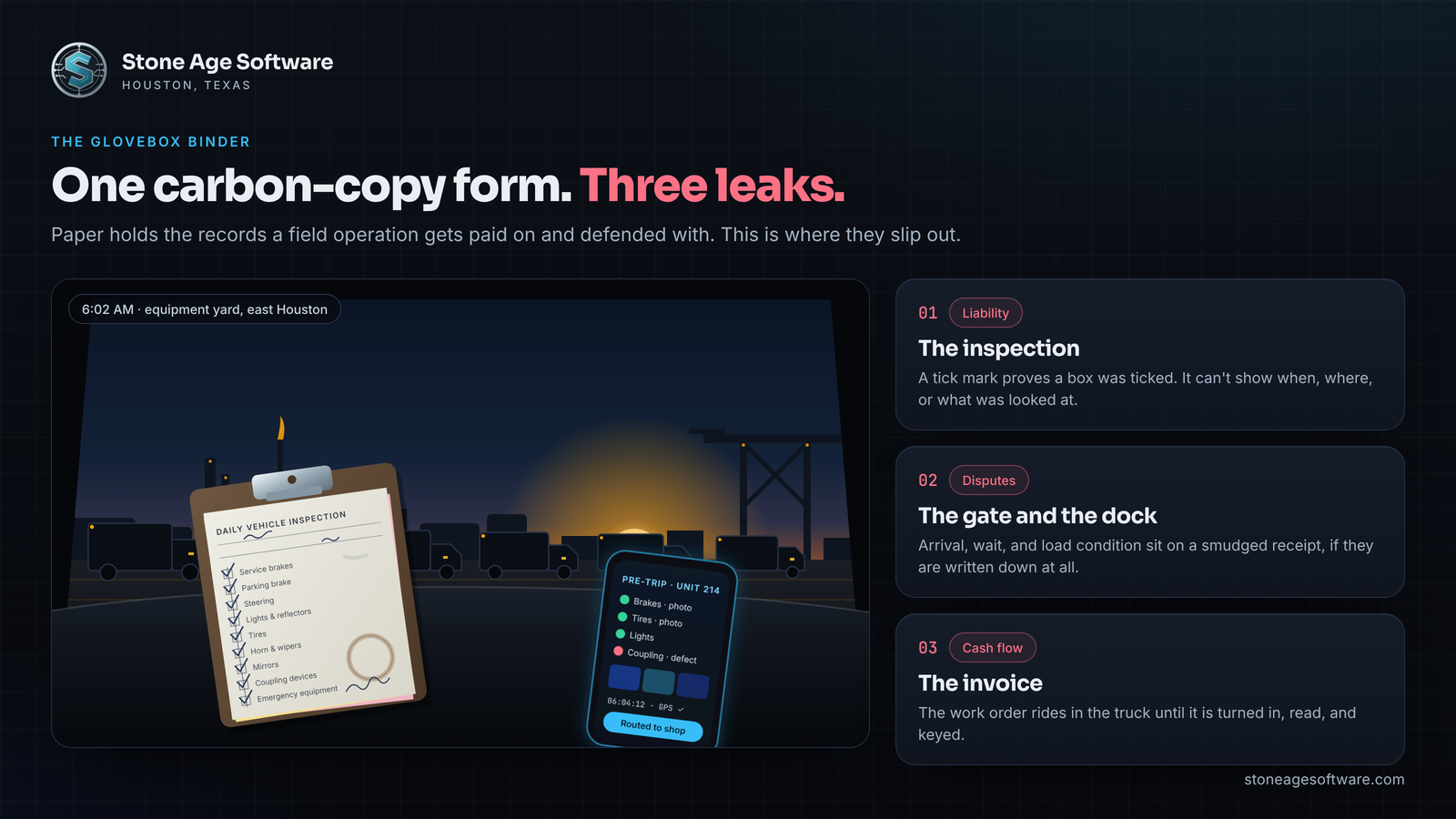
That paper leaks margin in three places: safety records you can't defend, gate time you can't bill, and invoices that wait for Friday. It is also why the field apps Houston operators ask us about have changed. Nobody wants another platform. They want one small tool that closes one leak.
Bottleneck 1: the safety liability of a pencil-whipped inspection
What the rules actually require
For commercial trucks, the federal floor is lower than most people think. 49 CFR 396.11 calls for a written report at the end of each day's work. It covers 11 items, including brakes, steering, tires, and coupling devices. Since 2014, property carriers only file it when a defect turns up. Before driving, the next driver must "be satisfied" the truck is safe and review the last report, if there is one.
So on a clean day, the law may leave no record at all. Your own checklist is the only proof anyone looked.
Job sites work the same way. OSHA requires a forklift exam at least daily, but no written record of it. Fall-arrest gear gets checked before each use, with no form required.
Why a paper checklist can't prove anything
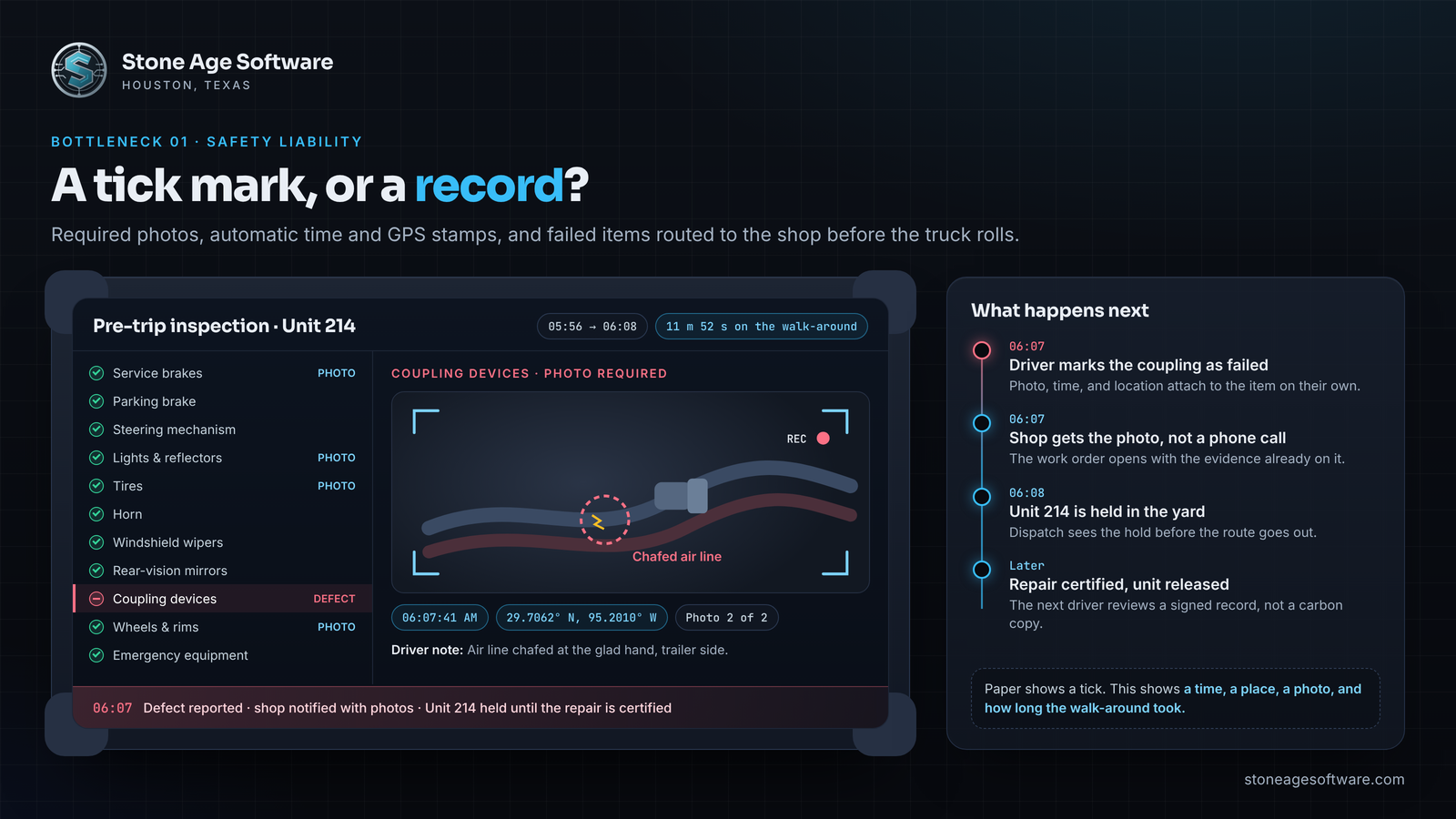
A tick-box form looks the same after a 15-second glance as after a 15-minute walk-around. It records a mark, not a time, a place, or what was seen. That is a flaw in the form, not in the crew. When the morning is already late, the form makes the fast version easy.
Inspectors keep finding what paper missed. In CVSA's 2026 International Roadcheck, inspectors put 23.5% of the vehicles they examined out of service. Brake systems topped the violation list. After a crash, those inspection and maintenance records become evidence.
What a mobile inspection records instead
The walk-around takes as long as it takes. Recording it takes about a minute of taps. The app requires photos on critical items like brakes, tires, and couplings. It stamps the time and GPS location on its own. It logs how long the walk-around ran. A failed item goes to the shop with the photo attached, and the unit stays held until the repair is signed off.
FMCSA confirmed in February that DVIRs may be created and kept electronically. Photos and GPS stamps are not required. They are a choice that makes the record hard to argue with. In federal court, app-generated data can be self-authenticated under Rule 902(13), without a live witness.
We built the warehouse version for a contract-logistics site: a pre-use inspection that locks failing equipment out of service.
Bottleneck 2: gate time, demurrage, and lost PODs
Where the minutes go
Houston's container gates run on appointments, and they move. Port Houston's Oct. 19 terminal report showed average truck turns of 43 minutes at Barbours Cut and 44 at Bayport. The leak is the clocks around the gate. Loaded imports get seven free days under the port's terminal tariff. Demurrage keeps counting on days the gates are closed, and they close for Thanksgiving on Nov. 26.
Customer docks add their own waits. ATRI found detention at 39.3% of truck stops. Carriers invoiced three of every four detention events, and only 55% of those invoices were paid.
The dispute that arrives weeks later
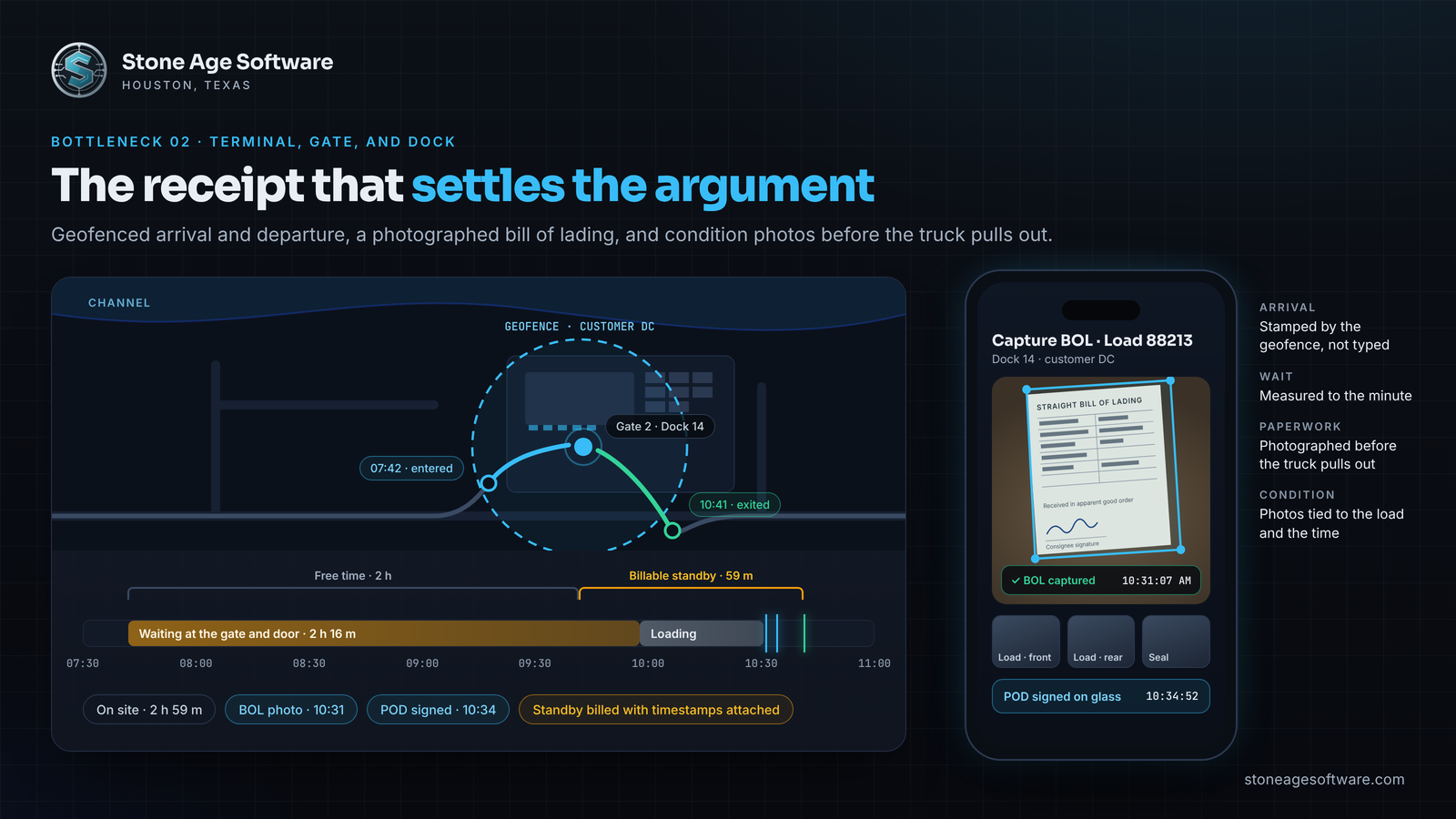
The driver knows when the truck arrived. The paper receipt often doesn't. Weeks later, a customer disputes the standby or says the load arrived damaged. The argument then runs on memory and a smudged signature.
The rules reward whoever kept timestamps. Under the Federal Maritime Commission's billing rule, a demurrage or detention invoice must go out within 30 days with the required data. Otherwise, the billed party doesn't have to pay. Billed parties get at least 30 days to dispute. A 2025 court ruling also removed the rule's bar on billing truckers directly. In July, a federal appeals court upheld an FMC ruling against detention billed during a holiday port closure. Winning that argument takes proof of the closure and the return attempt. A time- and location-stamped record supplies both.
Cargo claims get at least nine months to be filed under the Carmack Amendment. A clean, signed POD with photos is a carrier's best answer.
What the app captures before the truck leaves
- Arrival and departure, stamped by a geofence instead of typed by hand.
- The signed bill of lading or POD, photographed at the door.
- Load condition and seal photos, tied to the load and the minute.
- Wait time measured against free time, ready to bill as standby.
We used the same evidence-first approach for dock-side damage and shortage cases. Photos, counts, and the bill of lading get captured while the freight is still there.
Bottleneck 3: the receivables float
How a Monday job becomes a two-week-old invoice
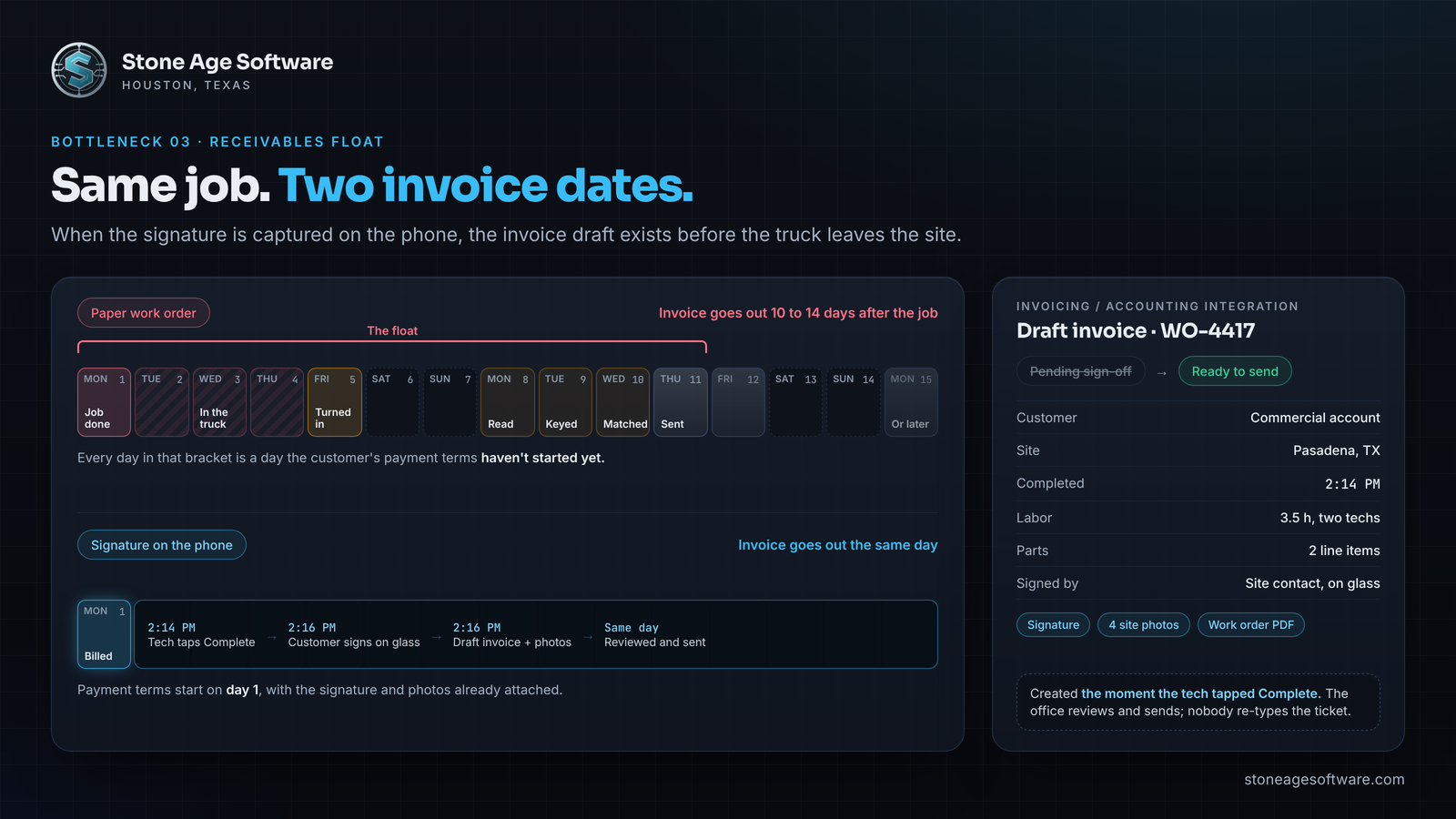
Follow one paper work order through a week. A tech finishes a job on Monday. The work order rides on the dashboard until the Friday turn-in. Early next week, the office reads it, keys it, and matches it. The invoice goes out 10 to 14 days after the work. The customer's payment terms only start then.
What the float costs in cash days
Small businesses don't carry much cushion. A JPMorgan Chase Institute study found the median Houston small business held about 15 days of cash buffer. Nearly half held less than two weeks. That data is from 2020, but the math still holds. A two-week float can eat the whole cushion before an invoice exists.
The strain shows up in Texas. In the Federal Reserve's 2026 Texas chartbook, 60% of employer firms named paying operating expenses as a financial challenge. Nationally, it was 54%.
State law doesn't close the gap. On most private construction, the Texas prompt payment statute gives an owner 35 days to pay after receiving a payment request. That clock starts at receipt. A late invoice pushes the deadline back by the same number of days.
Sign on glass, invoice the same day
The fix is short. The customer signs on the tech's phone at completion. When the tech taps Complete, a webhook drafts an itemized invoice through your invoicing/accounting integration. The signature and site photos ride along. The office reviews and sends it the same day.
Under the Texas Uniform Electronic Transactions Act, a signature can't be denied legal effect just because it is electronic. Federal law says the same.
Lean field apps Houston crews will actually use
Why another platform is not the fix
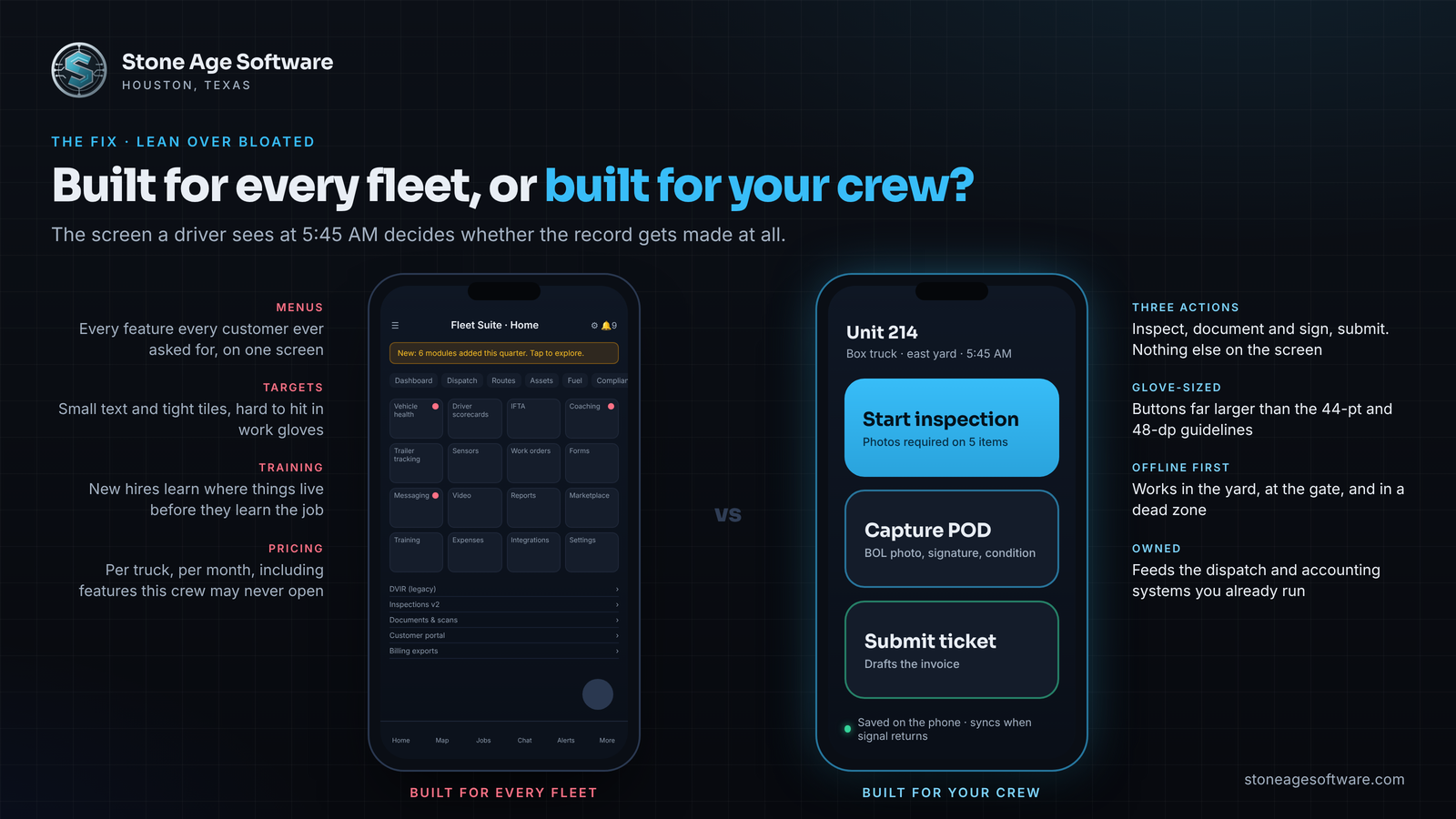
A per-truck, per-month platform demos 50 features, and the crew uses a handful. That is structural, not a vendor failing. Software built for every fleet has to carry every feature any fleet asked for. Pendo's benchmarks show even top products get 80% of clicks from about 16% of their features.
Three buttons, built around your workflow
A purpose-built field app does less, on purpose:
- Inspect. Required photos, automatic stamps, and defects routed to the shop.
- Document and sign. BOL, POD, condition photos, and a signature on glass.
- Submit. The ticket becomes a draft invoice.
The buttons are sized for work gloves, well past Apple's 44-point and Android's 48-dp targets. The app works offline and syncs when signal returns. It feeds the dispatch and accounting systems you already run, so nothing gets ripped out. You own the code and the store accounts. The build is a fixed price, quoted up front.
One Houston caveat: ordinary phones don't belong in classified hazardous areas at refineries and chemical plants. Plan for rated devices there, or keep capture in the yard and the cab.
That is the approach behind our custom field mobile applications.
Run a paper-bleed audit this week
Size the leak with records you already have:
- Days to bill. For your last 20 jobs, subtract the completion date from the invoice date. Average the result.
- Lost or disputed POD rate. Count last quarter's PODs that were missing, unreadable, or disputed. Divide by total deliveries.
- Inspection proof. Pull 10 recent inspections. Can you show when, where, and how long each one took? Does every defect have a repair sign-off?
- Unbilled standby. Compare a month of gate and dock times against the standby you actually billed.
A rough rule: if days to bill runs past two, or one POD in 50 goes missing, close that leak first.
Where this fits
Efficiency in the field shows up as cash in the bank. A record made at the source means one less dispute, one less day of float, and one less checkmark to defend. When you're ready to look at a field app your crews can own outright, start with one leak. Book a workflow discovery session and we'll map the clipboard you have into the three-button tool your crew will use.