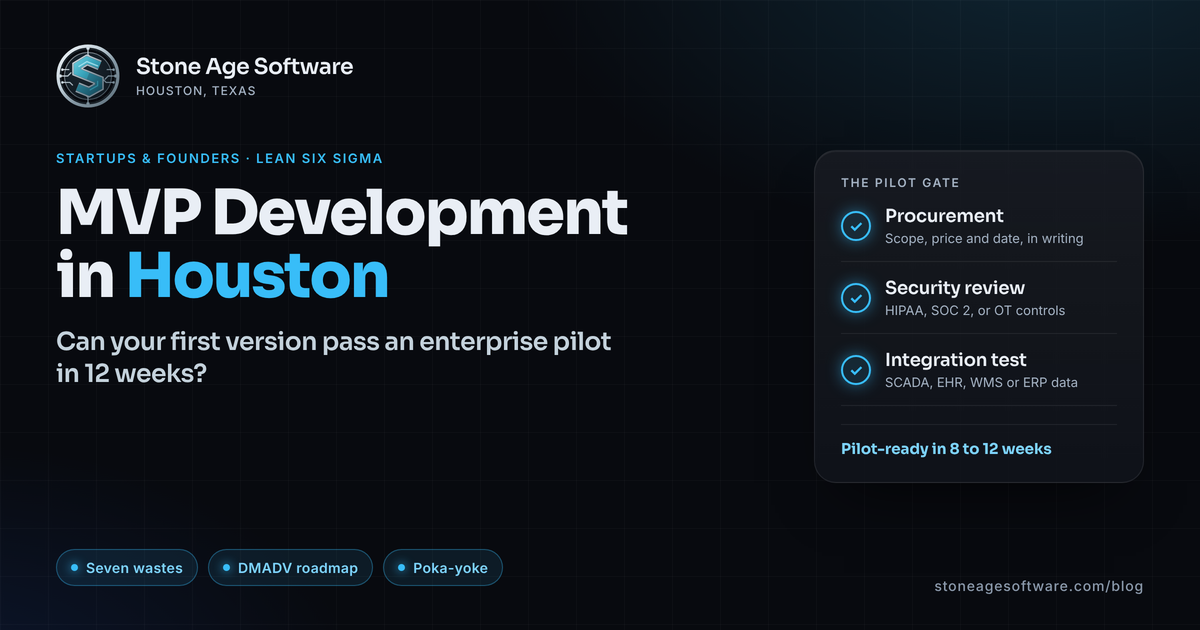
Earlier this month InnovationMap reported that Shape Digital, an industrial analytics company spun out of MODEC, opened its first U.S. office at The Ion on the strength of a Halliburton collaboration. That is what a growth milestone looks like here. In Houston the prize is rarely a spot on an app-store chart. It is a signed pilot with an operator, a hospital system, or a port tenant. That changes what a Houston MVP has to produce. "Move fast and break things" was written for consumer apps with forgiving users. A pilot sponsor at an energy major is not a forgiving user. The first version has to survive procurement, a security questionnaire, and an integration test. Lean Six Sigma gives founders a way to ship that version in eight to twelve weeks, without burning capital on features nobody asked for.
Houston is a pilot market, not an app-store market
Look at where Houston startup software development actually happens. The Ion anchors software and energy-transition teams in Midtown. TMC Innovation runs medtech and digital-health programs inside the largest medical complex in the world. Greentown Labs houses climatetech hardware a few blocks away. The Energy Corridor holds the operators those teams want as customers. Add the Houston Spaceport and Port Houston, and you have four verticals: energy, medtech, aerospace, and logistics.
Every one of them buys the same way. A champion inside the enterprise sponsors a pilot. Procurement, legal, and security then decide whether the pilot becomes a contract. Startup Genome's 2026 report places Houston among its emerging ecosystems, and InnovationMap notes the ecosystem grew 24 percent in 2025 to more than 1,300 startups. The pipeline is real. The gate is enterprise readiness.
Consumer MVP logic assumes you can fix things after launch. Industrial buyers assume the opposite. A SCADA integration that drops a reading, or a patient record that leaks, ends the pilot and the relationship. So the question is not "how fast can we ship?" It is "what is the smallest version that still survives the gate?" Rapid prototyping in Houston only pays off when the prototype is built to pass that review.
The seven wastes of MVP engineering
Taiichi Ohno's seven wastes, or muda, were written for the Toyota production line. The Lean Enterprise Institute keeps the canonical list. Every one has a software twin, and every one has a Lean fix.
- Overproduction. Features built ahead of any evidence a user wants them. Fix: one tested hypothesis sets the scope, and everything else waits on a "later" list.
- Waiting. Developers idle while a decision, a credential, or an API key sits in a queue with no owner. Fix: a weekly working demo, with decisions due before each one.
- Transport. Code handed between front-end, back-end, and QA queues. Fix: one small team that owns the workflow end to end.
- Over-processing. Microservices, Kubernetes, and a design system for a product with twenty users. Fix: a modular monolith on a conventional stack, split only when load proves it.
- Inventory. Half-finished branches, unreleased features, and unread backlog tickets. Fix: capped work in progress, so nothing starts until the last slice has shipped.
- Motion. Six tools to answer one status question. Fix: one board, one repository, one place where the truth lives.
- Defects. Bugs found by the pilot sponsor instead of by a test. Fix: poka-yoke controls and automated tests on every path that carries money or safety.
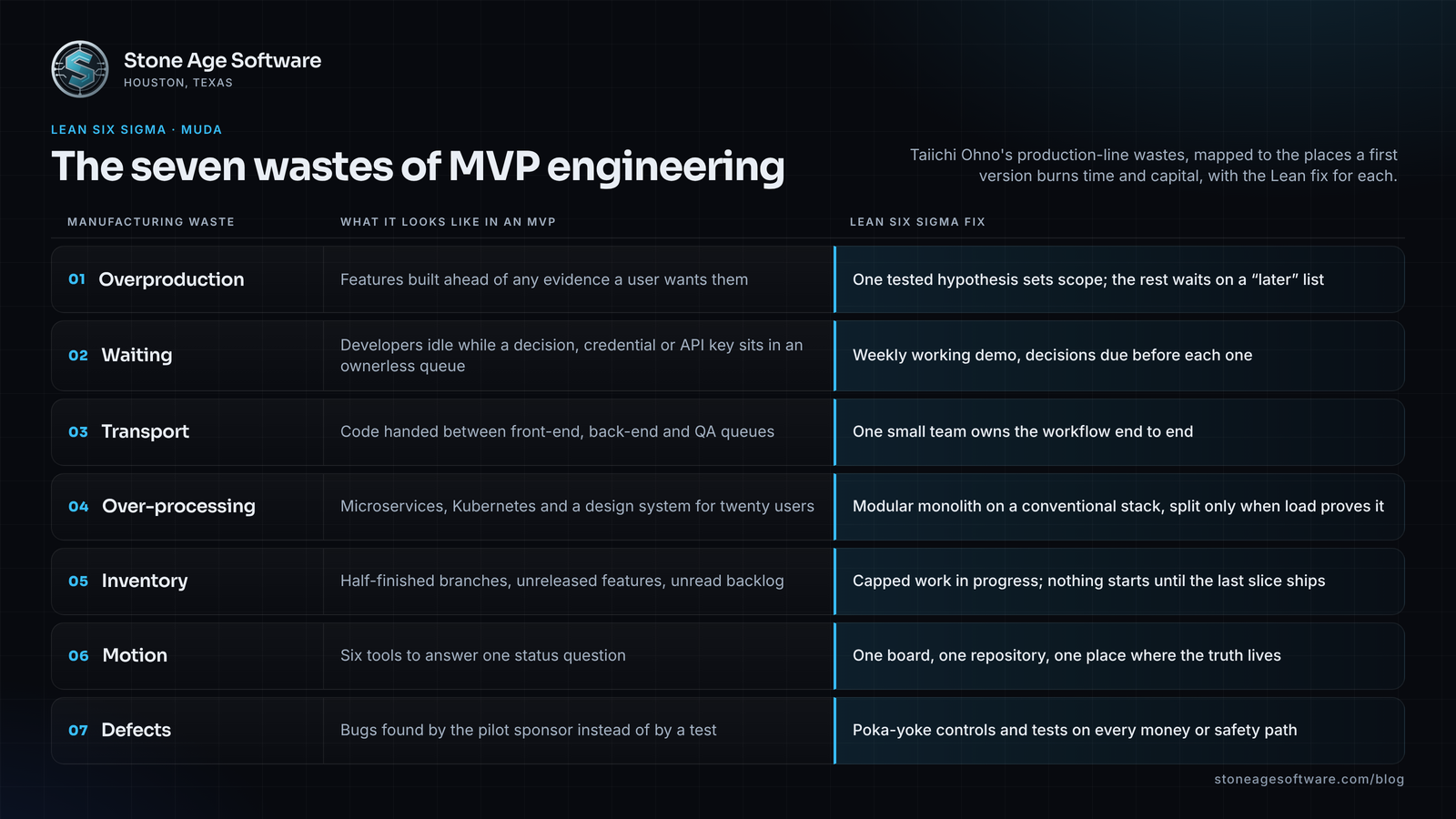
The pattern matters more than any single row. Waste in software hides inside structure: queues, handoffs, and tooling that outgrew the product. It is almost never a people problem, and treating it as one just adds a new queue.
A DMADV roadmap for a pilot-ready MVP
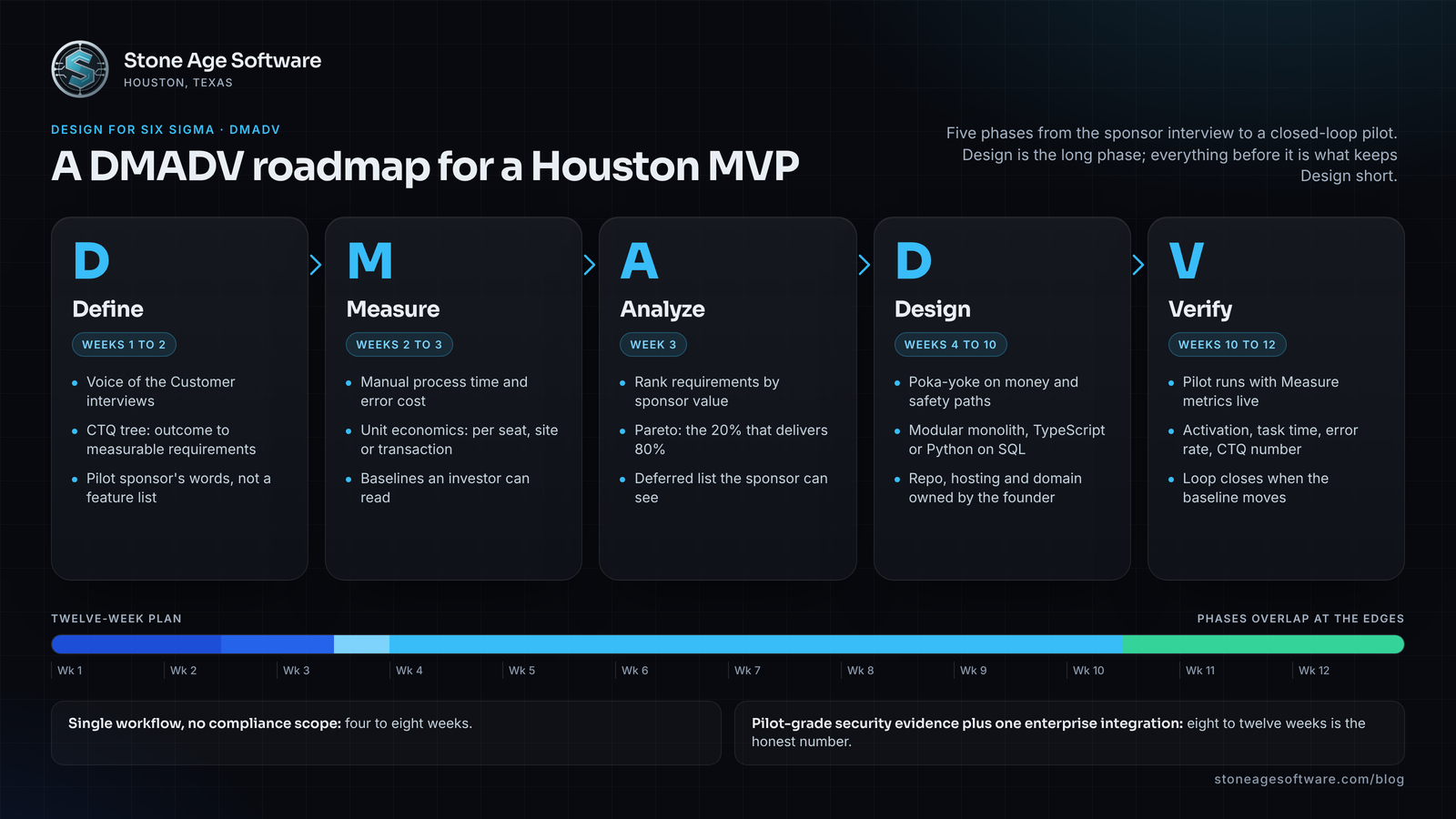
DMAIC improves a process that already exists. A new product has no process to improve, so Design for Six Sigma uses DMADV instead: Define, Measure, Analyze, Design, Verify. Here is how they map onto a Lean Six Sigma MVP for a Houston pilot.
Define: Voice of the Customer and a CTQ tree
Start with the pilot sponsor's words, not a feature list. Interview the operator who will touch the product every day. Write down what "working" means to them. Then build a critical-to-quality tree: the outcome at the root, measurable requirements on the branches. "Reduce reconciliation time" becomes "a variance closes within one shift, with an audit trail." Weeks one to two.
Measure: unit economics and baselines
Capture the current state before anyone writes code. How long does the manual process take? What does one error cost in hours of rework? What will a customer pay per seat, per site, or per transaction? These baselines turn a demo into a business case an investor can read. Weeks two to three.
Analyze: Pareto scoping
Rank the requirements by value to the sponsor. In most pilots, roughly 20 percent of the requested features deliver 80 percent of the outcome. Build that slice first. The remaining 80 percent is deferred, not refused, and the sponsor sees the list. Week three.
Design: poka-yoke and modular architecture
Poka-yoke means mistake-proofing. In software it means the system refuses the bad input instead of logging that someone was warned. One Stone Age project, a safety equipment inspection kiosk, treats an unticked inspection box as a failed point and takes the equipment out of the pool automatically. That single design decision turned a checklist into a control. The software handles the refusal, and the supervisor spends attention on the exception instead of the paperwork. Build the same reflex into your MVP's money paths and safety paths.
Architecture follows the same logic. Use a modular monolith in TypeScript or Python over a SQL database. Separate modules along business boundaries, so a future team can split them if load ever demands it. Register the repository, hosting, and domain to the founder's company on day one. Weeks four to ten.
Verify: closed-loop pilot metrics
Verification is not a launch party. It is the pilot running with the numbers from Measure wired into a dashboard the sponsor sees. Activation rate, task time, error rate, and the one number at the root of the CTQ tree. The loop closes when the sponsor watches the baseline move. Weeks ten to twelve.
A single-workflow first version with no compliance scope still runs four to eight weeks. Add pilot-grade security evidence and one enterprise integration, and eight to twelve is the honest number.
Dev shop, agile agency, or Lean Six Sigma partner?
Founders searching for a Houston software development agency meet three kinds of partner. The differences show up in diligence, not in the demo.
Traditional dev shop. Builds the spec as written. Quality assurance happens at the end. Compliance is an afterthought. Architecture is whatever the team already knows. Investor diligence gets a demo. The commercial model is hourly and open-ended.
Generic agile agency. Runs a rolling backlog, sprint by sprint. Tests get written when time allows. Compliance arrives shortly before launch. Architecture is often over-built for the user count. Diligence gets a demo plus a backlog. The commercial model is a sprint retainer.
Lean Six Sigma MVP partner. Scopes one hypothesis into a Pareto-sized slice. Puts poka-yoke on the critical paths from day one. Carries compliance in the CTQ tree. Ships a modular monolith on a conventional stack. Diligence gets baselines, an architecture note, and a clean commit history. Fixed price, quoted up front.
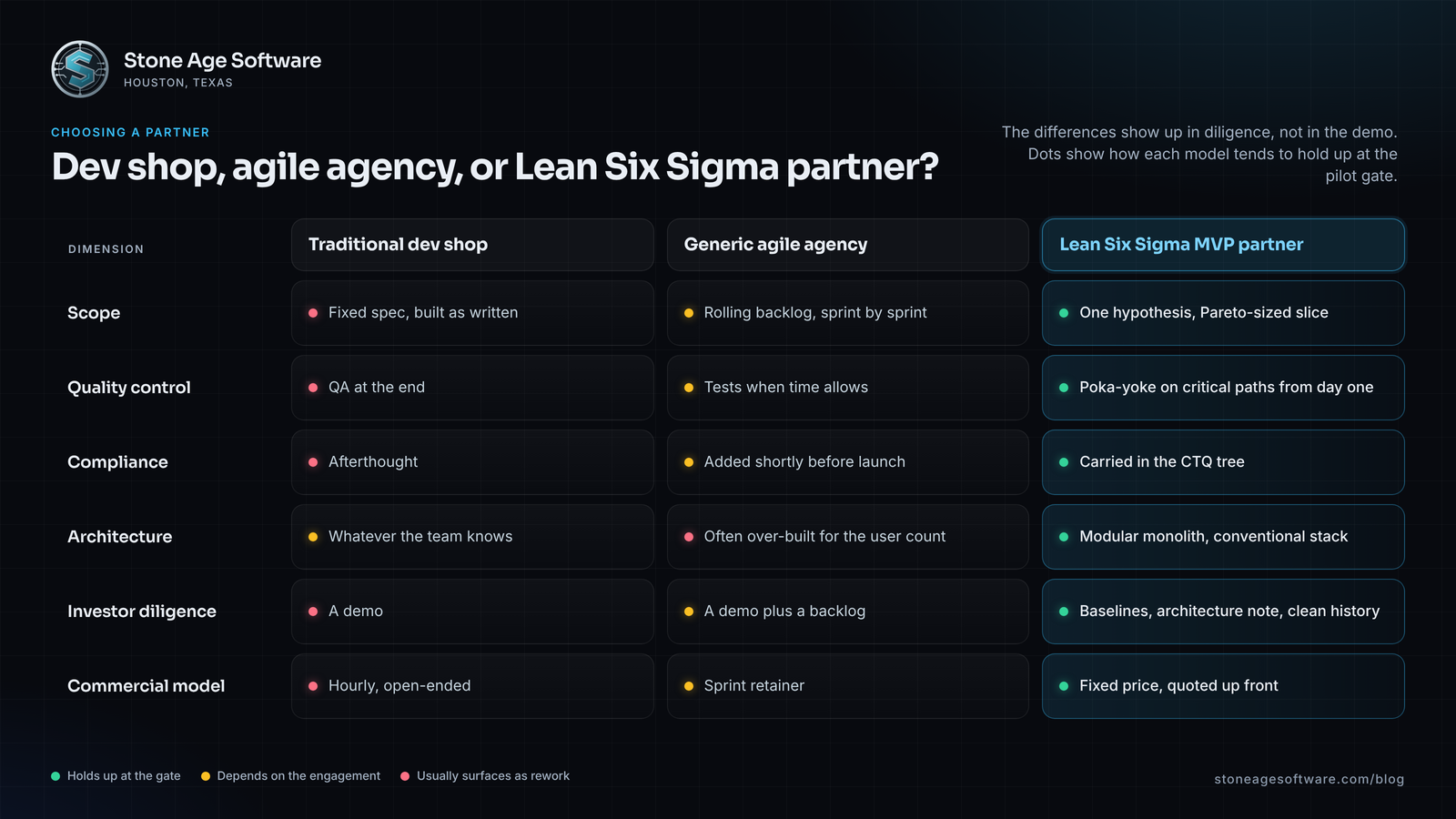
That third model is how Stone Age Software approaches custom software in Houston for founders. None of these partners replace the founder's judgment. The method exists to protect that judgment from waste.
Pilot readiness in Houston: compliance is part of the MVP
Each Houston vertical has a gate your first version will meet. Designing for it in week one costs less than retrofitting it in week eleven.
- MedTech and TMC pilots. Any product that handles patient data for a hospital system works under the HIPAA Security Rule as a business associate: administrative, physical, and technical safeguards for electronic health information. A proposed overhaul of that rule is still pending, with a final rule now expected in 2027. Design for the stricter version.
- Enterprise procurement. Energy and logistics buyers increasingly ask for a SOC 2 report or a credible path to one. Role-based access, audit logging, and change control need to exist from the first commit, not as a retrofit.
- Industrial integrations. Anything that reads from SCADA systems or plant historians lives under operational technology rules. NIST SP 800-82 Rev. 3 and the ISA/IEC 62443 series set the expectations: segmented networks, read-only access by default, and no write path without a control.
Poka-yoke is the thread through all three. A server-side gate that blocks a sign-off on a failed check is a compliance control and a quality control at once. Build it once and it answers three questionnaires.
A check you can run this week
Take your current feature list and your pilot sponsor's last email. Underline every feature the email actually asks for. Count what is left. If more than a third of the list has no sponsor sentence behind it, the scope is overproduction. Then ask one more question. On the path where money or safety moves, does the software refuse the bad input, or just record it? A "record" answer is a defect waiting for the pilot to find it.
If the list came back heavy, the cheapest fix is a scoping conversation before any code. Our startup MVP development page explains the discovery workshop: find the bet, cut to the first slice, and put a number on it, fixed price, quoted up front. Bring the feature list and the sponsor's email.