Amazon said on October 20 that it plans to hire more than 300,000 people in the U.S. for the holidays. Retail Dive reports that is 20% more than the 250,000 it has hired each season since 2023. Peak brings new faces to warehouses everywhere. Each one adds a badge tap, a seat in a briefing and a turn at the equipment cage.
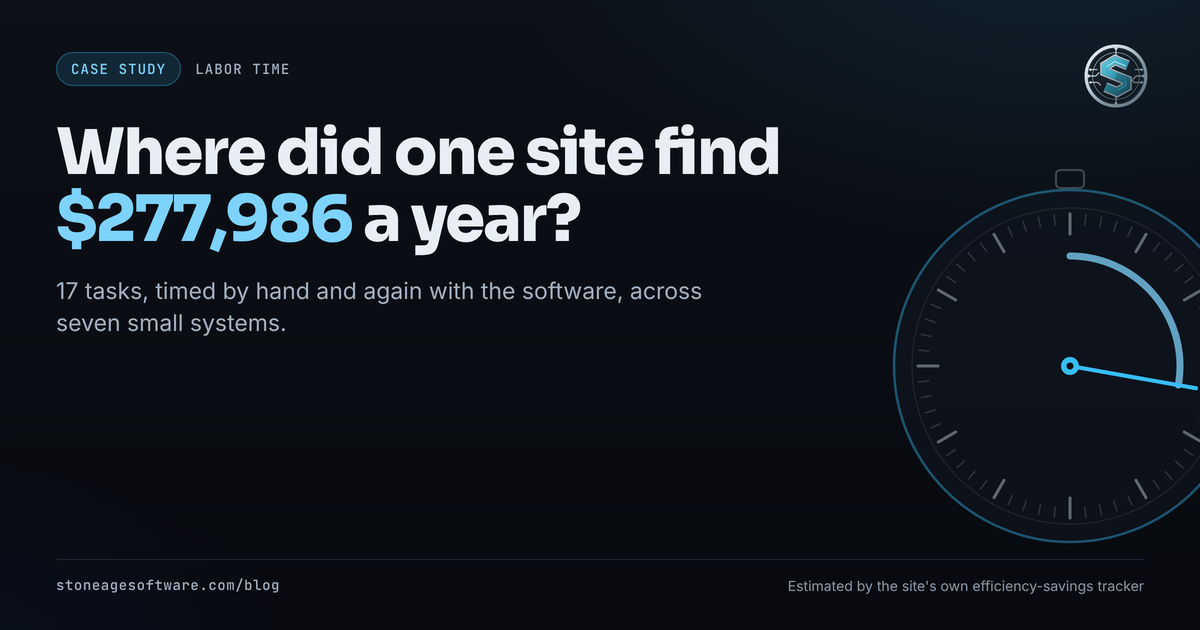
Those small waits are where many operators can reduce warehouse labor costs without buying a new platform. At one contract-logistics site, seven small systems we built gave back an estimated $277,986 a year in labor time. The site's own tracker timed 17 tasks by hand. Then it timed them again with the software.
Here is where the time was hiding, and how to look for it at your site.
How the site counted the savings
The figure comes from the site's efficiency-savings tracker, not from a sales deck. Each task was timed the old way first. Then it was timed with the software doing its share. The difference was valued at a fully loaded labor rate over a 252-day working year. That is roughly a five-day week, less holidays.
Fully loaded matters. A wage is only part of what an hour costs. In June 2026, benefits made up 31.4% of compensation costs for private-industry transportation and material moving workers, according to the Bureau of Labor Statistics. Leave that out and every estimate comes in low.
The tracker counts labor time only. It puts no value on a short order caught before the truck left. It ignores chargebacks avoided and audit findings that never happened. Those gains can be real, but they are not in the number.
We keep the client, the site and the volumes confidential. The minutes, rates and headcount behind each figure stay private too. What we can share is the pattern, and the full savings table shows each system's total.
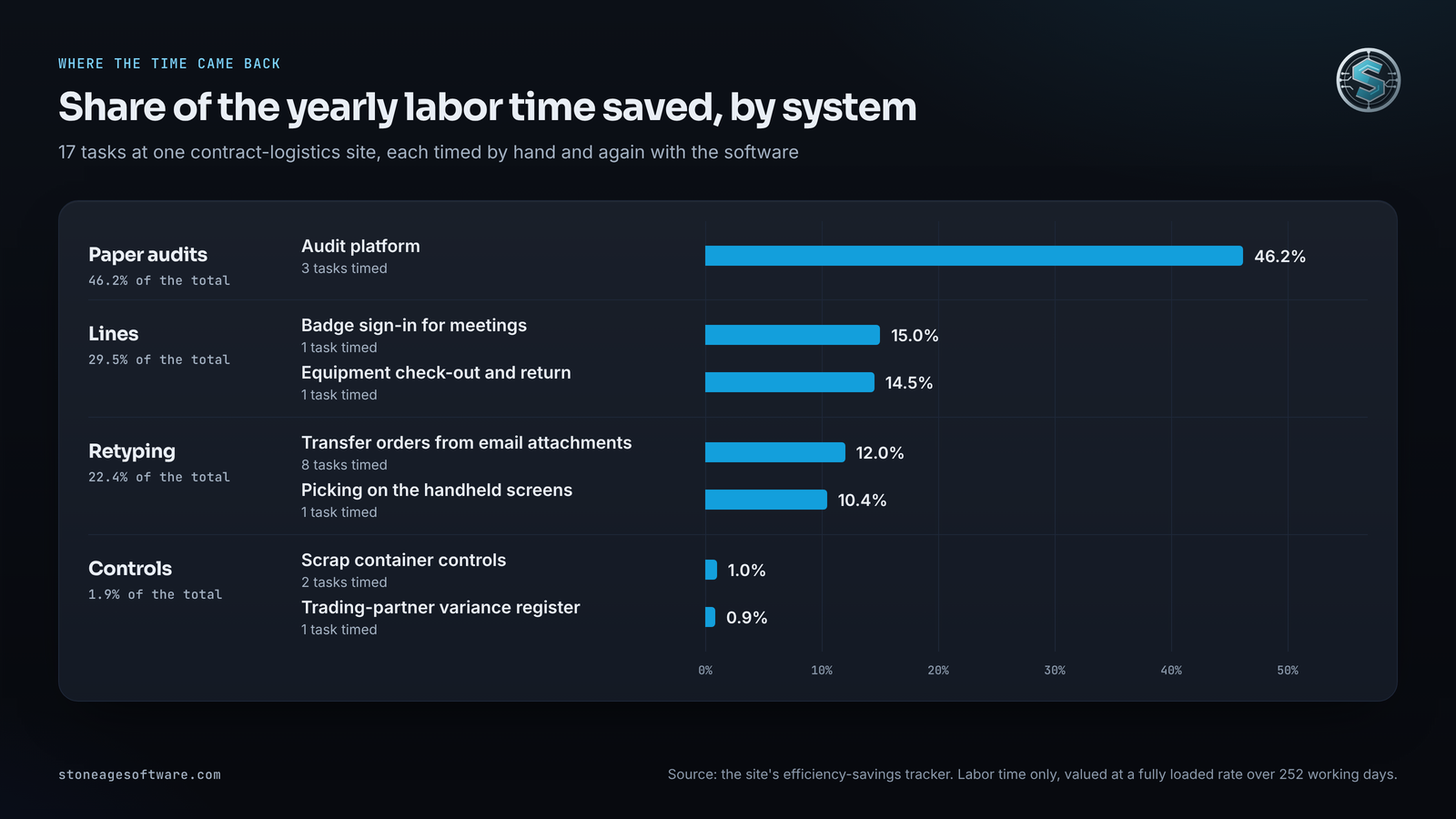
Paper audits were the biggest seam
Paper proves an audit happened. It does not prove anything was checked. Nobody can say who did it, how long it took or where it was finished.
At this site, quality results were owed to the end customer under contract. The evidence lived on paper forms and in a general-purpose survey tool. That tool could not report across responses.
We built an audit platform where a failed audit cannot be quietly signed off. Each form is configuration, not code. The outbound audit compares every scan with the order. A mismatch blocks submission and emails leadership. Only a manager who signs in again and types a reason can override it.
A monthly housekeeping audit had one rule that mattered: nobody audits their own area. That rule used to depend on whoever built the schedule. Now the rotation enforces it. It never assigns auditors to their own area or reuses one within a cycle.
The time came back in three tasks:
- Outbound verification audits
- Quality audits
- Exporting the order data each audit checks against
Together they make up 46% of the total. The speed and the control arrived together. Reports that paper could never answer now come from the same records.
Lines multiply every lost minute
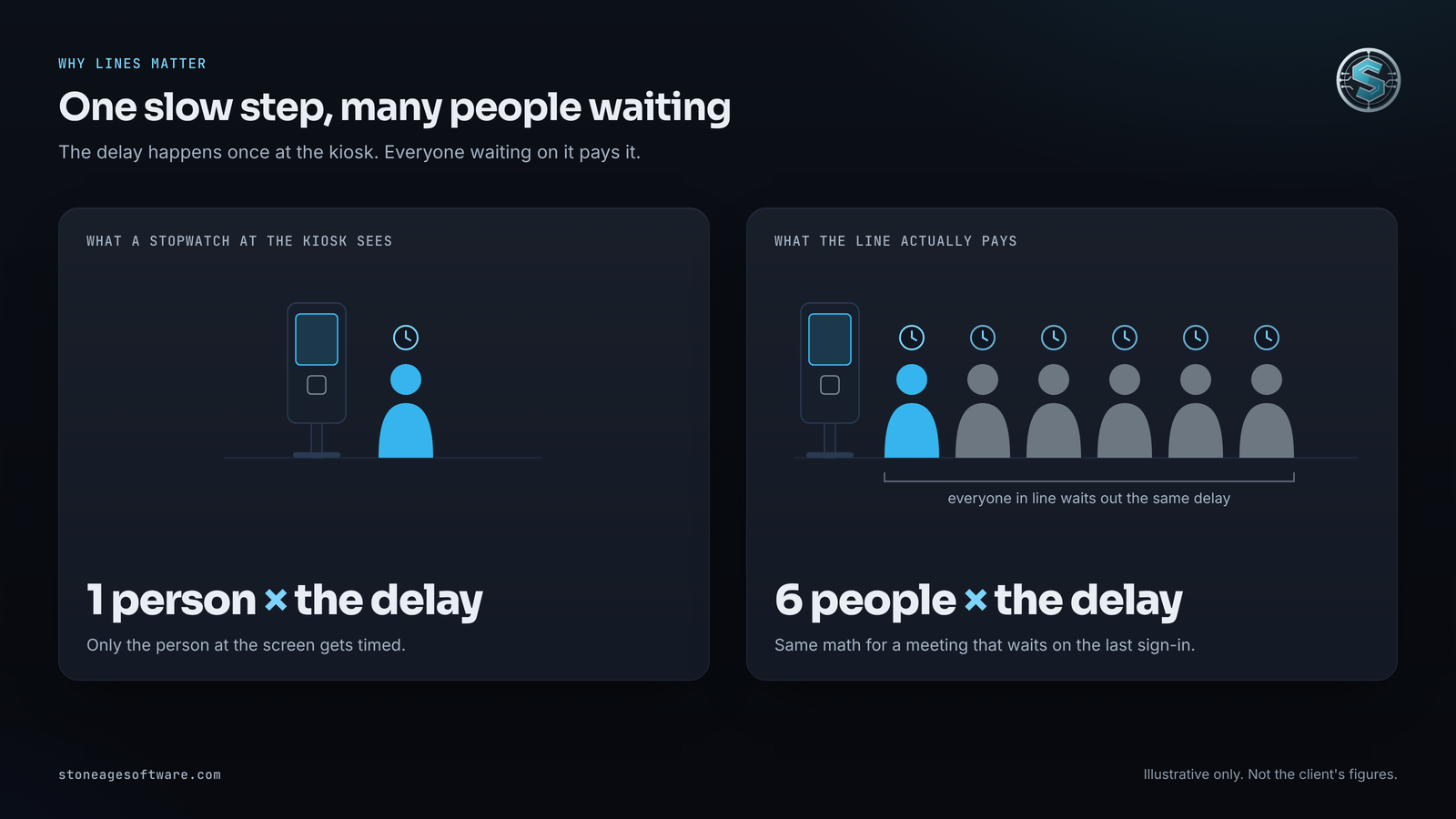
The second pattern is easy to miss. A person waiting at a kiosk is rarely alone. For two of the seven systems, the savings were counted across a whole line of people.
Badge sign-in for meetings. A meeting cannot start until the last person signs in. So every attendee waits out the line. The kiosks ran in a browser, and a browser cannot reach a badge reader without per-machine setup. We built a small local service that bridges the reader to the page. It also restarts itself when the reader stops answering.
Equipment check-out and return. Everyone in the queue waits out each check-out ahead of them. OSHA requires powered industrial trucks to be examined before they go into service, at least daily. The site ran that check on a clipboard. Our badge kiosk lets the truck decide the inspection. An unticked box counts as a failed point. A failed item locks out of the pool until an administrator clears it.
Each of those systems produced about 15% of the savings. Together that is almost 30%. A stopwatch on the person at the front sees one wait. The tracker counted everyone who was waiting.
Peak season makes these lines longer. Every new hire adds a badge to read and a check-out to wait on.
Look for the same shape at your site. A shift-start huddle waits on the last arrival. A shared label printer builds a queue at the pack bench. One slow step can hold up a whole crew.
Stop retyping what another system already knows
About 22% of the savings came from typing. The data already existed somewhere else. People were moving it by hand.
Transfer requests. Requests to move inventory arrived as spreadsheets attached to email. Every requesting team sent a different shape. Someone keyed each line into an order. Now a pipeline builds the order from the attachment. It checks every line against live balance first. Lines that fail are dropped and reported, so a person can follow up. That one system covered eight of the 17 tasks, about 12% of the total.
Picking on the handheld screens. The customer-owned warehouse platform had no write interface. Every transaction went in through its screens. So we automated the screens themselves, the way an experienced operator would. Jobs are claimed before they start, so two sessions never pick the same order. Unusual cases stop and escalate with the item, location and reason attached. That task alone was about 10% of the total.
Retyping costs more than minutes. Errors against live inventory are slow and expensive to unwind. On the transfer side, reference numbers used to come off a shared running list, which works until two people use it at once. Now each number is reserved in the database before use.
Both builds moved people from keying data to checking exceptions.
Two systems pay off mostly in control
Not every build is a labor play. Two of the seven accounted for about 1% of the savings each.
The scrap controls watch material leaving the building. Before, nothing caught inventory dropped into a container after its paperwork was filed. Now a background check compares each container with its closing snapshot and raises an alert.
The variance register keeps every inventory variance on the trading partner's report. Each line keeps its age and its history. Only the system can close a line, and only when the variance is actually gone.
Together they produced under 2% of the savings. Their bigger payoff is control, and the tracker does not count control. When a project pays in control, say so up front. Do not dress it up as a labor play.
Seven small builds, no platform swap
None of the seven replaced the warehouse platform. That platform belonged to the customer, so the work had to fit around it. Each build closed one seam: a form, a line, an attachment or a screen.
Because each build stands alone, each one shows up in the tracker on its own. Nobody has to argue about which change saved what.
The total stays traceable too. It adds up 17 task-level estimates, each from its own before-and-after timing.
How to reduce warehouse labor costs at your site
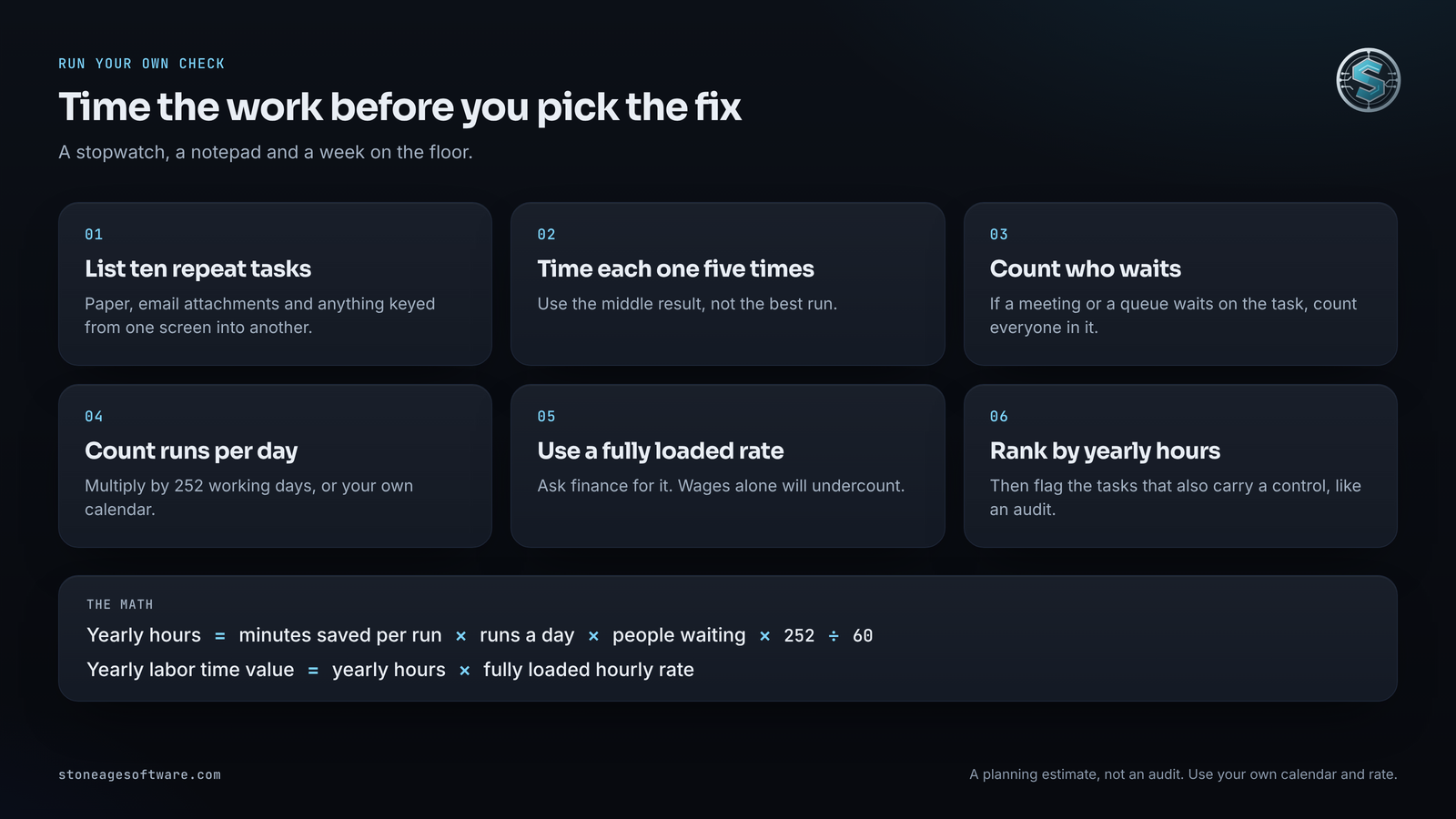
You can run a rough version of this check in a week. Bring a stopwatch and a notepad. Stand where the work happens, because a process map will not show the line.
- List ten repeat tasks. Look for paper, email attachments and anything keyed from one screen into another.
- Time each one five times. Use the middle result, not the best run.
- Count who waits. If a meeting or a queue waits on the task, count everyone in it.
- Count runs per day. Multiply by 252 working days, or your own calendar.
- Use a fully loaded rate. Ask finance for it. Wages alone will undercount.
- Rank by yearly hours. Then mark which tasks also carry a control, like an audit or a safety check.
Your top three are the shortlist. Most will not need a new platform. They need the seam between two systems closed, so people spend their shift on judgment calls instead of keystrokes.
Our Legacy Modernization & Migrations practice does this work, alongside our logistics integration and custom software practices. We replace the clipboard, the attachment and the retyped screen, and keep the systems you already run. Work starts with an assessment, and the build is a fixed price, quoted up front.