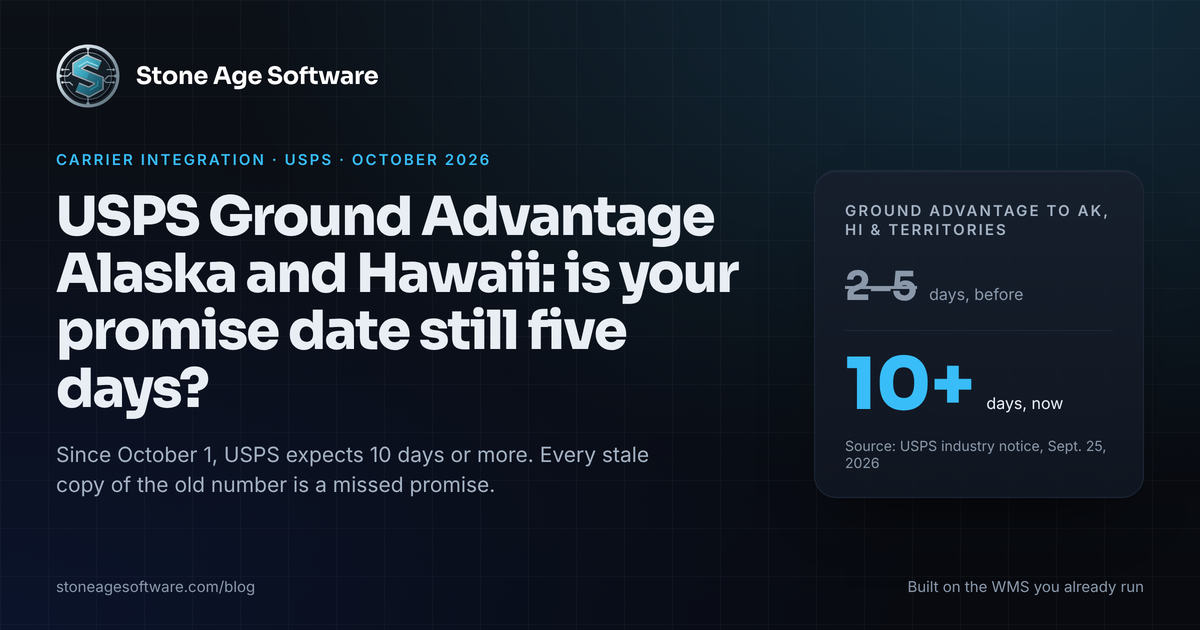
Picture a parcel that leaves your dock on a Monday in October. It is bound for Anchorage on USPS Ground Advantage. Your client's checkout told the shopper it would arrive in five days. The rate shop picked it because the transit table said five days. Your late-shipment alert will fire on day six. All three numbers came from the same old table. As of October 1, the USPS Ground Advantage Alaska expectation is 10 days or more. Nothing in your stack had to break for this to go wrong. One number changed at the carrier, and every copy of it downstream stayed put.
This article walks through what USPS changed, where the old transit number tends to hide in a 3PL's systems, and a short check you can run before peak.
What USPS changed on October 1
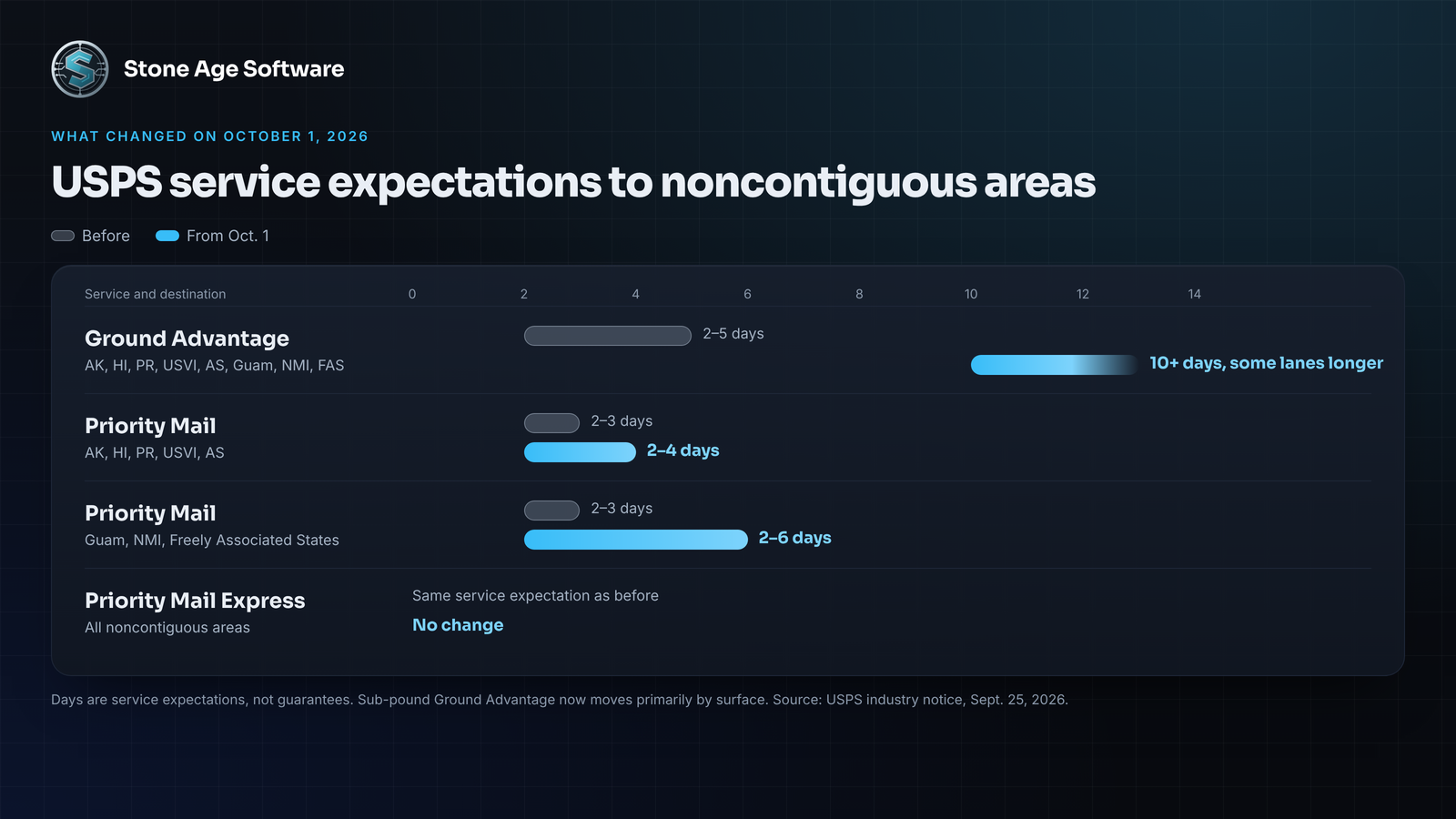
On September 25, USPS published an industry notice titled Adjustments to Priority Mail and USPS Ground Advantage Service Expectations for Noncontiguous States and Territories. It took effect October 1, 2026. The key changes:
- USPS Ground Advantage between the contiguous US and the noncontiguous areas now carries a 10-day-or-more expectation. USPS says some lanes may be significantly longer than 10 days.
- Sub-pound Ground Advantage packages now move primarily by surface, the same as heavier ones. Before, they used a mix of air and surface.
- Priority Mail to or from Alaska, Hawaii, American Samoa, Puerto Rico and the US Virgin Islands moves to 2 to 4 days. It was capped at 3.
- Priority Mail to or from Guam, the Northern Mariana Islands and the Freely Associated States moves to 2 to 6 days.
- Priority Mail Express does not change.
The areas covered are Alaska, Hawaii, American Samoa, Guam, the Northern Mariana Islands, Puerto Rico and the US Virgin Islands. The Federated States of Micronesia, the Marshall Islands and Palau are included too.
USPS gave two reasons. One is setting realistic expectations given distance and transportation options. The other is keeping hazardous material out of air transport. Supply Chain Dive's coverage puts the change in context with the wider USPS network overhaul.
Why the USPS Ground Advantage Alaska change breaks quietly
A rate increase is loud. It shows up on the invoice and somebody asks about it. A transit change is quiet. The label still prints. The tracking number still works. The parcel still arrives, just later than every system promised.
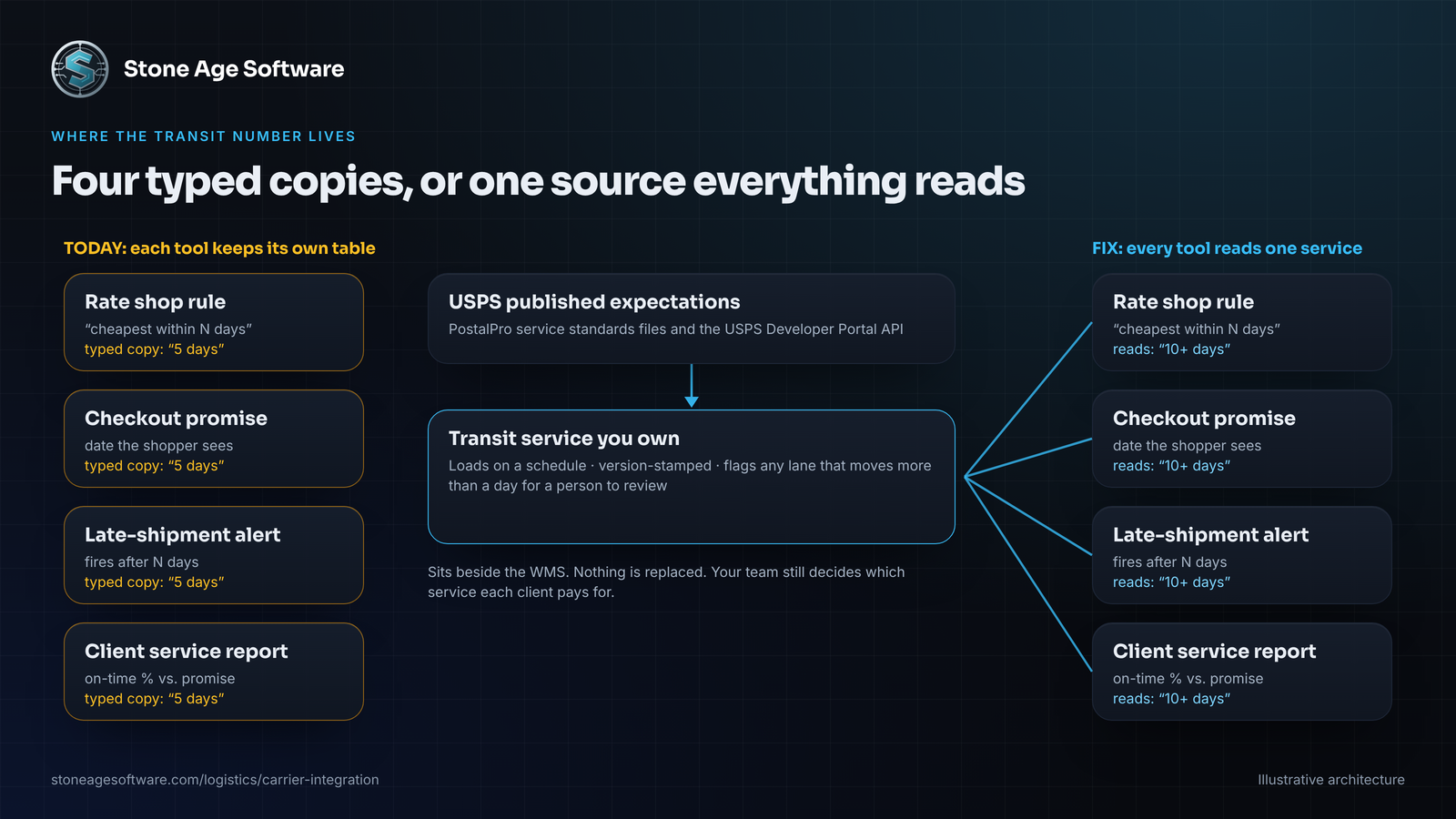
The problem is structural. Most 3PL stacks keep transit days in more than one place. Each copy was correct when it was entered. Nothing ties them back to the carrier's published expectation. So when USPS moves the number, each copy has to be found and changed by hand.
That is a seam between systems, not a mistake by anyone. The WMS ships the order. The shipping layer picks the service. The storefront shows a date. The alerting tool watches the clock. Each one owns a slice, and none of them owns the transit number.
Four places the old number is still hiding
Here is where we usually find a stale transit table in a 3PL operation:
- The rate shop rule. Many rules read "cheapest service that arrives within N days." If the table still says Ground Advantage reaches Honolulu in five days, the rule keeps picking it for orders that need Priority Mail.
- The promise date on checkout or order confirmation. Your client's storefront or order portal may compute a delivery estimate from its own table. Shoppers in Alaska and Hawaii now see a date USPS no longer stands behind.
- Late-shipment alerts. A late alert keyed to the old allowance fires too early. Your team spends time chasing parcels that are on schedule. The real exceptions get buried under the noise.
- Client service reports. On-time percentages are measured against an expected date. Use the old number and your on-time rate looks worse than it is. That can turn into an awkward client review.
Two more spots are worth a look:
- Hazmat routing logic. Some shops send light hazmat items by Ground Advantage to keep them off air. Sub-pound items already move by surface now. The rule may still work, but the transit promise attached to it does not.
- Customer service scripts. If your team quotes delivery times by phone, the script may carry the old number too.
The holiday calendar makes it sharper
Peak is when transit promises matter most. The USPS 2026 holiday shipping deadlines page lists recommended send-by dates for Alaska, Hawaii, Puerto Rico and the territories. For Ground Advantage, the listed date is December 16.
The same page adds a caution. Ground Advantage to or from offshore ZIP codes may take longer. USPS tells shippers to check the estimated delivery date for those ZIP codes. Read that next to the new 10-day-plus expectation. A single chart date is a starting point, not a cutoff your software should trust on its own.
For a 3PL, this lands in three places:
- Client cutoff messaging. If your clients run "order by" banners, the noncontiguous date may need to come earlier than the chart suggests.
- Service upgrades. Some clients will want Priority Mail for these lanes during December. That is a cost decision for them, not for your rate shop default.
- Exception staffing. Late calls from Alaska and Hawaii shoppers will land somewhere. Better they land on a queue with an owner than in a general inbox.
The point is not to guess for your clients. It is to give them accurate numbers so they can choose.
Pull the expectation from the source, not a spreadsheet
USPS publishes its expectations in forms software can read. The USPS service standards pages on PostalPro carry downloadable files and their specifications. The notice also points to service standards files and API specs on the USPS Developer Portal. For one-off checks, the USPS ZIP-to-ZIP service commitments lookup shows expected dates by mail class.
So the fix is not another spreadsheet. It is one place that owns the transit number and feeds everything else. In practice that looks like this:
- A small transit service that sits beside your WMS. It loads the published files on a schedule and stamps each load with a version date.
- Every consumer reads from it. The rate shop, the promise date, the late alert and the client report all ask the same service.
- A change report on each load. When a lane moves by more than a day, a person sees it before customers do.
- Owned exception queues. Parcels past their real allowance go to a named queue, not an inbox.
Nothing here replaces your WMS or your shipping software. It sits on top of what you already run. Your team still decides which service a client should pay for. The software just makes sure everyone is reading the same number.
We built this pattern for an inbound receiving operation. Carrier status flows into one integration engine. Revised arrival dates land on the open shipment record. Anything past its transit allowance drops into a research queue with an owner. You can read how it works in our inbound freight visibility case study. The same structure applies to outbound transit promises.
A 20-minute check you can run this week
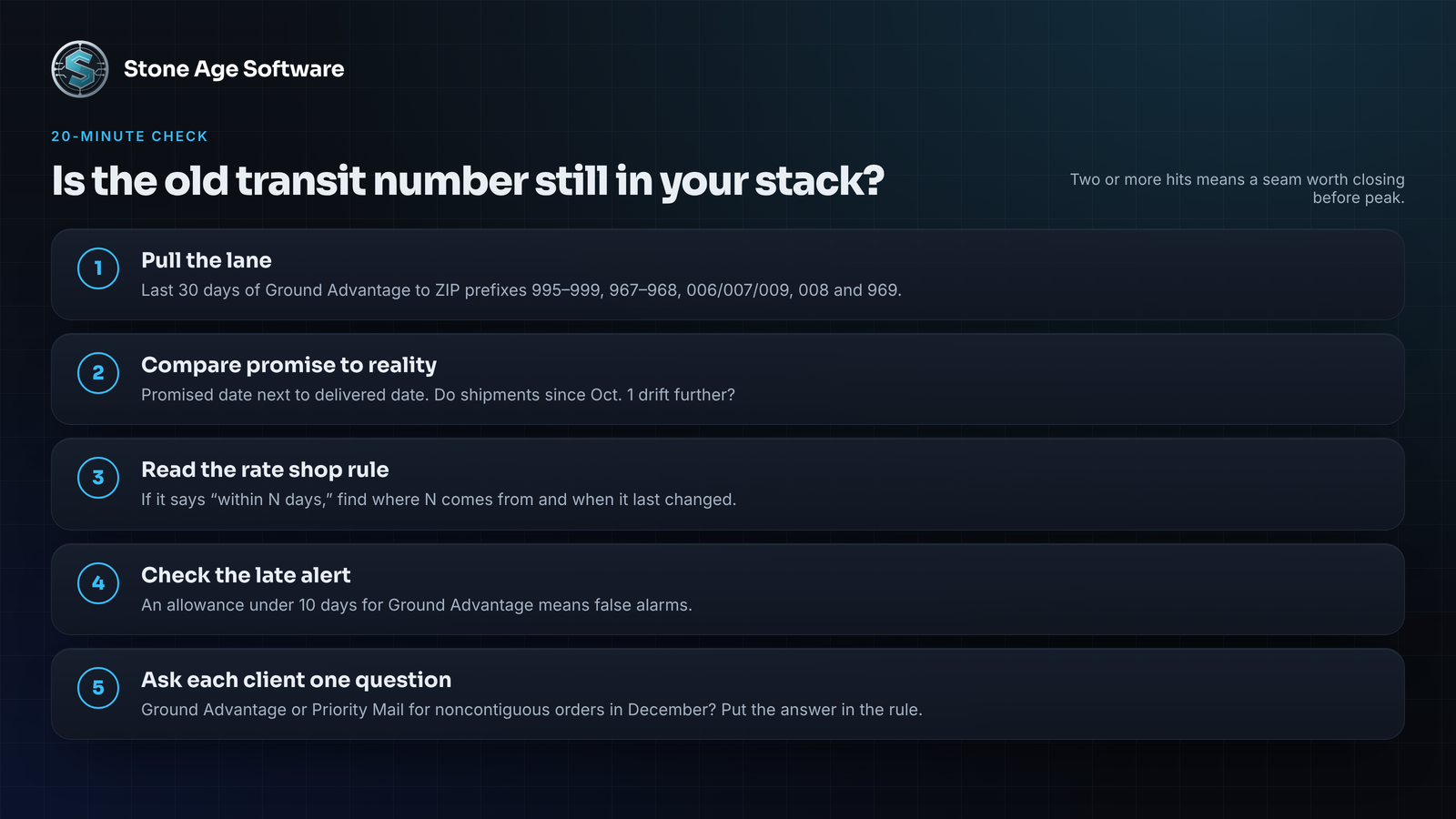
You do not need a project to find out whether you are exposed. Run this with a shipment export and one person who knows your rate shop rules.
- Pull the lane. Export the last 30 days of Ground Advantage shipments. Filter to ZIP prefixes 995 to 999 for Alaska, 967 and 968 for Hawaii, and 006, 007 and 009 for Puerto Rico. Add 008 for the US Virgin Islands and 969 for Guam and the Pacific territories.
- Compare promise to reality. For each shipment, put the promised date next to the delivered date. Count how many arrived after the promise. Note whether shipments since October 1 drift further.
- Read the rate shop rule out loud. If any rule says "within N days," find where N comes from. If it is a typed table, write down when it was last changed.
- Check the late alert. Find the allowance your alerting uses for these lanes. If it is under 10 days for Ground Advantage, expect false alarms.
- Ask each client one question. Do they want Ground Advantage or Priority Mail for noncontiguous orders during December? Write the answer into the rule, not into an email.
If all five come back clean, you are in good shape. If two or more show the old number, you have a seam worth closing before peak volume arrives.
Closing that seam is what our carrier integration practice does. We build the layer that keeps carrier rules, transit expectations and exception queues in one place you own outright, on top of the WMS you already run. The work is fixed price, quoted up front.