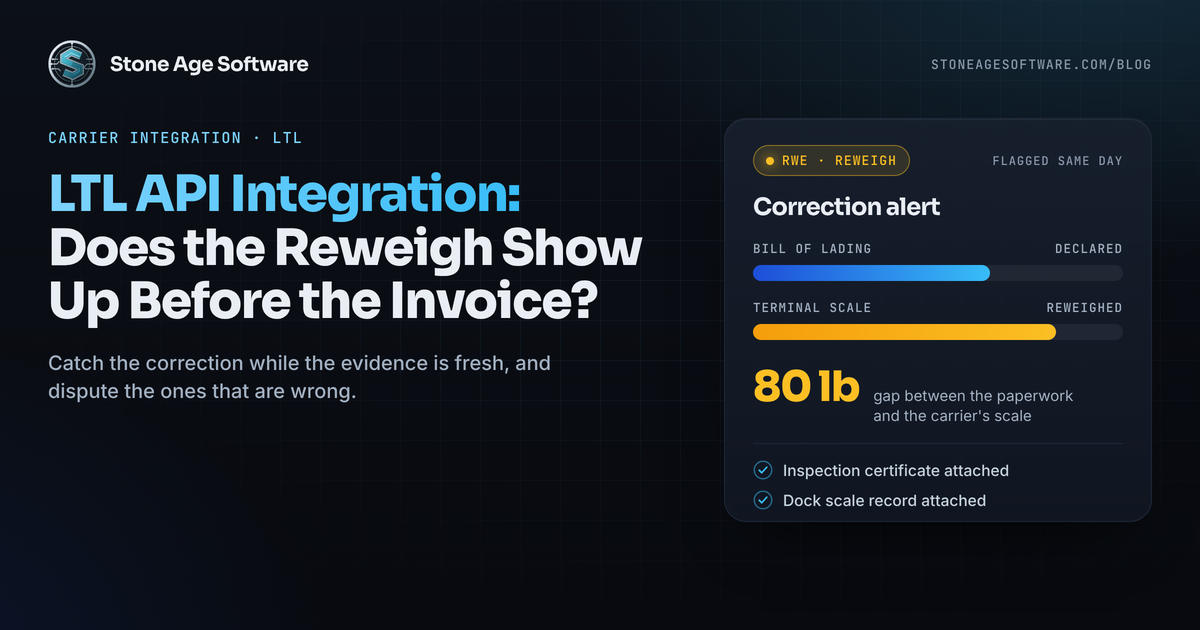
A client of ours recently sent a small LTL shipment on a routine quote. At the carrier's terminal, the scale and the bill of lading disagreed by 80 pounds. The corrected invoice came back at more than seventy times the quote.
Most corrections are far smaller. The timing is usually the same, though. For many shippers, the first word of a reweigh is the corrected invoice, weeks after the freight left the dock. By then the pallet is delivered, and the dock scale reading was never saved anywhere.
LTL API integration changes when you find out. Below is why a small weight gap grows into a large bill. After that comes what a direct connection to your LTL carriers shows you, and how to dispute a correction that does not hold up.
Why an 80-pound gap can become a much larger bill
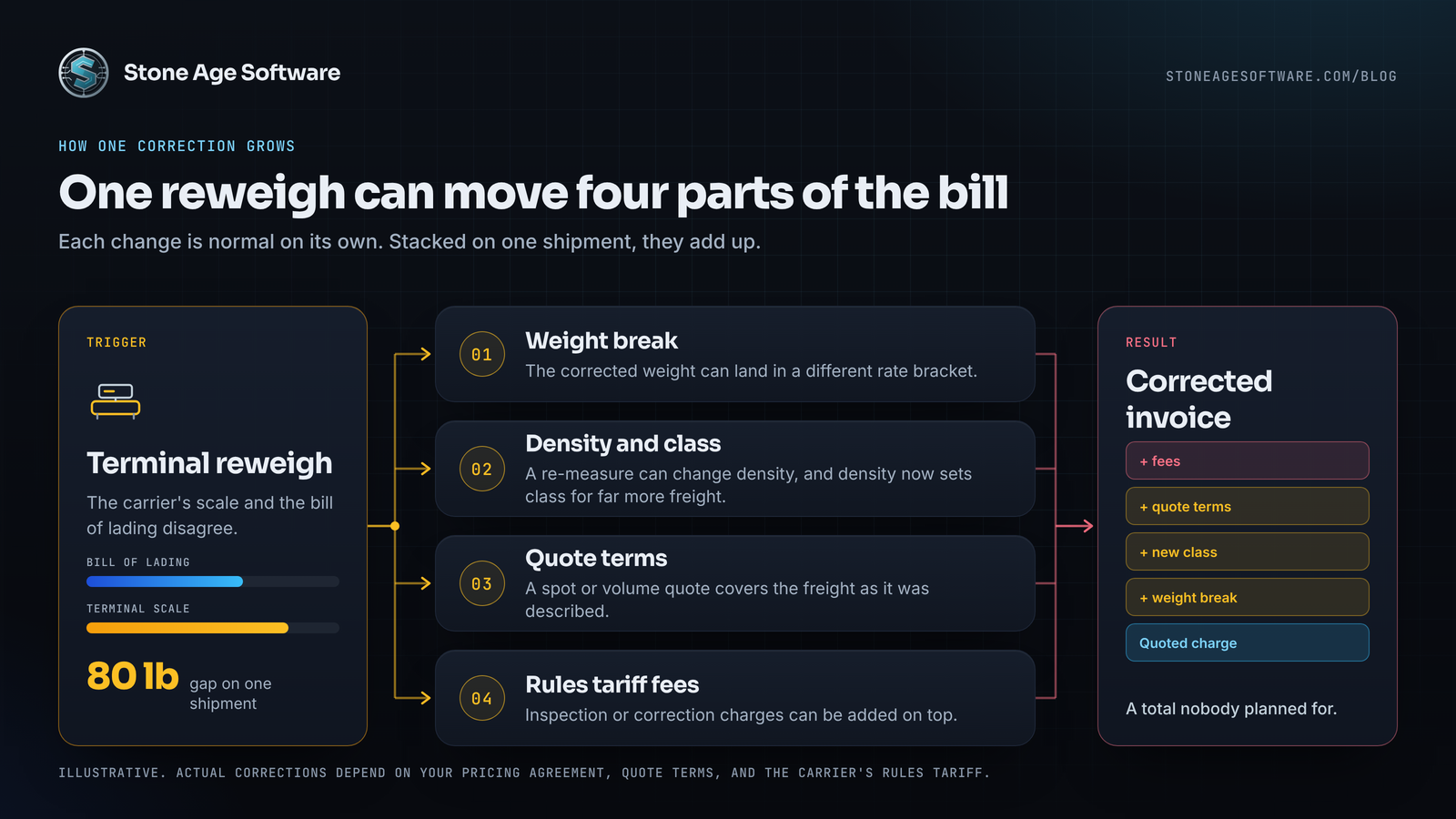
A reweigh rarely changes just the weight. An LTL price is built from several numbers, and one correction can move several of them at once.
- Weight breaks. LTL rates change as a shipment crosses weight thresholds. A corrected weight can land in a different bracket.
- Density and class. Since the July 2025 classification overhaul, density sets the class for far more freight. If the carrier re-measures as well as reweighs, the class can change too.
- Quote terms. A spot or volume quote is priced for the freight as described. Its terms say what happens when the freight does not match.
- Fees. The carrier's rules tariff can add inspection or correction charges on top.
Each of these is normal on its own. Stacked on one shipment, they can produce a bill nobody planned for.
Mixed pallets carry one more risk. Under the current rule, carriers usually charge a poorly documented mixed pallet at the class of its highest-classed article. A Kuehne+Nagel executive told Trucking Dive in September that this puts the burden on the shipper to dispute the charge. A proposal to class mixed pallets by the density of each handling unit went to a public meeting on September 29. On October 9, the National Motor Freight Traffic Association published its disposition of the proposal. It was disapproved, and the current rule stays in place.
So the paperwork still decides the class. What is on the bill of lading, and what you can prove, matters as much as ever.
Where the weight on the bill of lading comes from
None of this is a people problem. It is a data path problem.
In many warehouses, the weight on the bill of lading comes from the order. The system adds up item master weights and prints the total. The pallet, the stretch wrap, and the dunnage never make it into that number. Neither does a carton swapped at the pack station.
The dock may have a good scale. Its reading often stays on the scale's display. Someone copies it onto paper, or the moment passes.
The carrier's terminal scale has no such gap. Its reading goes straight into the carrier's billing system. When the two numbers disagree, the carrier's number is the one on record.
We covered the dimension side of this in our article on mixed pallet freight class. The fix starts the same way. Weigh each handling unit. Record the weight with a time and an ID. Send that record to the carrier, not the order total.
What LTL API integration changes
An API connection lets your system and the carrier's system talk while the freight is moving. Four capabilities matter when a reweigh happens.
- The bill of lading goes out as data. The Digital LTL Council publishes an electronic bill of lading standard. It sends your weights, piece counts, and handling units straight to the carrier. Nobody retypes them at a terminal.
- Corrections come back as alerts. The council's Preliminary Freight Charges API standard flags reweighs, reclassifications, and added accessorials between pickup and invoice. Transport Topics reported at its August 2025 launch that the aim is fewer billing disputes.
- The carrier's evidence comes with it. Many carriers offer imaging APIs that return shipment documents on request. One national carrier's imaging guide lists inspection reports, weight correction certificates, and weight research photos.
- The invoice is checked against the record. When the bill arrives, software compares it with the quote and the handling unit record before anyone pays it.
The difference is time. A reweigh flagged the same day can be answered while your evidence is fresh. A reweigh found on the invoice becomes a research project.
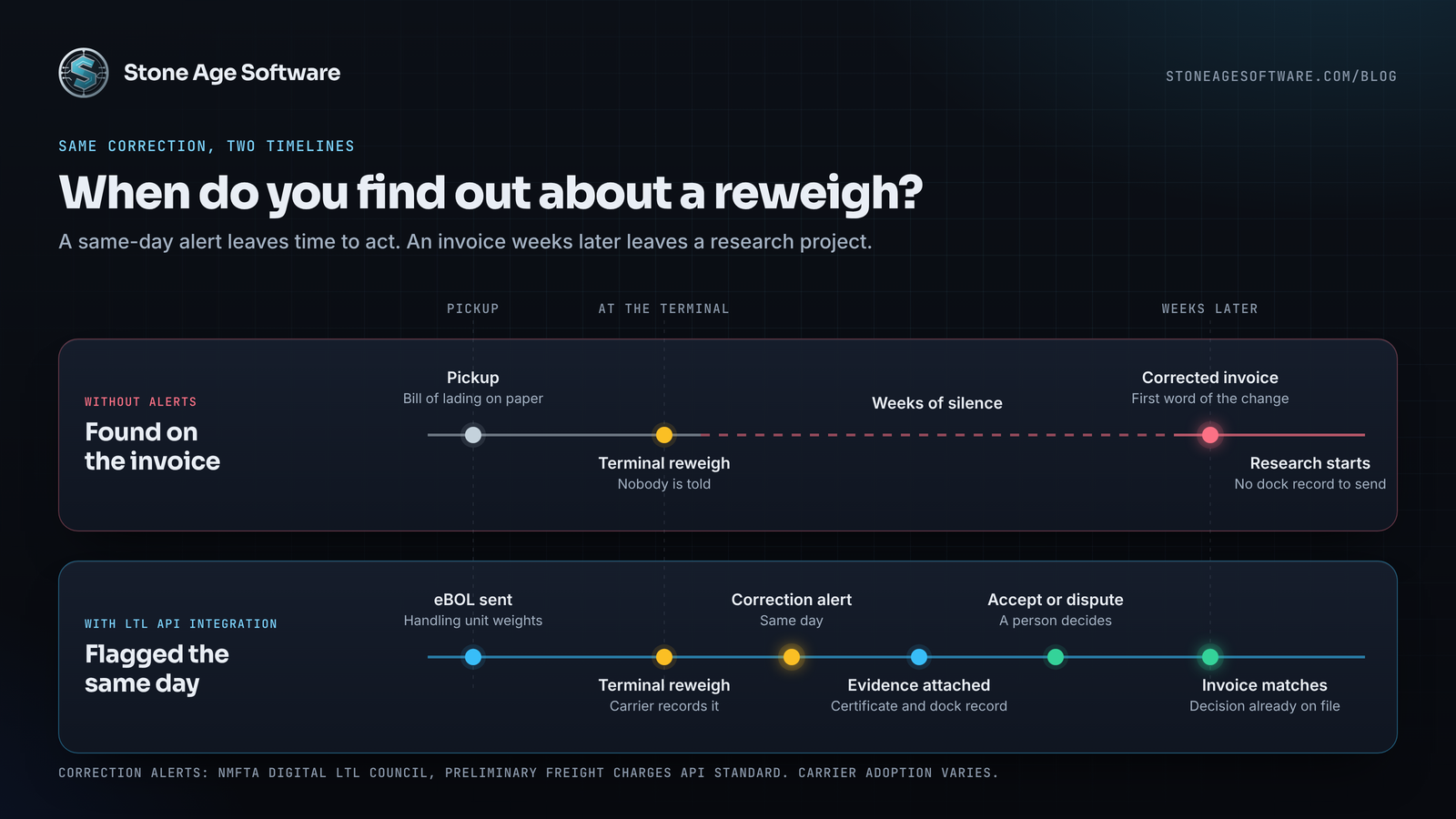
Adoption varies by carrier. Ask each one whether it sends correction alerts by API, or shows the change only on the invoice or in a portal. A good integration handles each case and puts every correction in one queue with an owner. Software watches every shipment, so people can spend their time on the few corrections worth a phone call.
We covered the parcel side of carrier connections in our article on direct carrier API integration. LTL follows the same rule. Take the API where the carrier offers one.
How to dispute a reweigh or reclass
Carriers inspect freight because declared weights and classes do drift. Many corrections are right. The goal is to pay the right ones quickly and challenge the ones that do not hold up. Here is a working playbook.
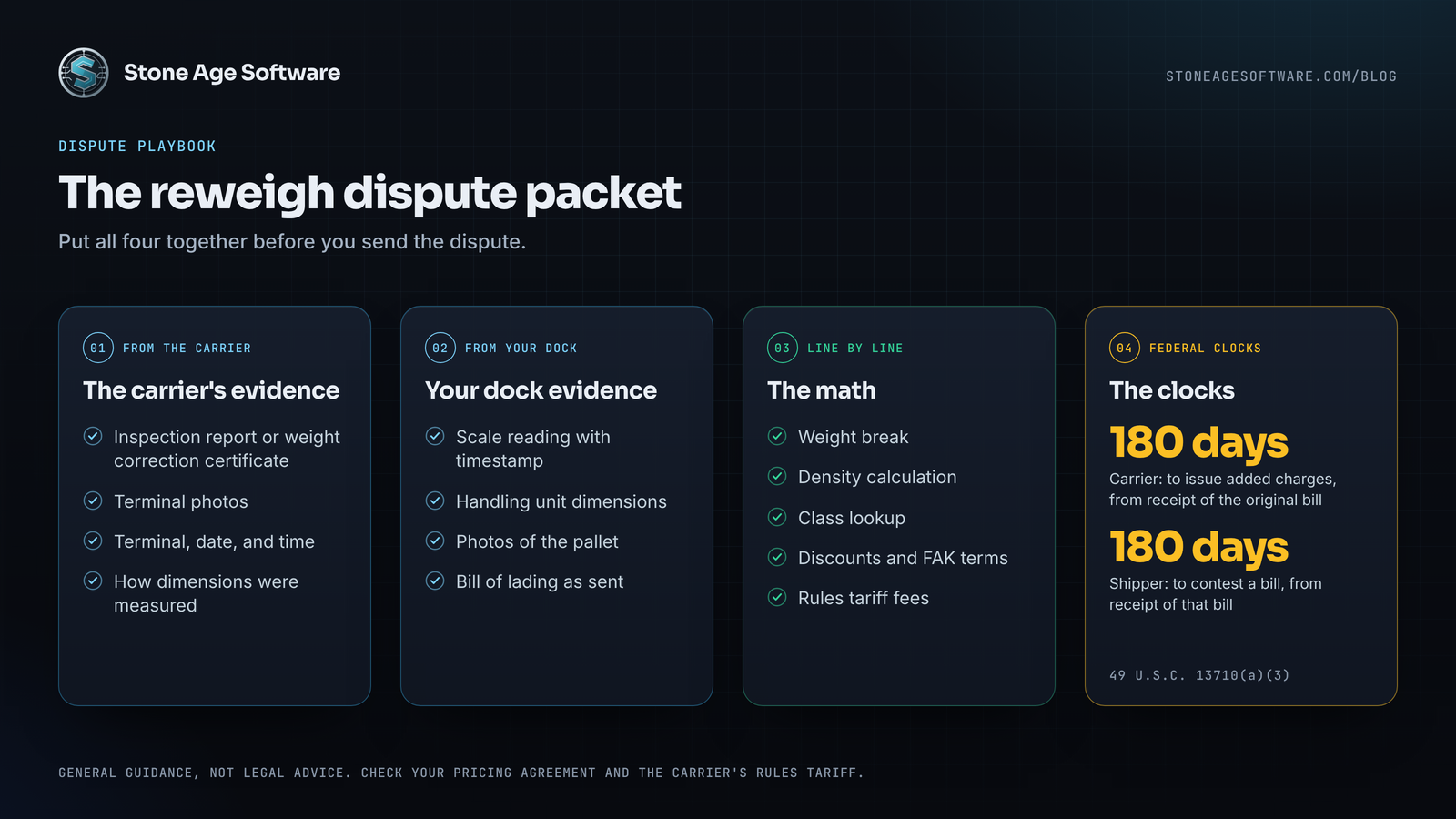
- Note the dates. Federal law gives both sides a clock. Under 49 U.S.C. 13710, a carrier must issue added charges within 180 days of receipt of the original bill. A shipper must contest a bill within 180 days of receiving it.
- Ask for the carrier's evidence. Request the inspection report or weight correction certificate, the photos, and the terminal, date, and time. Ask how the dimensions were measured.
- Pull your own evidence. Gather the dock scale reading with its timestamp, the handling unit dimensions, photos of the pallet, and the bill of lading as sent. A record made before the truck left carries more weight than a reconstruction.
- Check the math line by line. Confirm the weight break, the density calculation, and the class lookup. Check your pricing agreement for discounts or freight-all-kinds terms the corrected bill skipped. Read the rules tariff for every fee that was added.
- Dispute in writing. Send the PRO number, both sets of numbers, the exact charge you contest, and your evidence. Log the date you sent it. Ask your carrier representative how disputed amounts are handled while the claim is open, and get that answer in writing.
- Escalate when the stakes justify it. For large corrections, bring in a freight audit partner or transportation counsel. This is general guidance, not legal advice.
- Fix it in the next contract. Ask for photos with every correction. Ask for a weight tolerance before a rebill. Ask how inspection records will be shared.
A dispute is won or lost on evidence captured at the dock. We built that capture for a contract logistics site. There, seven of nine receiving exception types open a case on their own, with photographs taken at the point of discovery. The write-up is exceptions that open their own case file. The same pattern works outbound: weigh, measure, photograph, and attach before the truck pulls away.
Run a correction audit on last quarter's bills
You can size your exposure in an afternoon. Pull every LTL invoice from the last 90 days and work through this list.
- Flag each invoice with a reweigh, reclass, or inspection line.
- Write down the declared weight and class next to the billed weight and class.
- Note where each declared weight came from: a scale, the order total, or an estimate.
- Count the days between pickup and the day you learned of the correction.
- Check whether you had dock evidence on file: a scale record, dimensions, or a photo.
- Mark which corrections you disputed, and whether you filed within 180 days.
Then read the list back. Corrections on order-total weights point to a data path gap. Long waits between pickup and notice point to a missing alert. Corrections with no evidence on file are the ones you could not fight.
If the list is short, your process is working. If it is long, you now have a scope.
Stone Age Software builds LTL and parcel carrier integration on top of the WMS or ERP you already run. That covers electronic bills of lading, correction alerts, document retrieval, and invoice checks, in code you own. Every project is fixed price, quoted up front. Tell us what's broken. A sentence or two is plenty.