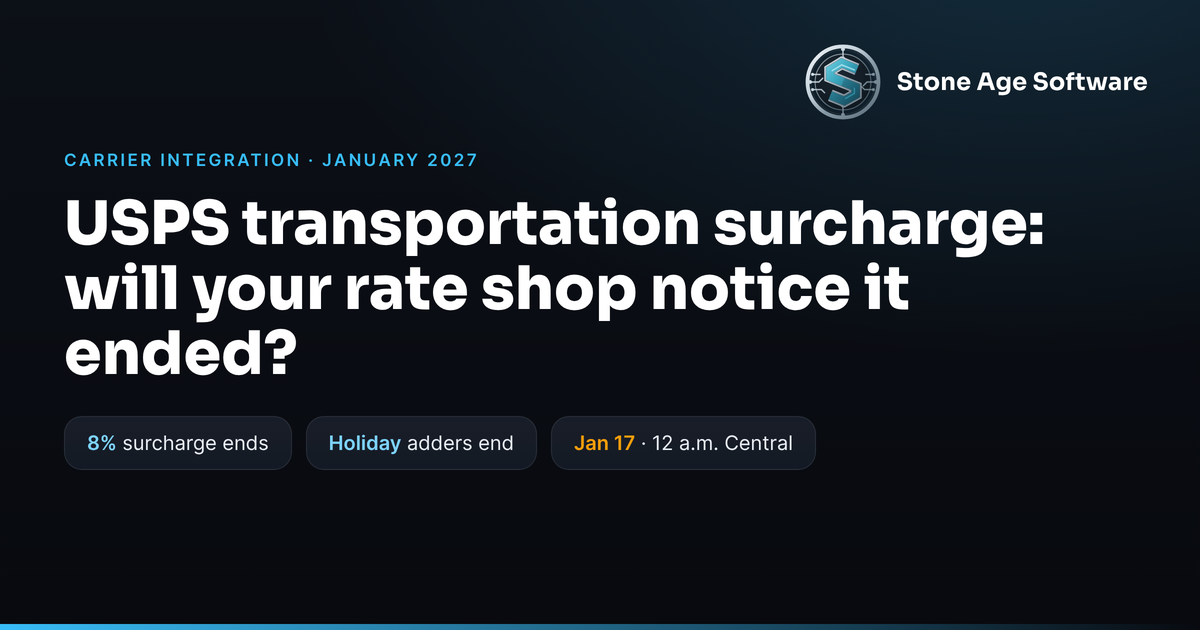
At 12 a.m. Central on Sunday, January 17, 2027, two USPS price layers switch off at once. The USPS transportation surcharge of 8 percent ends. The 2026 holiday price adders end too. A parcel labeled at 11:58 p.m. on Saturday costs one thing. The same parcel at 12:02 a.m. costs less.
That sounds like good news. It is, if every system in your building hears about it. Most 3PLs have the old price stored in more places than they think. The rate shop has it. The client rate cards have it. The rebill logic has it. So do the margin reports.
This article walks through where a temporary surcharge hides, what January looks like across carriers, and how to check your own setup before the switch.
What changes on January 17
The Postal Service filed the surcharge in March 2026. It covers four domestic parcel products, retail and commercial. Per the USPS announcement of the time-limited price change, those products are:
- Priority Mail Express
- Priority Mail
- USPS Ground Advantage
- Parcel Select
The surcharge started April 26, 2026. It is scheduled to end January 17, 2027. Stamps and First-Class Mail were never part of it.
The holiday layer is separate. The USPS 2026 holiday price change began October 4. It adds flat per-piece amounts to the same four products. The amounts vary by product, zone group, weight band, and for commercial pricing, cubic tier. It ends at the same minute as the surcharge.
So two different structures expire together:
- A percentage applied to base postage
- A flat adder keyed to zone and weight
Software that stored them the same way will have trouble removing them cleanly. Software that stored them as one blended number may not be able to remove them at all.
USPS also left the door open. The March release called the surcharge "a necessary bridge to a permanent mechanism." It said the Postal Service can then "determine if a different long-term approach is needed." A replacement filing could appear before January. Your systems need to handle an end date, and possibly a new start date right behind it.
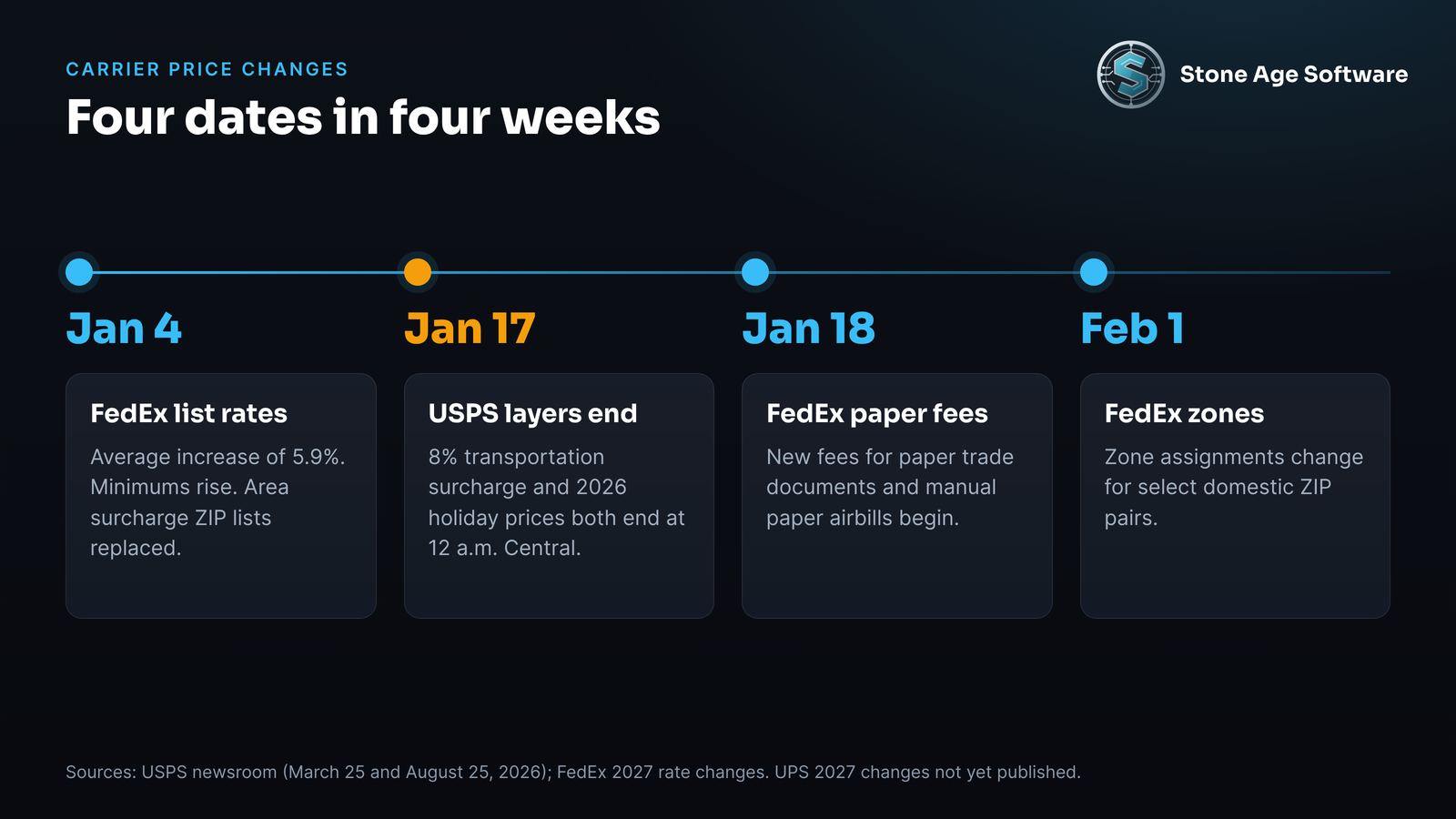
January is crowded on every carrier
USPS is not the only change in the window. The FedEx 2027 rate changes page lists three dates:
- January 4: list rates rise an average of 5.9 percent. Minimums rise. Area surcharge ZIP lists are replaced.
- January 18: new fees for paper trade documents and manual paper airbills begin.
- February 1: zone assignments change for select domestic ZIP pairs.
UPS had not published a 2027 increase at the time of writing. Expect one.
Put those together and the direction flips in two weeks. For about two weeks, FedEx goes up while USPS still carries its peak layers. Then USPS drops. A rate shop that compares carriers on live numbers will start sending more volume to USPS on January 17. A rate shop that compares on stale numbers will keep routing as if it were still December.
That is the real cost of a missed sunset. It is not one wrong invoice. It is three or four weeks of routing decisions made on prices that no longer exist.
Where the USPS transportation surcharge hides in a 3PL stack
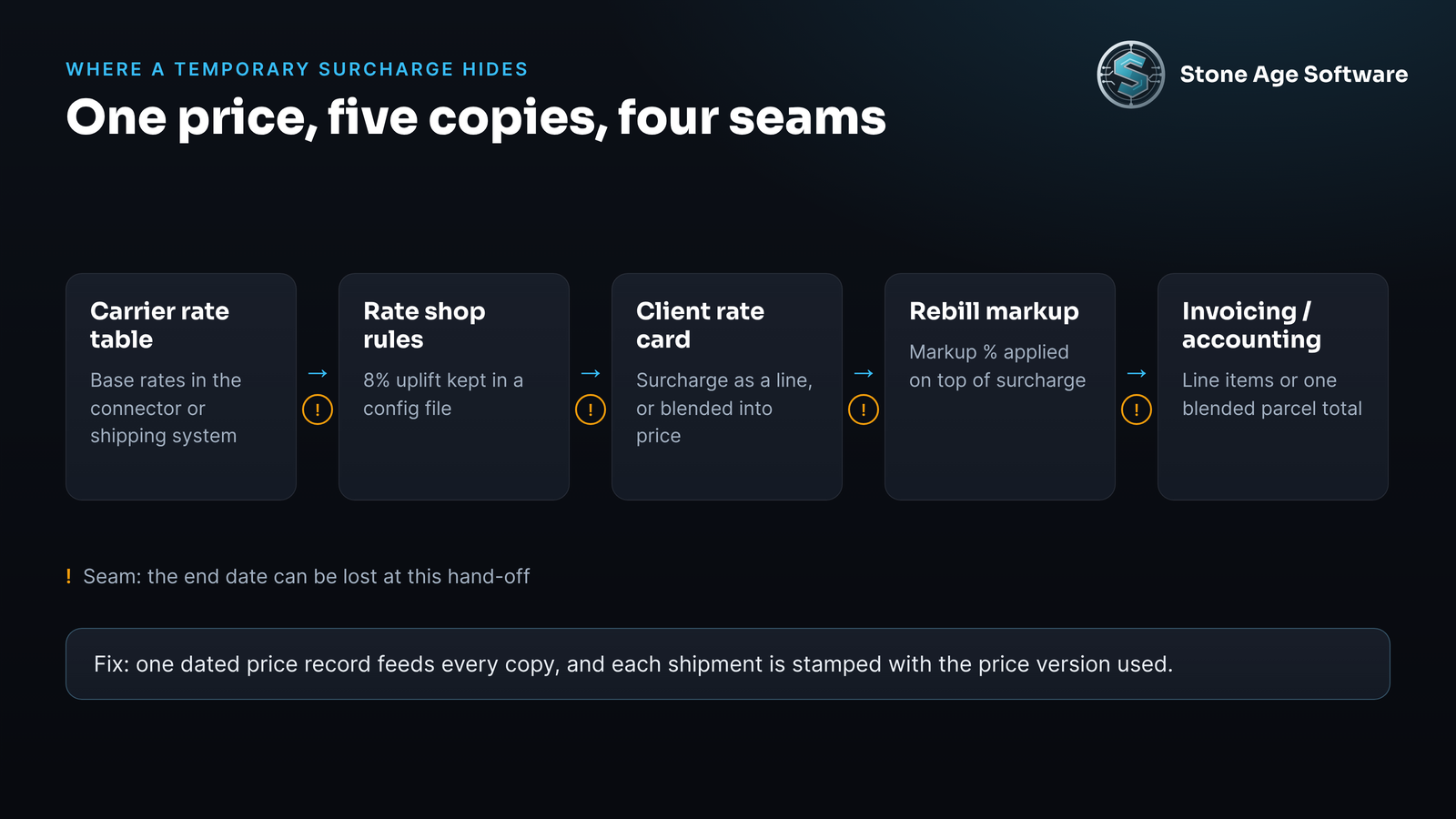
A surcharge rarely lives in one table. It gets copied as it moves through the building. Each copy is a seam, and each seam is a place the end date can get lost.
Here is the usual path:
- Carrier rate table. The shipping system or carrier connector holds base rates. Some connectors pull live prices. Others load a file once a year.
- Rate shop rules. Routing logic compares carriers by cost. If the USPS figure was uplifted by 8 percent in a config file, the uplift stays until someone edits it.
- Client rate cards. Many 3PLs passed the surcharge through to clients. Some added it as a line. Others rolled it into a new parcel price.
- Rebill and markup logic. Markup is often a percentage on top of carrier cost. If carrier cost includes the surcharge, the markup includes it too.
- Invoicing/accounting integration. Charges flow to the invoice as line items or as one blended parcel total.
- Margin and client reporting. Reports compare what you paid against what you billed. If one side updates and the other does not, margin looks wrong in both directions.
None of these copies is a mistake on its own. Each made sense when it was set up. The gap is structural. Nothing ties them back to one dated record that says when the charge started and when it stops.
The label date, the ship date, and the invoice date
The cutover is set by when the parcel enters the network. Your systems may key on a different date.
Consider a pallet of orders released Saturday evening. Labels print at 9 p.m. The trailer is picked up Monday morning. Which price applies? Your carrier agreement and the USPS rules settle that. Your rebill logic may settle it differently. It might use the label timestamp, the manifest close time, or the invoice run date.
This matters most for weekend operations and multi-day manifests. It also matters for clients billed monthly. A January invoice may hold parcels from both sides of the line.
A clean setup stores three dates on each shipment:
- When the label was created
- When the carrier accepted the parcel
- Which price version was applied, and why
With those three fields, any dispute takes minutes. Without them, it takes a spreadsheet and a long afternoon.
Why owning the price record helps
Carrier connectors and shipping platforms do a lot well. The weak spot is the space between them and everything downstream. A connector may update its own rates on time. It cannot reach into your client rate cards or your rebill rules.
The fix is a small piece of software you own. Call it a price version register. It sits beside the WMS you already run. It does not replace anything. It does four jobs:
- Holds every surcharge and temporary adder as a dated record, with a start, an end, and a source link.
- Feeds the rate shop, the rate cards, and the rebill logic from that one record.
- Stamps each shipment with the price version used.
- Flags any charge still applied after its end date.
When USPS files a replacement, someone adds one row. Every downstream copy updates from it. Your team still decides what to pass through to each client and when. The register just makes sure the decision lands everywhere at once.
We built this pattern for live carrier data on an inbound freight tracking integration. There, manual carrier lookups became live feeds with exception flags for the dock. The same approach works for prices. Pull from the source, store it with dates, and flag what does not match.
A check you can run this week
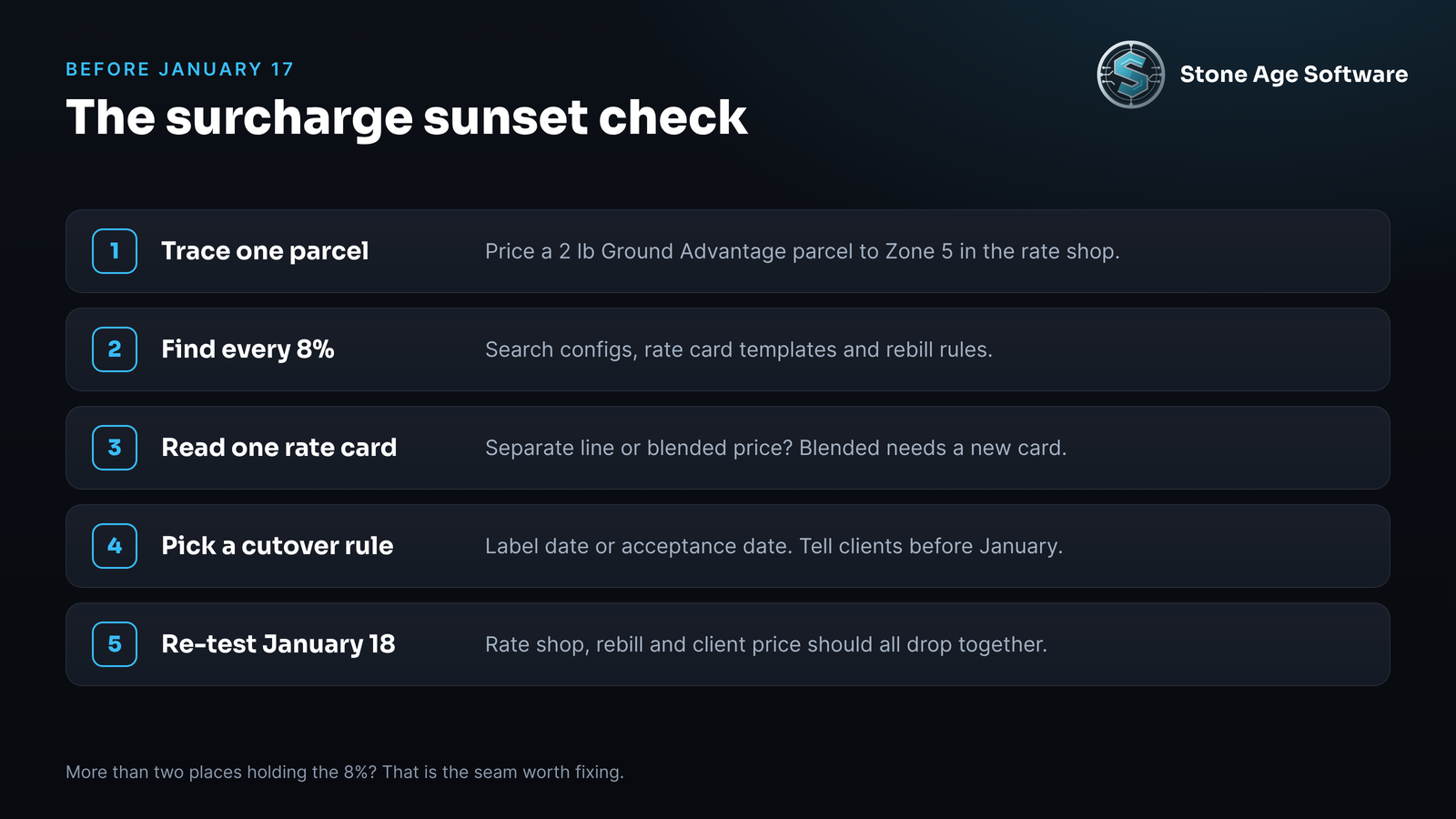
You do not need new software to find out where you stand. Pick one real parcel profile your clients ship often. A 2-pound Ground Advantage parcel to Zone 5 is a good test. Then trace it.
- Find the rate shop number. Ask your shipping system what it would charge for that parcel today. Note whether the 8 percent and the holiday adder are visible as separate parts.
- Find every place 8 percent appears. Search config files, rate card templates, and rebill rules for the surcharge. Write down each location and who owns it.
- Check one client rate card. Is the surcharge a separate line, or blended into the parcel price? A separate line is easy to drop. A blended price needs a new card.
- Pick your cutover rule. Decide whether rebills key on label date or acceptance date. Write it down and share it with clients before January.
- Plan a test on January 18. Re-run the same parcel profile on Monday morning. Compare the rate shop, the rebill, and the client price. All three should drop together.
If step 2 turns up more than two locations, you have found the seam. That is where a missed end date will cost you, and it is worth fixing before the next temporary charge arrives. With a replacement mechanism still possible, it probably will.
Keep watching the Postal Regulatory Commission filings portal for any new USPS competitive price notice. Trade press like Supply Chain Dive's coverage of USPS Ground Advantage pricing is a useful early signal too.
Getting carrier prices into one place
Stone Age Software builds carrier integrations that sit on top of the WMS and shipping tools you already run. You own the code. The work is a fixed price, quoted up front. If your surcharges live in four places today, see how we approach carrier integration for 3PLs and what one dated price record could look like in your building.