A truck pulls away from a 3PL dock at 3:40 in the afternoon. The retail DC is 90 minutes down the highway. The warehouse confirms the shipment on the spot, and the X12 945 is ready before the trailer clears the gate.
The ASN for that same freight leaves the brand's system after 7:00 that evening. Nothing in that story broke. Every system did its job, on its own schedule.
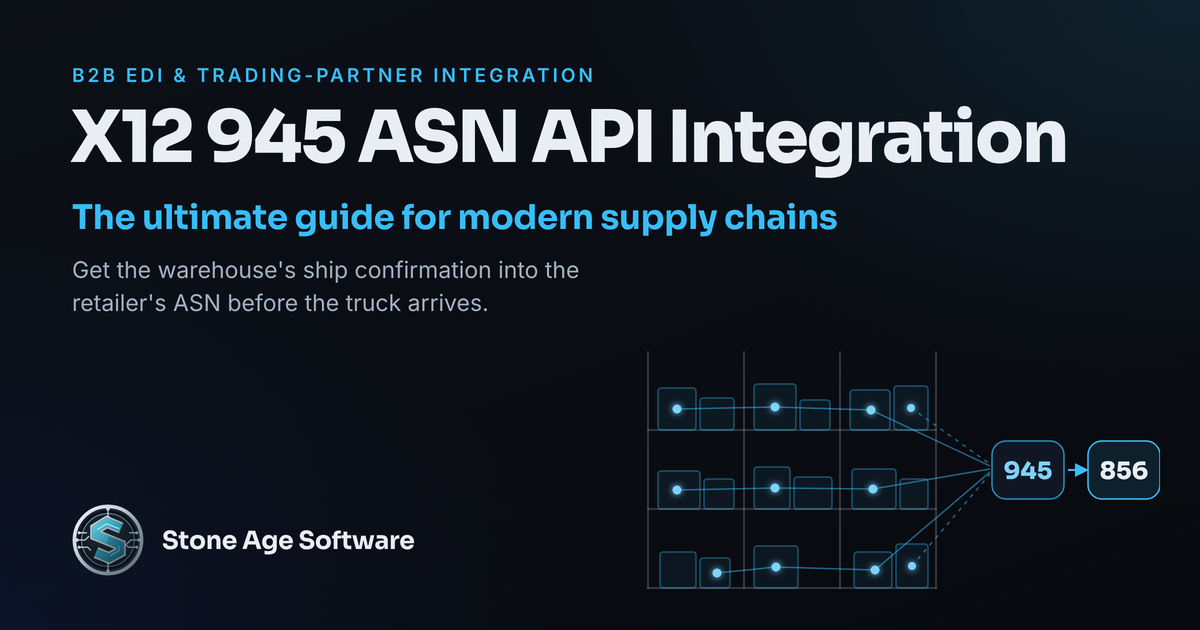
The gap between those schedules is what an X12 945 ASN API integration is built to close.
Peak season makes that gap wider. Adobe expects U.S. online holiday sales to grow 6.7% this year, according to Retail Dive. More orders mean bigger waves, later cutoffs, and less slack at every hand-off.
Retailers and shoppers increasingly expect to see freight the moment it moves. Traditional EDI schedules were not built for that.
The fix is not ripping out EDI. It is wrapping the 945-to-ASN relay in an API layer, so the data moves as fast as the freight.
What Is the X12 945 (Warehouse Shipping Advice)?
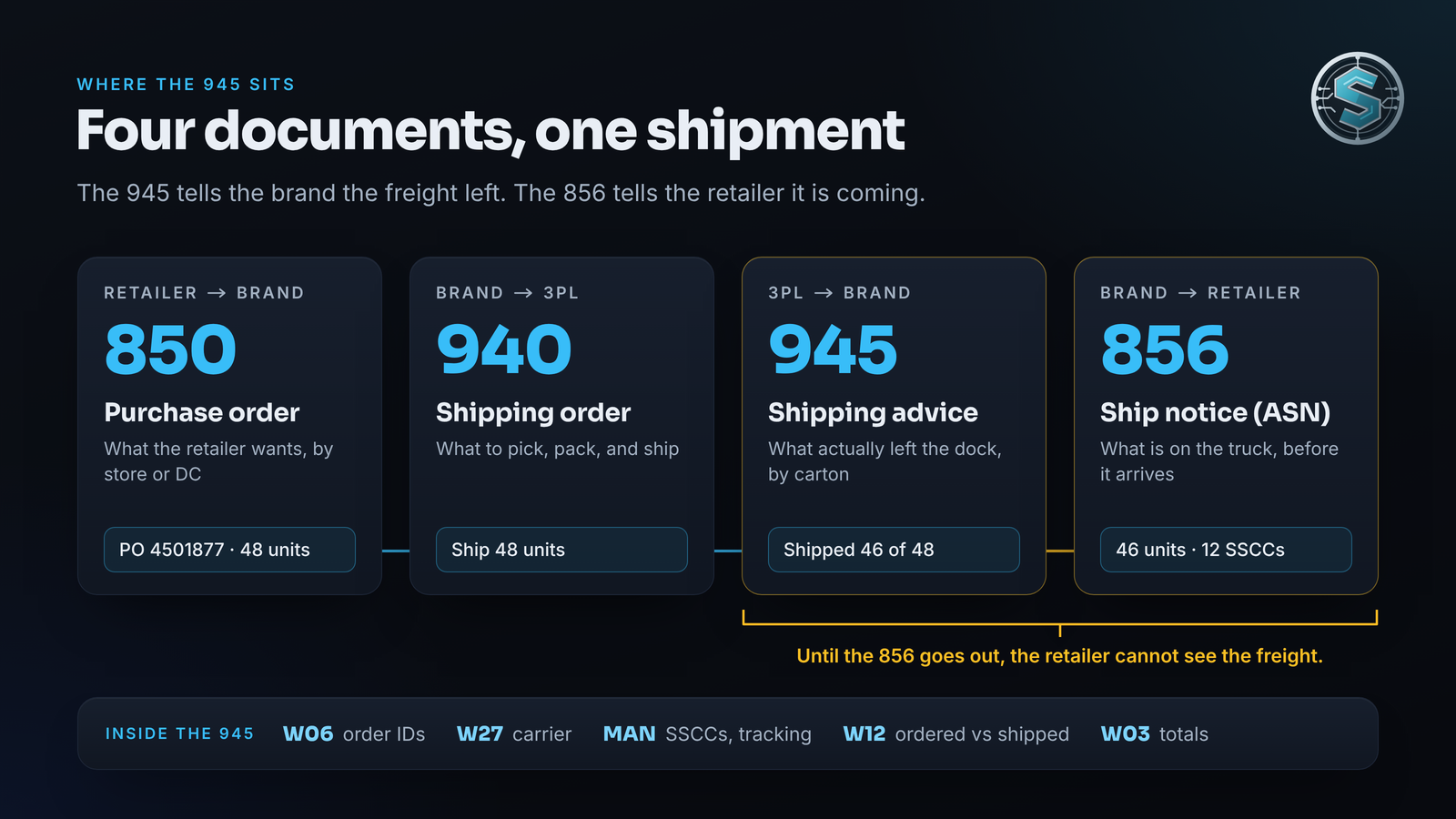
The EDI 945 is the warehouse's receipt for work done. X12 describes the 945 as the document a warehouse uses to tell the depositor a shipment was made. It is also used to reconcile ordered quantities against shipped quantities.
In a 3PL relationship, the depositor is the brand or merchant that owns the inventory. The brand sends a 940 shipping order. The 3PL picks, packs, and ships it, then answers with a 945.
A typical 945 carries:
- Order and shipment IDs: the depositor's order number, the PO number, and the warehouse's shipment ID, in the W06 header.
- Parties and dates: ship-from, ship-to, and when the freight left.
- Carrier detail: the carrier's SCAC code and transport method, in the W27 segment.
- Carton marks: SSCC label numbers and parcel tracking numbers, in MAN segments.
- Line items: each SKU or UPC, with quantity ordered against quantity shipped, in W12.
- Totals: units, weight, and volume for the whole shipment, in W03.
That quantity line matters more than it looks. A short ship shows up here first, as a gap between ordered and shipped. Whatever reads the 945 should notice that gap in seconds, not at month end.
How the X12 945 Triggers the ASN (Advance Ship Notice)
The 945 talks to the brand. The Advance Ship Notice talks to whoever receives the freight. In retail EDI that is the 856 Ship Notice/Manifest, which X12 defines as a description of a shipment's contents, packaging, and carrier details.
The relay usually runs in four steps:
- The 3PL confirms the shipment and sends the 945.
- The brand's system closes the order and relieves inventory.
- The same data becomes an 856, nested by shipment, order, carton, and item.
- The 856 goes to the retailer, ideally while the truck is still rolling.
Some 3PLs send the 856 on the brand's behalf. Many brands keep it in house, so the ASN, the invoice, and the order all come from one system of record. Either way, the ASN can only be as fast as the hand-off in front of it.
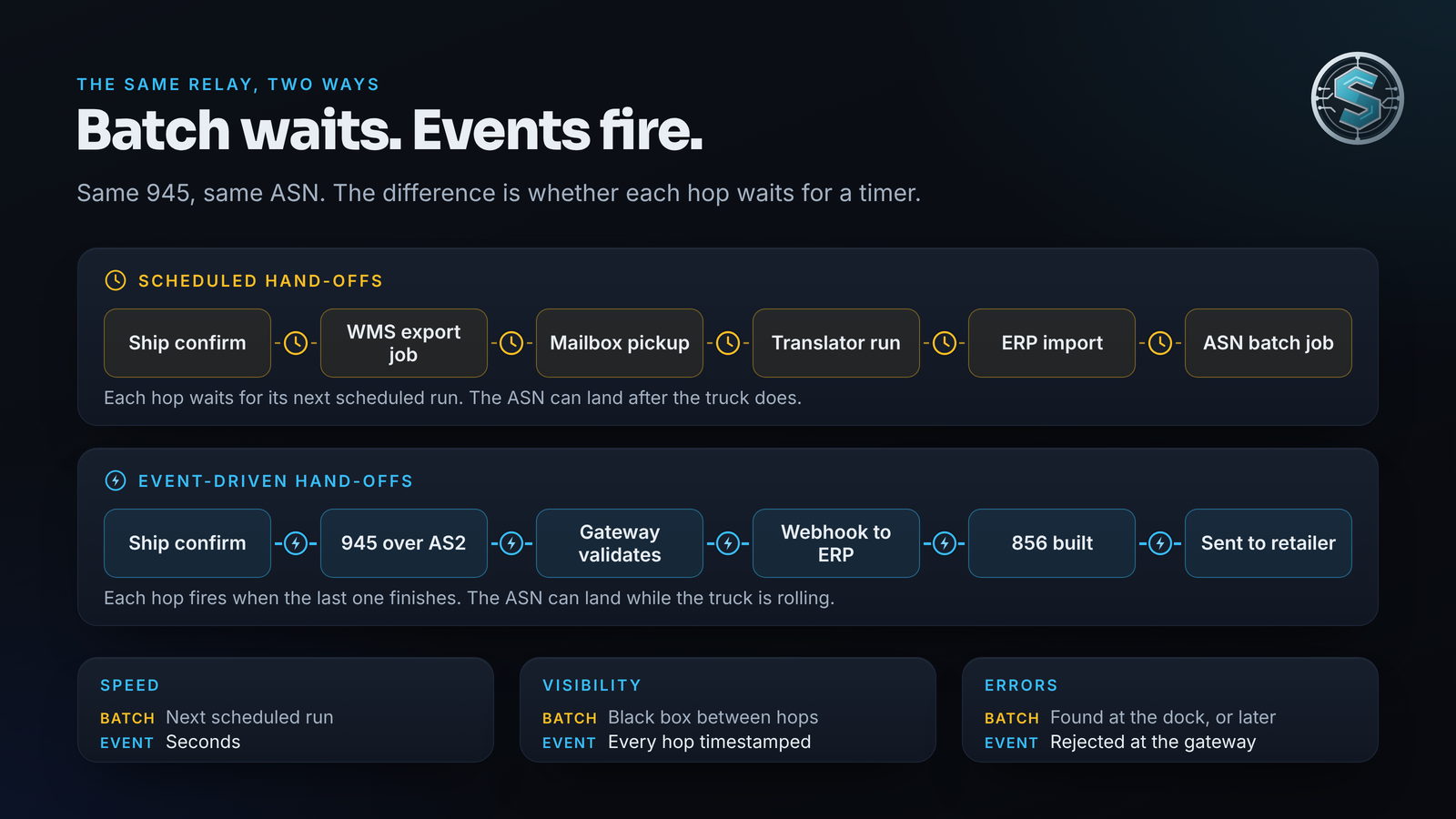
This is where batch processing hurts. If the 945 waits for an hourly mailbox pickup and the ASN waits for an evening job, the retailer receives a truck it cannot see.
Retail compliance programs score that as a defect. Walmart's supplier quality program, for example, counts an ASN as late when it is sent after the order arrives at the receiving DC.
We covered the accuracy side in EDI 856 ASN chargebacks. This guide is about time.
Legacy EDI vs. Modern API Integration in Logistics
EDI did not get slow. The schedules around it did. Traditional setups move X12 files through Value-Added Network (VAN) mailboxes, SFTP folders, and translator jobs that run on timers.
Each hop is dependable, and each hop waits its turn. Stack four or five timers end to end, and a shipment's data can trail the shipment by hours.
Modern APIs work differently. A logistics API endpoint accepts JSON the moment it is sent. A webhook pushes an event the moment something happens, and validation happens on the call itself.
Here is how the two compare where it counts:
- Speed: Batch hand-offs move on the next scheduled run. Event-driven hand-offs move in seconds.
- Visibility: A batch chain is a black box between hops. A well-instrumented API chain timestamps every step, so anyone can see where a shipment's data stands.
- Error handling: A 997 acknowledgment only confirms a file arrived and passed syntax checks, not that the data is right. An API call can reject bad data on the spot, with a reason a person can act on.
None of this means X12 is going away. On October 9, Logistics Viewpoints argued that EDI is not dying and that in many cases the strongest design combines EDI, APIs, and events. We agree, and your retail partners will keep asking for X12.
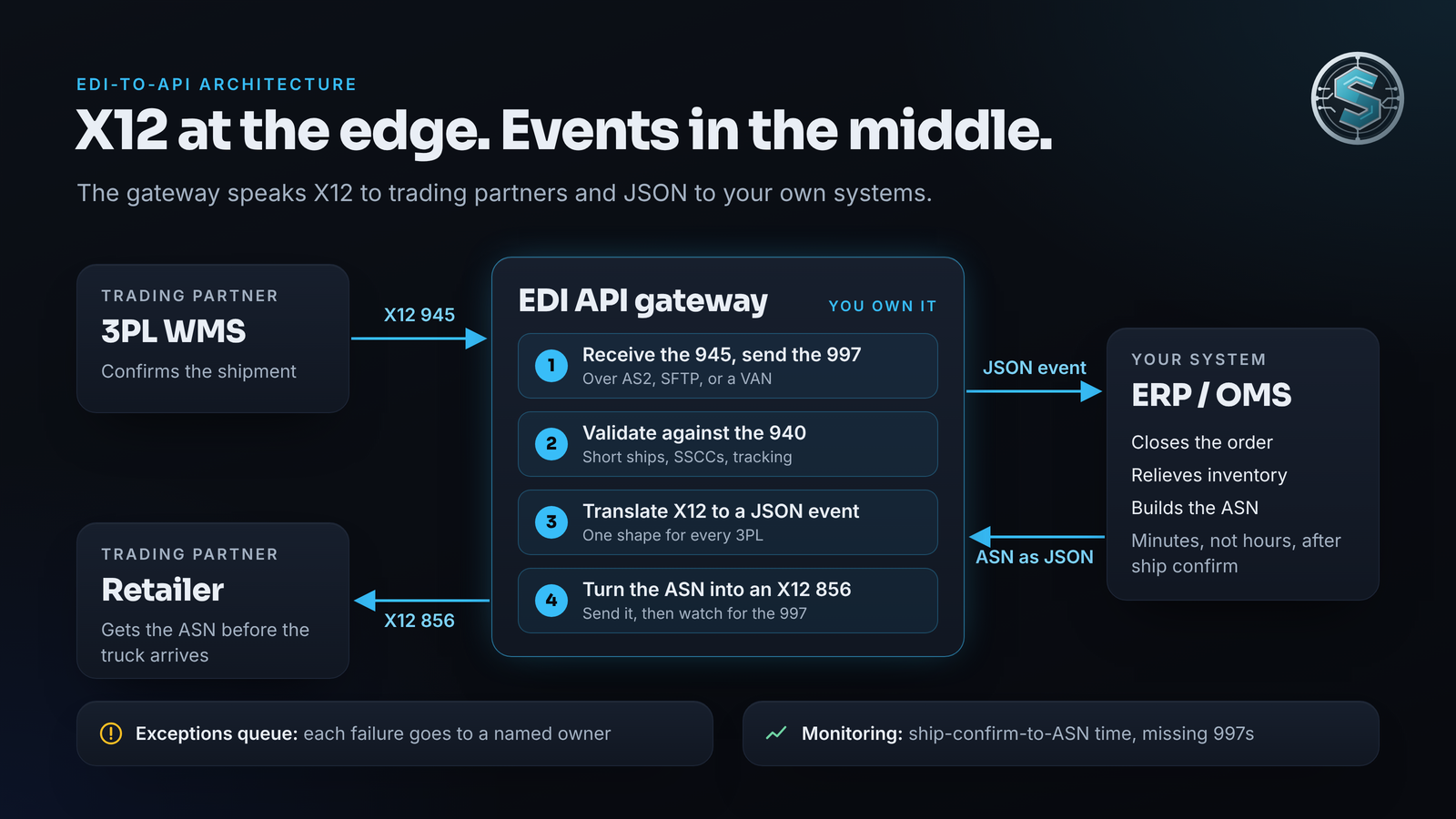
That is the real idea behind EDI to API integration. Keep X12 at the edge, where trading partners require it. Run events in the middle, where your own systems live.
Why You Need an X12 945 ASN API Integration
A well-built X12 945 ASN API integration turns the warehouse's confirmation into the retailer's notice without waiting on a clock. Here is what that buys you.
1. Real-time data sync. Once the 945 reaches the gateway, your ERP hears about it within seconds. Take it in over AS2, or poll the mailbox every few minutes, and the hourly sweep and overnight import both go away. Order status, inventory, and the ASN move together.
2. Fewer chargebacks. A late ASN is a scored defect, and it is usually a scheduling problem, not a data problem. When the ASN fires off the ship confirmation itself, it can beat the truck even on short lanes.
3. Better customer experience. For direct-to-consumer orders, the 945 often carries the parcel tracking number. Push it to your storefront as an event, and the shipping email goes out with a live link. That is what real-time supply chain visibility looks like to a customer.
4. Operational agility. Each new 3PL or trading partner gets mapped once, into one standard shipment event. Your ERP keeps consuming the same JSON, so onboarding becomes a mapping job instead of a rebuild.
There is a people side, too. When the relay runs itself, your EDI and customer service teams stop chasing files. They spend their time on the exceptions that need judgment: the short ship, the split load, the carrier swap.
And the layer is yours. It sits beside whatever WMS, ERP, or 3PL you already run, so no platform has to be replaced.
How to Implement a Modern EDI-to-API Architecture
A common approach is to build an X12 945 ASN API integration around an EDI API gateway. That is middleware that speaks X12 to partners and JSON to your own systems. Here is the sequence we follow.
- Timestamp the current relay. Pull a week of shipments. Record ship confirm, 945 receipt, ERP posting, and 856 transmission for each one.
- Put a gateway at the edge. It receives the 945 over AS2, SFTP, or a VAN, returns the 997, and translates X12 into a clean JSON event.
- Validate in flight. Check each 945 against its original 940. Flag short ships, missing SSCCs, and missing tracking numbers before anything posts.
- Deliver by webhook. Your ERP, or a small service beside it, receives the event, closes the order, and builds the ASN right away.
- Translate back out. The gateway turns the ASN into an X12 856, sends it to the retailer, and watches for their 997.
- Test with every partner. Mapping specs differ by retailer. Run test files first, then run old and new side by side before cutover.
Mapping and validation are where these projects succeed or stall. A good map documents every field, every qualifier, and every partner exception. Route each validation failure to a named owner, so nothing sits in a folder.
Reconciliation deserves the same discipline. For one contract-logistics operation, we turned a recurring emailed variance report into a register where a variance closes only when it drops off the partner's own report. The 945's ordered-versus-shipped line deserves that kind of memory.
Conclusion: Start With the 945-to-ASN Gap
Batch schedules were built for a slower dock. Today the freight moves faster than the files that describe it. That gap is a software seam, and seams can be closed.
The supply chain is going real time whether the paperwork keeps up or not. An X12 945 ASN API integration is the best place to start, because the data already exists. It just has to stop waiting.
Run this check before you call anyone:
- Pick one retail trading partner and pull last week's shipments.
- For each one, find the ship confirm time in the WMS and the 856 transmission time in your EDI log.
- Sort the list by the gap between those two times.
- Flag any gap longer than the transit time to that DC. Each one is a late ASN waiting to happen.
If the gaps run long, or the timestamps are hard to find, that is the project. Our B2B EDI and trading-partner integration practice builds the gateway, the maps, and the monitoring, at a fixed price, quoted up front. Contact our team to talk through your 945-to-ASN relay, your API architecture, or the custom software around it.